Handyman Contract Template: What to Include (Free Template + Example)
A plain-English walkthrough of the clauses handyman businesses put in their service agreements: task list and scope, exclusions and work that needs a licensed trade, materials and markups, hourly or fixed pricing, deposits and payment terms, change orders, scheduling and access, hidden conditions, workmanship warranty, cancellation and completion sign-off, with a worked example and free handyman forms.
Why handyman jobs need a written contract
Handyman work is built on small jobs and big lists. A client asks you to hang shelves, fix a running toilet, patch a hole in the drywall and “take a look” at a sticking door. By the end of the day the list has grown, a part had to be ordered, and nobody wrote down what the price included. That is how friendly customers turn into payment disputes.
A short handyman contract, sometimes called a handyman service agreement, fixes this before you pick up a tool. It lists the tasks you agreed to, what is not included, who buys materials, how you charge, when you get paid and what happens when the job changes. It also shows clients that you run a real business, which makes it easier to win larger repair lists and repeat work. This guide walks through each section, offers sample wording ideas and ends with a worked example.
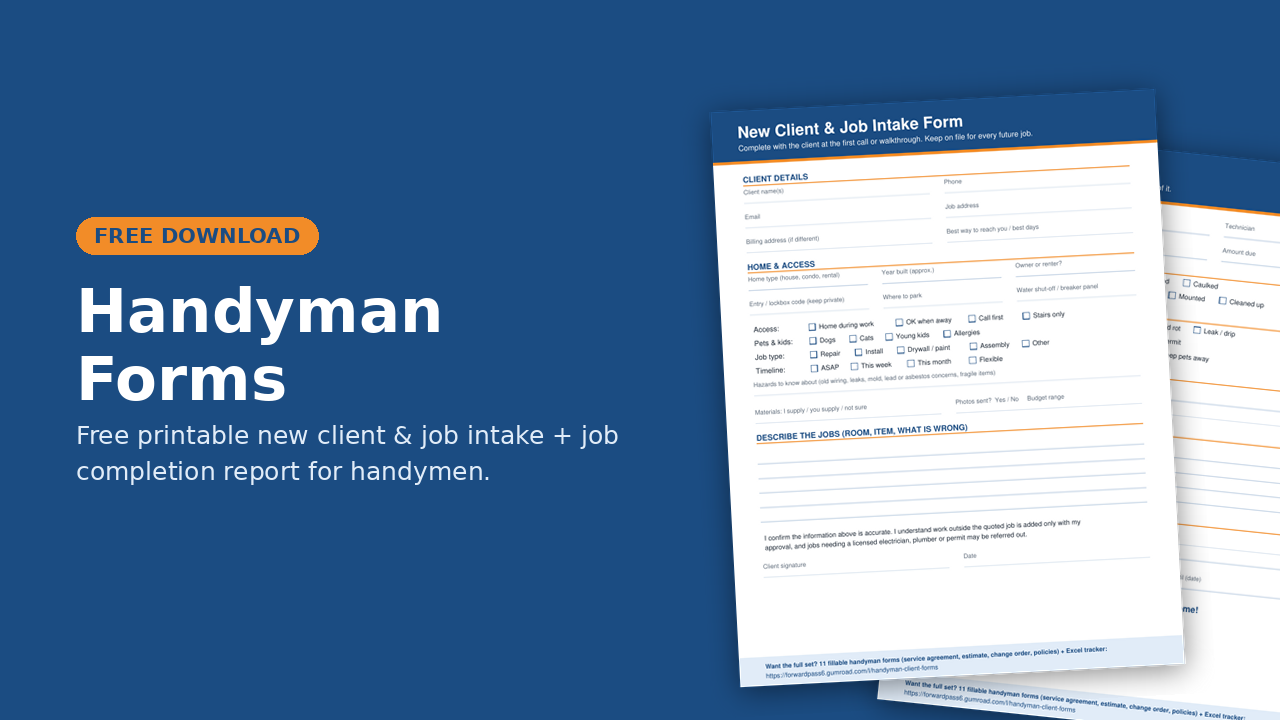
Free Handyman Forms
A printable new client and job intake form plus a job completion report for handyman businesses.
Download free →1. Parties, property and job details
Start with your business name, phone, email and any license or registration number you hold. Then add the client's name and contact details and the service address. If the client is a tenant, landlord or property manager, note who owns the property and confirm the person signing is allowed to authorize the work. Add the start date, an arrival window and a reference to the attached estimate or walkthrough notes, so the contract and the quote clearly describe the same job.
2. Scope of work: a numbered task list
This is the heart of the agreement. Instead of “general repairs,” list every task as its own line with the room and a short description, for example:
- Kitchen: replace faucet with client-supplied fixture, reuse existing supply lines if in good condition
- Hallway: patch two drywall holes up to 6 inches, sand, prime and paint to match (client supplies paint)
- Living room: mount 65-inch TV on client bracket into studs, conceal cables in wall kit
- Bedroom: adjust and rehang sticking closet door
A numbered list makes it easy to check off work at the end and to price additions later. If a task depends on what you find when you open something up, say so in the line itself.
3. Exclusions and work that needs a licensed trade
Write down what you will not do. Common exclusions are permit fees, hauling large debris, repairing damage hidden behind walls, moving heavy furniture and any work not on the task list. Just as important is a clear line around regulated trades. Many states and cities only let handymen take jobs under a certain dollar amount without a contractor license, and electrical, plumbing, gas, HVAC, roofing and structural work often require a licensed professional or a permit no matter the size. The thresholds and rules vary widely, so check your local licensing rules and keep your contract inside them. A sentence such as “Work requiring a licensed trade or permit is excluded and will be referred to a qualified professional” protects you and the client.
4. Materials, parts and markups
Say who supplies materials. Some clients buy their own fixtures; others want you to bring everything. If you buy, decide whether you bill at cost plus a markup or include materials in a fixed price, and state it. Add a line about special-order items that are non-returnable, and ask for payment or a deposit before ordering them. If the client supplies parts, note that you are not responsible for defects in client-supplied materials and that extra trips caused by wrong or missing parts may be billed.
5. Price: hourly, fixed price or a mix
Handymen usually charge in one of three ways: an hourly rate with a minimum charge, a fixed price per task or project, or a mix where defined tasks are fixed and open-ended work is hourly. Whatever you use, put it in writing: the rate or price, the minimum visit charge, how time is counted (for example, in 15- or 30-minute increments), and whether travel, supply runs and cleanup time are billable. If you give an estimate rather than a firm quote, say that the final price may change and that you will ask before going more than a set amount over it.
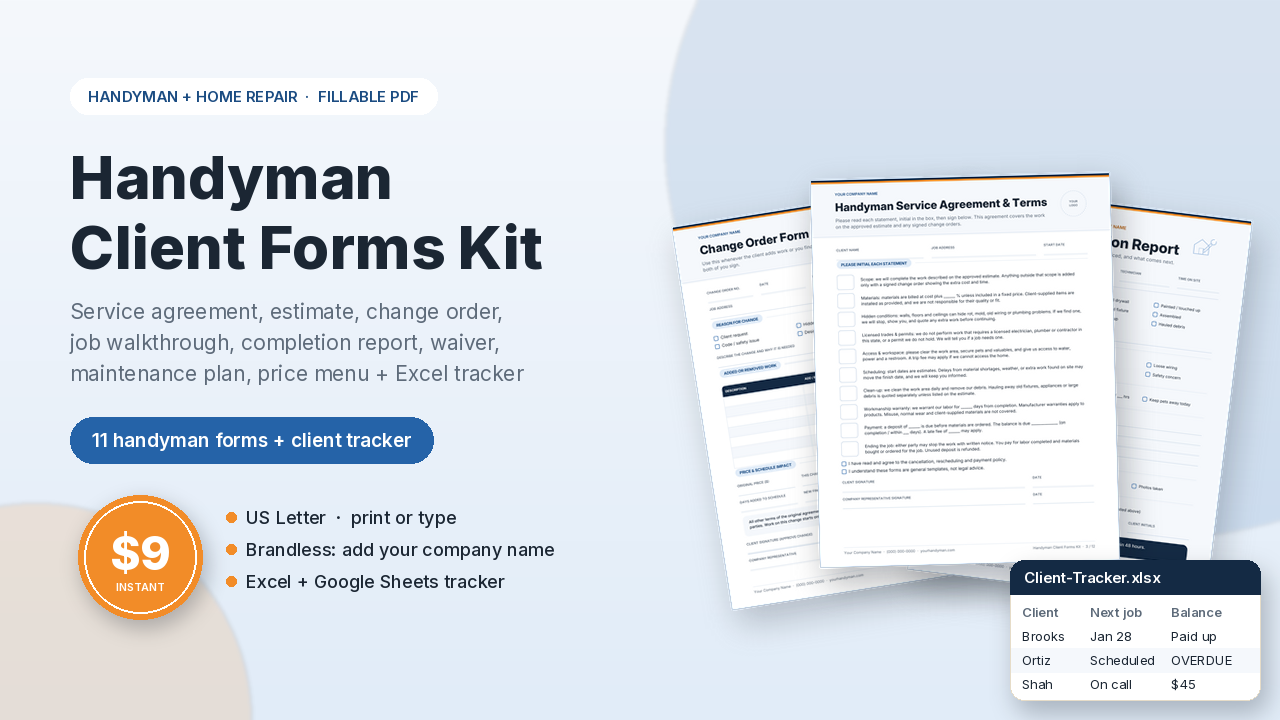
Handyman Client Forms Kit
11 fillable and printable handyman forms (new client & home profile, service agreement, job walkthrough with room sketch grid, estimate / quote, change order, job completion report, home maintenance plan and more) plus an Excel client tracker with balances, next-visit dates and overdue payment flags.
Get it →6. Deposit and payment terms
For small same-day jobs, many handymen take payment on completion. For multi-day projects or jobs with special-order materials, a deposit is common, often with a progress payment and a final balance on completion. Spell out accepted payment methods, the due date, any late fee and what happens to the deposit if the client cancels. Some areas limit how large a home improvement deposit can be, so check local rules before you set a percentage.
7. Change orders
The list always grows. Add a change order clause that says any added or changed work will be priced and approved in writing before you do it. A signed change order form, or at minimum a text or email confirming the task and price, keeps the final invoice from being a surprise. Note whether additions also move the schedule.
8. Hidden conditions
Opening a wall, pulling a vanity or lifting flooring can reveal rot, mold, water damage, outdated wiring or pests. Include a hidden conditions clause: if you find something that was not visible during the walkthrough, you will stop, show the client, and give a written price or referral before continuing. This avoids the client feeling ambushed and keeps you from doing unpaid work.
9. Schedule, access and client responsibilities
State the planned start date, the expected duration and that dates may move for weather, part delays or illness. List what the client must do: provide access and keys or codes, clear the work area, keep pets and children away from tools, provide parking and access to water and electricity, and have an adult present if required. Mention a trip fee for locked-out visits or no-shows.
10. Workmanship warranty
Many handymen offer a limited warranty on their labor, for example 90 days or one year on workmanship (example terms only; choose your own). Be clear about what it covers and excludes: normal wear, misuse, client-supplied materials and manufacturer defects, which fall under the manufacturer's warranty. Say how the client should report a problem and that you get the chance to inspect and fix it first.
11. Insurance, liability and cleanup
Note whether you carry general liability insurance, and be ready to show proof if a client or property manager asks. Add a short liability clause that limits your responsibility to the work you performed, and describe cleanup: debris swept and removed from the work area, with hauling of large items excluded unless listed. Keep liability wording plain and fair; how far a limitation of liability can go depends on local law.
12. Cancellation and completion sign-off
Give a cancellation window, such as free cancellation up to 24 or 48 hours before the visit, with a fee for later cancellations and a refund rule for deposits. Some home improvement contracts signed at the client's home come with a legal cancellation period, so check whether one applies where you work. When the work is done, walk the task list with the client and use a completion report to confirm each item is finished. Give a short window to report concerns, after which the job is treated as accepted.
Common mistakes in handyman contracts
- Writing “misc repairs” instead of a numbered task list
- No line around licensed trades or permit work
- Not stating who buys materials and how they are billed
- Hourly rate with no minimum charge or time increment
- Doing add-on tasks on a handshake with no change order
- No hidden conditions clause before opening walls or floors
- Skipping the completion sign-off and photos
Worked example: a half-day repair list
Example numbers only; set your own prices for your market. A homeowner asks for four tasks: replace a kitchen faucet with a client-supplied fixture, patch and paint two drywall holes, mount a TV, and rehang a closet door. The example handyman charges a fixed price per task: $140 for the faucet, $160 for the drywall patches, $120 for the TV mount and $70 for the door, for a total of $490. Materials such as patch compound, primer and anchors are included; any extra parts are billed at cost plus an example 15%. No deposit is taken because nothing is special-ordered, and the balance is due on completion. During the job the client adds a loose towel bar; the handyman writes a $45 change order by text, the client replies to approve, and the final invoice is $535. The completion report lists all five items, signed on site.
How to send and store your contract
Send the agreement with your estimate, and confirm the date once it is signed and any deposit is paid. A fillable PDF that clients can sign electronically saves time. Keep the signed agreement, walkthrough notes, change orders, photos and the completion report in one job file. Repeat clients can sign a single master agreement and receive a short work order for each new visit. Review your template once a year, or whenever you add a new service, change your rates or move into a new area, so the terms still match how you actually work and the local rules where you operate. Small updates now save long arguments later.
FAQ
Do I need a contract for small handyman jobs?
Yes, even a one-page agreement helps. It lists the tasks, price, materials and payment terms so a quick repair visit does not turn into a disagreement over what was included.
What is the difference between a handyman estimate and a contract?
The estimate shows the expected price for the tasks. The contract adds the terms: payment, change orders, exclusions, hidden conditions, warranty and cancellation. Many handymen attach the estimate to the signed agreement.
Can a handyman do electrical or plumbing work?
It depends on where you work. Many places require a licensed electrician or plumber, or a permit, for anything beyond minor repairs, and some limit handyman jobs to a certain dollar amount. Check your local licensing rules and exclude regulated work you cannot legally do.
Should I charge hourly or by the job?
Both work. Fixed prices suit well-defined tasks and help clients say yes; hourly with a minimum charge suits open-ended troubleshooting. Write the method, rate and minimum into the contract.
How do I handle extra tasks a client adds during the job?
Use a change order. Describe the added task and price, get written approval by signature, text or email, and add it to the final invoice.
Should a handyman contract include a warranty?
Many do. A limited workmanship warranty with a set period, clear exclusions and a reporting process builds trust without making open-ended promises.
This page is general guidance, not legal advice. Contractor and handyman licensing thresholds, permit requirements, deposit limits, cancellation rights and consumer contract rules vary by location. Have a qualified professional review your handyman contract before you use it.
Related templates
Free Handyman Forms
A printable new client and job intake form plus a job completion report for handyman businesses.
Download free →Handyman Client Forms Kit
11 fillable handyman forms (agreement, walkthrough, estimate, change order, completion report) plus an Excel client tracker.
Get it →