Junk Removal Client Questionnaire: What to Ask Before You Quote a Job
A practical guide for small junk removal and hauling businesses: the questions to ask on a new inquiry before you give a price range or book a truck, how each answer changes the quote, and what to confirm before the crew arrives.
Why you need a questionnaire before you quote
"How much to haul away some junk?" is the message most junk removal businesses get every day, and it tells you almost nothing. "Some junk" can be three bags of yard waste by the curb, or a full basement of furniture, paint cans and an old upright piano at the bottom of a narrow staircase. Both customers think their job is small. If you give a number before you know which job it is, you either scare off the easy one or lose money on the hard one.
A short pre-quote questionnaire fixes that. It is the set of questions you ask on the phone, by text or in a web form before you give a price range or put the job on the schedule. It gets you a realistic picture of the volume, the access and the problem items, so the range you give is close to the final price and the crew shows up with the right truck, people and equipment.
This guide covers the intake questions only. For how to turn volume into a price (truck-load fractions, minimums, dump fees and labor), see how to price junk removal jobs. For the written quote you send after the questionnaire, see the junk removal estimate template, and for the signed terms see the junk removal contract template. If you are quoting post-holiday cleanouts or tree pickups, the holiday junk removal pricing guide covers the seasonal side.
A good questionnaire does three jobs at once. It filters out jobs you cannot take (outside your area, items you do not haul, dates you are full), it gives you enough detail to quote without a site visit for most small and medium jobs, and it tells you when a site visit is worth the drive. Keep the first contact short: five or six questions and a request for photos. Save the rest for a follow-up call or text once you know the job is a fit.
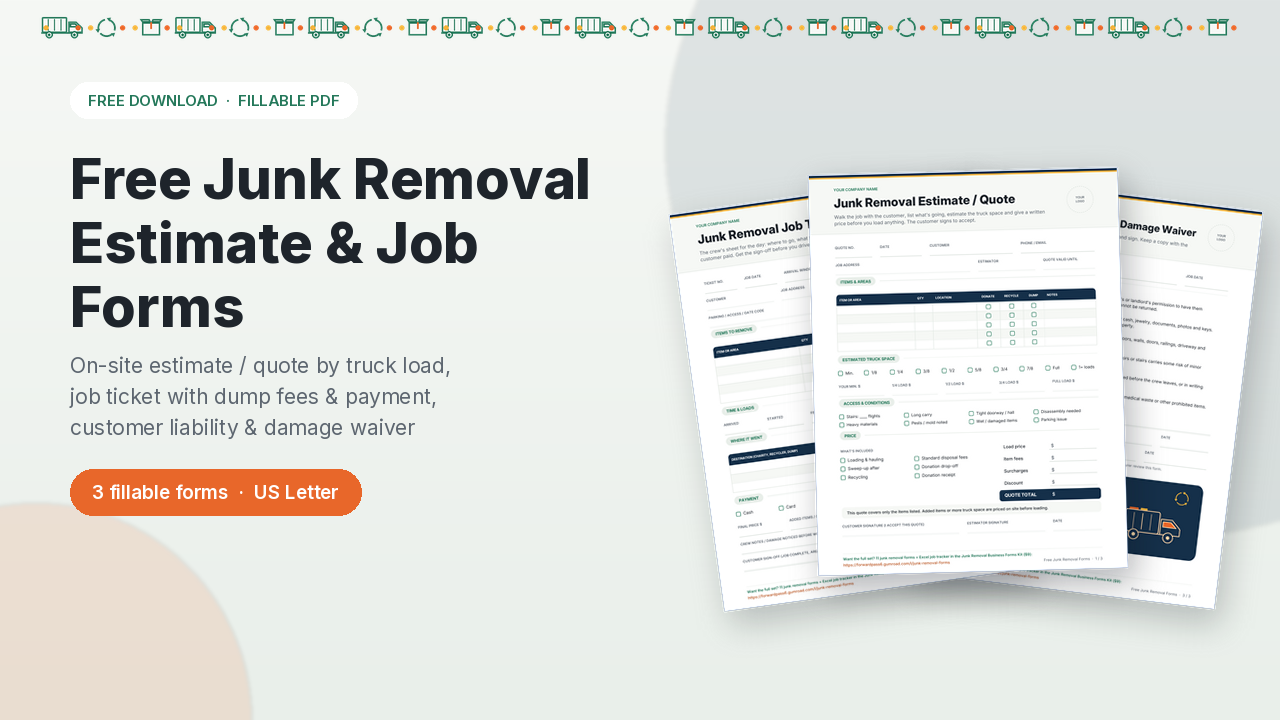
Free Junk Removal Estimate & Job Forms
A fillable junk removal estimate form priced by truck-load fraction, a job ticket and a customer liability waiver.
Download free →Section 1: Contact details and the basics
Start with the facts that tell you whether you can take the job at all. If the address is outside your service area or the date is already full, you can say so quickly and point the customer elsewhere.
- Customer name, phone number, email and preferred contact method (many customers prefer text for photos)
- Job address, including unit or apartment number and any gate or building code
- Is the customer the owner, a tenant, a landlord, a property manager, a real estate agent or a family member handling an estate? Who approves the price and pays?
- Will the customer be on site, or is someone else letting the crew in?
- Type of job: single item, a few items, garage or basement cleanout, full home cleanout, move-out, estate cleanout, yard debris, light construction debris, or a commercial or office job
- Preferred date and time window, and how flexible they are
- How did they hear about you? (Useful for your own marketing, not for the quote.)
Ask who pays early. On estate cleanouts and rentals, the person who calls is often not the person who approves the bill. Knowing that up front avoids a job that is finished but not paid for while two relatives or a landlord and tenant argue about it.
Section 2: What is going, and how much of it
Volume is the single biggest factor in most junk removal quotes, and customers are bad at estimating it. Ask for a list and photos instead of a guess at "how many truck loads."
- List the main items: furniture, mattresses, appliances, electronics, boxes, bags, yard waste, construction debris, exercise equipment, hot tubs, sheds
- Rough quantity for each: number of pieces, number of bags or boxes, size of the pile
- Is anything disassembled already, or does the crew need to take apart beds, shelving, playsets or sheds?
- Is everything in one spot, or spread through several rooms, floors or buildings?
- Is anything staying? Ask the customer to mark or separate items that must not go. Mistakes here are expensive and hard to undo.
- Can they send photos or a short video of everything that is going, from a few angles, with something for scale?
| What the customer says | Follow-up question to ask (example only) |
|---|---|
| "Just a few things" | "Can you list them and send a photo of each? Roughly how big is the biggest piece?" |
| "The whole garage" | "Is the garage full to the ceiling, waist high, or just along the walls? Is a car parked in it now?" |
| "An old couch" | "Is it a sofa, a sectional or a sleeper? How many pieces? Is it upstairs or on the ground floor?" |
| "Some yard waste" | "Is it bagged, in a pile, or still on the ground? Branches, leaves, dirt or sod?" |
| "Everything in the house" | "How many rooms and floors? Is there anything to keep, donate or sell first? Can we do a walkthrough?" |
Photos do more than any question. Ask for one wide photo of each area and a closer photo of anything large, heavy or unusual. Make it clear that the photo-based price is a range and that the final price is confirmed on site when the crew sees the load.
Section 3: Location, access and carry distance
Two jobs with the same volume can take very different amounts of time. Ten items in a driveway is a quick load; the same ten items on the third floor of a walk-up with a long hallway is a long, heavy job with more risk of damage. Access questions protect your crew's time and the customer's walls and floors.
- Where are the items: curbside, driveway, garage, inside on the ground floor, upstairs, basement, attic, crawl space, backyard, shed?
- How many stairs, and are they narrow, steep or curved? Is there an elevator, and does it need to be reserved?
- Distance from the items to where the truck can park, and what is in between (gates, lawns, slopes, gravel)
- Where can the truck park? Driveway, street, alley, loading dock, building lot? Any height limits, permit needs or HOA rules?
- Doors and hallways: will large items fit, or does something need to be taken apart?
- Anything the crew must protect: finished floors, tight corners, landscaping, low-hanging lights?
- Pets on site that need to be kept away from open doors
If access sounds difficult or unclear, ask for a photo of the route from the items to the door and from the door to the parking spot. It is a quick way to spot a problem before the crew arrives.
Section 4: Heavy, restricted and special items
Some items take extra people, special equipment, extra disposal fees or cannot be accepted at all. Ask about them directly instead of hoping the customer mentions them. A short "do you have any of these?" list works well.
- Very heavy items: pianos, safes, hot tubs, pool tables, cast iron tubs, large aquariums, commercial equipment
- Appliances: refrigerators, freezers, air conditioners or dehumidifiers (these often have special handling or disposal requirements)
- Mattresses and box springs (some areas charge separate fees or require special handling)
- Electronics: TVs, monitors, computers, printers
- Tires, batteries, propane tanks, fuel cans
- Paint, chemicals, solvents, pesticides, pool chemicals, motor oil and other liquids
- Construction debris: drywall, tile, concrete, roofing, lumber, dirt or rock
- Anything that may contain asbestos, lead paint, mold, or medical or biohazard waste
| Item type | What to note before quoting (example only) |
|---|---|
| Piano, safe, hot tub | Size and weight if known; access route; [extra crew or equipment]; [heavy item fee] |
| Refrigerator, freezer, AC unit | Number of units; whether they are empty and defrosted; [disposal or handling fee] |
| Mattress and box spring | Number of pieces; [per-item fee if your area charges one] |
| TVs and electronics | Type and number; [recycling fee] |
| Paint and chemicals | What and how much; whether you accept it at all; where the customer can take it if not |
| Concrete, dirt, roofing | Approximate volume and weight; [weight-based pricing or limits] |
Be clear about what you do not take. Rules on hazardous waste, appliances with refrigerants, electronics, tires and similar items vary by location and by disposal site. Check the rules that apply to you and your disposal sites, list the items you do not accept on your questionnaire, and tell the customer where they can find the right local service. Never guess about suspected asbestos, mold or biohazard material; those jobs need a qualified specialist.
Section 5: Donation, recycling and items to keep
Many customers care where their things go, and some expect you to donate or recycle as much as possible. Others need certain items saved for family, for sale or for a landlord's inspection. Ask about both before you quote, because sorting and separate drop-offs take time.
- Are there items they would like donated if possible? Do they need a donation receipt? (Many donation centers issue receipts directly and have their own rules on what they accept.)
- Are there items to be recycled separately (metal, cardboard, electronics)?
- Are there items to keep, sell or give to someone else? How are they marked?
- Do they want the crew to look for anything specific during a cleanout (documents, keepsakes, keys)?
- Are they expecting the space to be swept or broom-clean afterward, or just emptied?
Do not promise that a specific item will be donated. Donation centers decide what they accept, and condition, size and season all matter. Phrase it as "we will try to donate usable items where possible" and say what happens if they are not accepted.
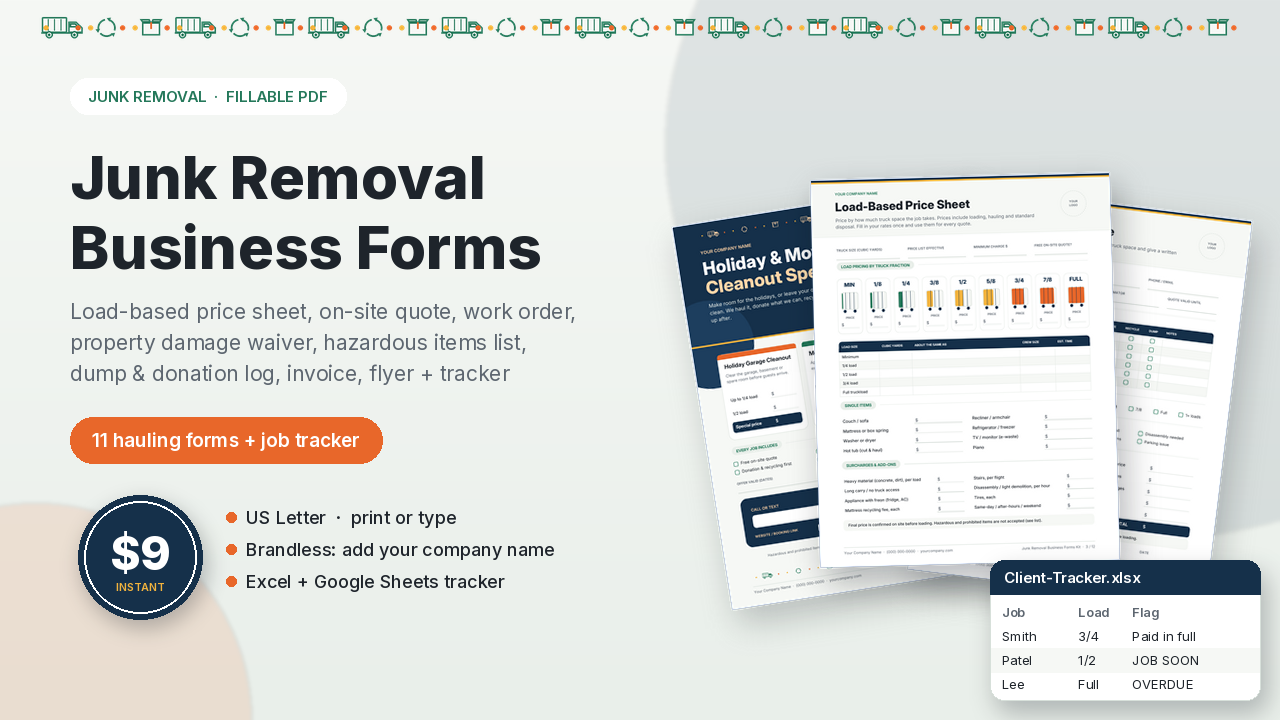
Junk Removal Business Forms Kit
11 fillable forms (booking form, load-based price sheet, estimate / quote, work order, liability & property damage waiver, prohibited items list, before / after checklist, dump & donation log, invoice, cleanout specials flyer, review cards) plus an Excel job tracker with profit per job.
Get it →Section 6: Timing, scheduling and who will be there
Timing questions help you fit the job on the right truck and tell you if there is a hard deadline, such as a move-out inspection, a closing date or a dumpster pickup.
- Preferred date and time window, and any hard deadline (move-out, lease end, closing, renovation start)
- Is this one trip, or will they need a second pickup later (for example, after an estate sale)?
- Will someone be on site to point out what goes and sign off on the job? If not, how will the crew get in, and how will the customer confirm the load before work starts?
- Any building rules: elevator reservations, quiet hours, loading dock times, certificate of insurance requests from the building
- Same-day or rush requests: do you offer them, and is there an extra charge?
Do not promise a date or a time window unless it is actually open on your schedule. It is better to say "we have openings on [day] and [day]" than to agree to whatever the customer asks and reshuffle later.
Section 7: Budget, payment and terms preview
Junk removal customers often compare a few companies, so they want a number quickly. Give a range, explain what it depends on, and preview your main terms so there are no surprises when the crew arrives.
| Question | How you might phrase it (placeholders only) |
|---|---|
| Price range | "From your photos, this looks like about [load fraction]. That is usually [price range]; we confirm the exact price on site before we start." |
| Minimum charge | "Our minimum charge is [amount], which covers [what it covers]." |
| Extra fees | "Heavy items, [item types] and stairs beyond [number] flights may add [fee or range]." |
| Payment | "Payment is due [when] by [accepted methods]." |
| Deposit | "For large cleanouts we ask for a [deposit amount or percentage] to hold the date." |
| Cancellation | "If you need to cancel or reschedule, please let us know [notice period]; [late cancellation policy]." |
Use your own amounts and policies. The point of the preview is that the customer hears about the minimum, the extra fees and the on-site confirmation before the crew arrives, so the final price feels like a confirmation, not a surprise.
Turning the answers into a quote
Once you have the answers and photos, the quote mostly writes itself. Each section of the questionnaire maps to one or more lines on your estimate. The pricing method is covered in junk removal pricing, and the written quote format is in the estimate template guide; the table below shows how the answers feed into it.
| Questionnaire answer | How it shows up in the quote (example only) |
|---|---|
| Item list and photos | Estimated load fraction: [quarter / half / three-quarter / full truck] at [your load rates] |
| Single items | [Per-item price] or your minimum charge, whichever applies |
| Stairs, carry distance, disassembly | [Labor or access fee] or a higher point in the range |
| Heavy items | [Heavy item fee] and [extra crew] if needed |
| Special items (appliances, mattresses, electronics, tires) | [Per-item disposal or handling fees] as separate lines |
| Construction debris, dirt, concrete | [Weight-based pricing or limits] as stated in your terms |
| Donation, recycling, sorting | [Sorting or extra drop-off fee] if you charge one |
| Timing | [Rush or same-day fee] if you offer it; date and time window |
Send the range with a short summary of the key answers ("one sectional and two mattresses from a second-floor apartment, no elevator, plus about ten bags in the garage; donation of the dresser if accepted"). If something is wrong, the customer can correct it before the crew drives out, not in the driveway.
When a site visit is worth it
Photo quotes work for most small and medium jobs. A site visit or a live video walkthrough is worth the time when:
- The job is a full home, estate or hoarding cleanout and the volume is hard to judge from photos
- The customer cannot send photos or the photos do not show the full space
- There are possible restricted or hazardous items you need to see before you agree to the job
- Access is unusual: long carries, tight stairs, a building with strict rules
- The customer wants a firm price in writing before the day rather than a range
If you charge for site visits or credit the fee to the job, say so on the questionnaire. If you do not, keep visits for jobs where the size of the quote makes the drive worthwhile.
Common mistakes
- Quoting from a description alone. "A couch and some boxes" is not a load estimate. Ask for photos, or quote a wide range and say why.
- Skipping access questions. Stairs, carry distance and parking change the labor more than most customers expect.
- Not asking about restricted items. Finding paint, chemicals or a freezer full of food on the day leads to awkward conversations and extra trips.
- Not confirming what stays. Ask the customer to mark or separate items to keep, and confirm the load with them before work starts.
- Not knowing who pays. On rentals and estates, confirm the person who approves and pays before you book.
- Promising donations. Say you will try; donation centers decide what they take.
- Hiding the extra fees. Preview heavy item, disposal and access fees up front so the final price is not a surprise.
One-page junk removal questionnaire checklist
- Customer name, phone, email, preferred contact method
- Job address, unit number, gate or building codes
- Owner, tenant, landlord, agent or family member; who approves and pays
- Who will be on site, or how the crew gets in
- Type of job (single item, cleanout, move-out, estate, yard, light construction, commercial)
- Item list with rough quantities
- Photos or video of everything going, with something for scale
- Items to keep, and how they are marked
- Location of items, stairs, elevator, carry distance
- Truck parking, height limits, permits, HOA or building rules
- Disassembly needed?
- Heavy items (piano, safe, hot tub, pool table)
- Appliances, mattresses, electronics, tires, batteries
- Paint, chemicals, liquids or suspected hazardous material (and what you do not accept)
- Donation, recycling and receipt requests
- Broom-clean or emptied only
- Preferred date, time window and any hard deadline
- Rush or same-day request
- Price range given, minimum charge, extra fees previewed
- Payment method, deposit and cancellation terms previewed
- Site visit needed?
Keep this list on your phone or in your booking form, and ask the first five or six items on the first call or text. Fill in the rest before you confirm the date.
FAQ
What should a junk removal client questionnaire include?
Contact details and who pays, the job address and type, a list of items with photos, location and access (stairs, carry distance, parking), heavy or restricted items, donation and items to keep, timing and who will be on site, and a preview of your price range, minimum, extra fees and payment terms.
Can I quote junk removal from photos?
For most small and medium jobs, yes, as a range. Ask for wide photos of each area and close-ups of large or unusual items, and make it clear the final price is confirmed on site when the crew sees the load.
How is a questionnaire different from a junk removal estimate?
The questionnaire collects the information you need. The estimate is the written quote you send afterward with the load size, price range, fees and terms. The contract or work order is what the customer signs before work starts.
Should I ask about hazardous items before every job?
Yes. A short list of items you do not accept or that carry extra fees avoids surprises on the day. Rules vary by location and disposal site, so check what applies to you.
When should I do a site visit instead of a photo quote?
For full home or estate cleanouts, unclear volume, possible restricted items, difficult access, or when the customer wants a firm written price before the day.
How do I handle items the customer wants to keep or donate?
Ask the customer to mark or separate them before the crew arrives, confirm the load together before work starts, and phrase donations as "we will try" because donation centers decide what they accept.
This page is general information for junk removal and hauling businesses, not legal, insurance, environmental or licensing advice. Rules on hauling licenses, waste disposal, recycling, hazardous materials, appliances, electronics, contracts, deposits and cancellations vary by location and by disposal site. Check the current requirements that apply to you and have your own forms and agreements reviewed.
Related templates
Free Junk Removal Estimate & Job Forms
A fillable junk removal estimate form priced by truck-load fraction, a job ticket and a customer liability waiver.
Download free →Junk Removal Business Forms Kit
Fillable junk removal forms plus an Excel job tracker with load pricing, dump fees, crew labor and profit per job.
Get it →