House Cleaning Walkthrough Checklist: What to Check Before You Quote (+ Free Forms)
A practical guide for independent house cleaners and small cleaning businesses: how to run a short in-home walkthrough (or video walkthrough) before the first clean, what to check in every room, how to record condition and existing damage, and how to turn your notes into a quote the client understands.
Why a walkthrough is worth fifteen minutes
A client tells you they have “three bedrooms, two baths, nothing crazy.” You quote from that, arrive, and find a glass shower covered in hard water scale, a shedding dog, a home office stacked with paper and an oven nobody has opened in a year. The clean takes far longer than planned, and either you absorb the time or you have an awkward conversation about the price.
A short walkthrough before the first clean prevents most of that. You see the real condition of the home, agree what is and is not included, spot existing damage before anyone can blame you for it, and test the way you will get in. It also shows the client you are organized, which helps you win the job at a fair price instead of the lowest one.
This guide is about the walkthrough itself: what to look at and what to write down. If you have not collected the basics yet, start with the cleaning client intake form or the house cleaning client questionnaire. For setting numbers, see the house cleaning pricing guide, and for terms, the house cleaning service agreement guide.
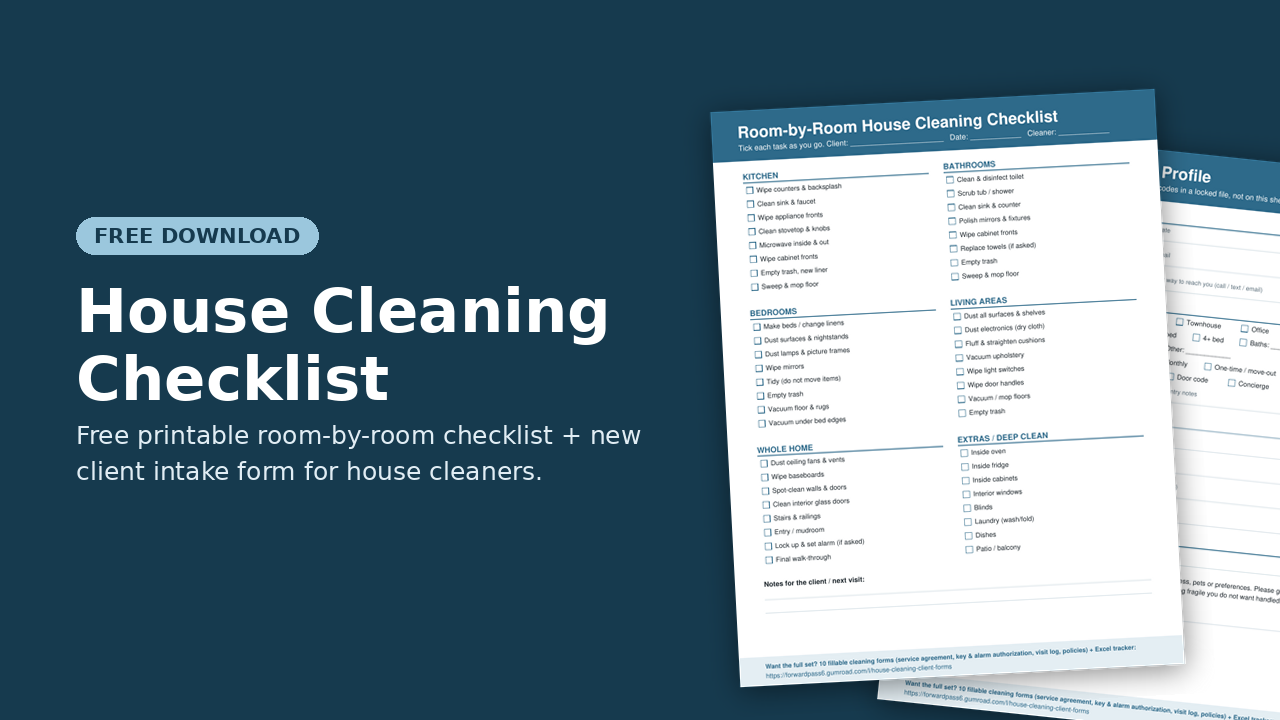
Free House Cleaning Checklist
A printable room-by-room cleaning checklist with 48 tasks plus a new client intake and home profile form.
Download free →Walkthrough vs questionnaire vs intake form
Cleaners often mix these up. They work best as three separate steps:
| Step | When | How | What it gives you |
|---|---|---|---|
| Questionnaire | First inquiry, before quoting | Phone, text or online form | Home size, type of clean, frequency, pets, rough condition, budget |
| Walkthrough | Before the quote or before the first clean | In person, or a live video call | Real condition, problem areas, damage, access, what is included and excluded |
| Intake form / home profile | Before the first clean, updated over time | Signed form kept in the client file | Contact details, access and alarm, priorities, products, allergies, off-limits areas, policies acknowledged |
The questionnaire tells you whether the job is worth a visit. The walkthrough confirms what you will actually be cleaning. The intake form and agreement record it so every cleaner on your team works from the same information.
Before you arrive
- Confirm the address, a time window and who will be home. Ask for parking instructions and any building check-in rules.
- Review the questionnaire answers so you are checking, not starting from zero.
- Bring a printed or fillable walkthrough sheet, a pen or tablet, and your phone for photos.
- Ask the client to have pets secured or nearby so you can meet them.
- Decide in advance whether you will quote on the spot or send the quote afterwards. Sending it the same day, in writing, usually looks more professional and gives you time to check your numbers.
Many cleaners keep walkthroughs short, around fifteen to twenty minutes for a typical home. Longer than that and the client starts to feel they are paying for a consultation.
Whole-home basics to confirm
Start at the door and note anything that affects every visit:
- Access: how you will get in next time (client home, key, lockbox, smart lock, doorman). Test the lockbox or code if you can.
- Alarm: whether there is one, where the panel is and who to call if it goes off.
- Parking and load-in: distance from the car to the door, stairs, elevators, where you can leave equipment.
- Size check: confirm bedrooms, bathrooms (full and half), floors and any finished basement against what the client told you.
- Flooring: carpet, hardwood, tile, laminate, natural stone. Each needs different products and time.
- Clutter level: cleaners usually clean surfaces, not tidy belongings. Note if surfaces will need clearing first and whether that is included.
- Supplies and water: whose products and vacuum you will use, and where you can fill buckets.
Room-by-room walkthrough checklist
Walk each room in the order you would clean it. For each one, note condition, problem areas and anything off-limits.
| Room | What to look at | Notes worth writing down |
|---|---|---|
| Kitchen | Counters, stovetop, backsplash, cabinet fronts, sink, appliance exteriors, floor | Grease level, inside oven and fridge condition (if requested), stone counters, items left on counters |
| Bathrooms | Shower or tub, glass doors, grout, toilet, vanity, mirrors, floor | Hard water or soap scum buildup, mold or mildew, delicate fixtures, ventilation |
| Bedrooms | Dusting surfaces, under-bed access, floors, beds | Whether to change linens, clutter on surfaces, rooms to skip |
| Living areas | Surfaces, electronics, furniture, floors, blinds | Pet hair on furniture, delicate items, fireplace or glass tables |
| Home office | Desk, shelves, floors | Usually off-limits or “floors only”; confirm papers and electronics are not touched |
| Stairs and hallways | Banisters, baseboards, steps | Carpeted stairs take extra time; note railings and spindles |
| Laundry and entry | Machines, sink, floor, mudroom | Whether laundry is included, boots and coats, heavy dirt from entry |
| Basement, garage, patio | Only if the client wants them | Usually extras; confirm scope and whether there is power and lighting |
Use the room-by-room house cleaning checklist as the task list; the walkthrough is where you mark which tasks apply to this home and which are extras.
Rating condition consistently
A simple 1 to 5 condition rating makes quotes faster and more consistent, especially if more than one person does walkthroughs. Write the rating for each room, not just the whole home, because a tidy home can still have one bathroom that needs real work.
| Rating | What it looks like | What it usually means for the quote |
|---|---|---|
| 1 – Well kept | Light dust, surfaces clear, no buildup | Standard clean pricing |
| 2 – Lived in | Normal dust and fingerprints, light bathroom buildup | Standard clean, maybe a little extra time on the first visit |
| 3 – Needs attention | Visible grime on stovetop, soap scum, dusty baseboards | First visit priced as a deep clean or with extra time |
| 4 – Heavy | Grease, hard water scale, heavy pet hair, sticky floors | Deep clean required before any recurring rate |
| 5 – Very heavy | Long-term neglect, strong odors, clutter on most surfaces | Quote hourly or a custom price; consider whether it is outside your services |
Example only. Set your own times, prices and policies for your market.
If you see anything that looks like a health or safety hazard (signs of pests, mold over a large area, biohazards, sharps), note it and decide whether it is outside the services you offer. Specialist cleaning may be needed, and it is fine to say no.
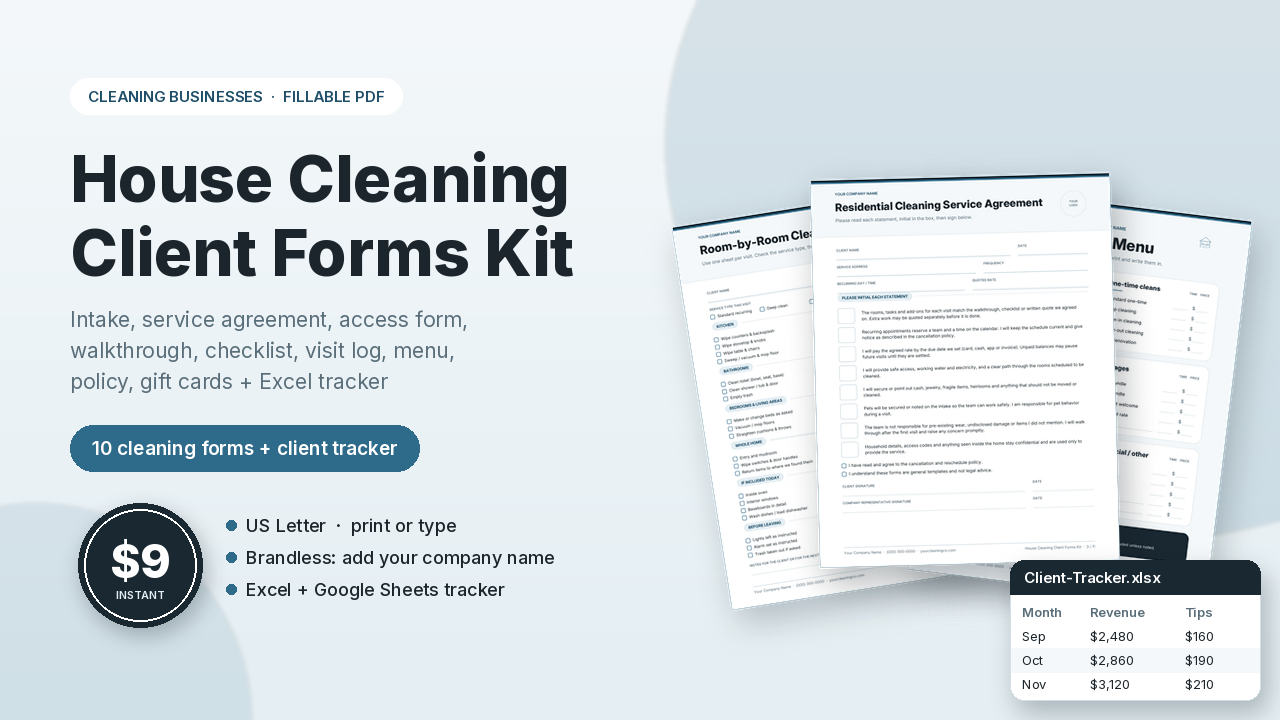
House Cleaning Client Forms Kit
10 fillable forms (intake and home profile, service agreement, key and alarm authorization, walkthrough sheet, room-by-room checklist, visit and quality log, service menu, cancellation policy, photo release, gift certificates) plus an Excel client tracker.
Get it →Existing damage and photos
The walkthrough is your best chance to record problems that were there before you started. Note and photograph:
- Scratched or etched counters, chipped tiles, cracked glass
- Stained carpet or upholstery, worn floor finish
- Loose fixtures, towel bars, cabinet doors or handles
- Damaged blinds, broken appliance parts, peeling paint
- Fragile or valuable items the client wants left alone
Ask the client before photographing their home, explain why, and say how photos are stored. Keep photos with the client file, not mixed into your personal camera roll, and only share them as the client agrees. A short photo release or a line in your agreement makes this clear. Rules on photos and customer data vary by location.
Scope: what is included, extra or off-limits
Most disputes come from scope. Use the walkthrough to agree it out loud, then put it in writing.
| Item | Standard clean? | Typical extra? | Ask at the walkthrough |
|---|---|---|---|
| Inside oven | No | Yes | How dirty is it? Self-clean function used? |
| Inside fridge | No | Yes | Will the client empty it first? |
| Interior windows and tracks | No | Yes | How many, and can they be reached safely? |
| Baseboards and doors (detailed) | Often on first or deep clean | Yes | How much buildup? |
| Inside cabinets | No | Yes | Will they be emptied? |
| Laundry, dishes, linens | No | Yes | Where are clean linens kept? |
| Walls, light switches, vents | Spot only | Yes | Any delicate paint? |
| Garage, patio, basement | No | Yes | Lighting, power, water access? |
Example only. Set your own times, prices and policies for your market.
Also write down off-limits areas (a child’s room, a home office, a safe, certain closets) and any items not to move. Safety limits matter too: many cleaners do not climb above a certain height or move heavy furniture, and saying so now avoids pressure later.
Pets, people and products
- Meet the pets. Note where they will be during the clean, any that must not get out, and how much hair to expect.
- Ask about allergies or sensitivities in the household, including to fragrance.
- Confirm product preferences: your products or theirs, fragrance-free, or specific products for natural stone or hardwood.
- Ask who will usually be home during cleans and whether anyone works from home.
- Note any special instructions: shoes off, rooms to do first, things that must be done every visit.
How the walkthrough changes by type of clean
The same checklist works for every job, but the focus shifts depending on what the client is booking:
| Type of clean | Focus at the walkthrough | Worth confirming |
|---|---|---|
| Recurring (weekly, every two weeks, monthly) | Average condition, priorities, routine extras | That the first visit may be a deep clean, and the recurring price assumes similar condition between visits |
| One-time or deep clean | Buildup in kitchen and bathrooms, baseboards, detail areas | Which detail tasks are included and how long the job may take |
| Move-in or move-out | Empty rooms, inside cabinets and appliances, walls and floors | Whether the home will be empty, utilities on, and any landlord or property manager checklist to follow |
| Post-renovation | Fine dust on every surface, vents, windows, floors | That construction debris removal is excluded unless agreed, and whether the work is fully finished |
Example only. Set your own times, prices and policies for your market.
For move-outs, ask for the landlord or property manager checklist if there is one and walk the home against it. The move-out cleaning checklist covers the room-by-room tasks.
Video walkthroughs
When a home is far away, the client is busy, or the job is small, a live video call can replace the in-person visit. Ask the client to walk you through every room slowly, open the oven and fridge if those are included, and show the shower glass and floors up close. Take notes the same way you would in person.
Video works well for standard recurring cleans in average condition. For very large homes, heavy condition or move-out cleans with a landlord checklist, an in-person visit is usually safer. Either way, say in your quote that the price is based on the walkthrough and may change if the home is very different on the day.
Turning walkthrough notes into a quote
Once you are back at your desk, go room by room through your notes. One simple approach (example only; use your own numbers):
- Estimate the time each room takes at its condition rating.
- Add travel and setup if you price per visit.
- Add each extra the client asked for as a separate line.
- Decide whether the first visit is a deep clean and say so.
- Send a written quote listing the rooms, the extras, what is excluded, the first-visit price and the recurring price.
| Walkthrough note | How it might show up in the quote |
|---|---|
| Main bathroom rated 4, hard water on glass | First visit priced as a deep clean; recurring rate starts from the second visit |
| Two dogs, heavy shedding | Extra time or a pet hair add-on |
| Inside oven and fridge requested | Two separate add-on lines |
| Home office off-limits | Listed as excluded, so the client sees it |
| Lockbox tested, key code works | Access method recorded in the client file |
Example only. Set your own times, prices and policies for your market.
Many cleaners also explain that the recurring price assumes the home stays at roughly the same condition between visits. That is a fair, clear way to protect your time.
After the walkthrough
- Send the quote the same day if you can, while the visit is fresh for the client.
- Attach or link your service agreement and cancellation policy.
- Once the client accepts, get the intake form, key and alarm authorization and any photo release signed.
- Store the walkthrough sheet and photos in the client file so any cleaner can read them before the first visit.
- Review the walkthrough notes after the first clean: if the job took much longer than planned, update the time estimate before the next quote.
Common walkthrough mistakes
- Quoting on the spot without checking your numbers, then regretting it
- Only looking at the main rooms and missing a second bathroom or a finished basement
- Not opening the oven, fridge or shower door when those are part of the job
- Skipping damage photos, then having no record when a client asks about a scratch
- Agreeing scope verbally and never writing it down
- Not testing the access method and getting locked out on the first clean
- Letting the walkthrough turn into a free clean or a long consultation
A one-page walkthrough checklist
If you only carry one page, make sure it covers:
- Client name, address, date and who was present
- Access method tested, alarm details, parking
- Bedrooms, bathrooms, floors and flooring types confirmed
- Condition rating for each room
- Problem areas and special surfaces
- Existing damage noted and photographed (with permission)
- Extras requested and items excluded
- Off-limits areas and items not to move
- Pets, allergies and product preferences
- First-visit type (standard or deep) and recurring frequency
- Quote sent date and next step
FAQ
What is a house cleaning walkthrough?
A short visit, in person or by video, before the quote or first clean. The cleaner looks at every room, rates the condition, notes problem areas and existing damage, confirms access, pets and products, and agrees what is included, extra or off-limits.
Do I need a walkthrough if the client filled in a questionnaire?
Not always. A questionnaire with photos is often enough for a standard recurring clean in average condition. A walkthrough is more useful for large homes, heavy condition, move-in or move-out cleans, or clients who want many extras.
How long should a cleaning walkthrough take?
Many cleaners aim for around fifteen to twenty minutes for a typical home. Bring a walkthrough sheet so you check the same things every time and do not turn it into a long consultation.
Should I charge for a walkthrough?
Many cleaners offer it free and include it in the price of the first clean, while some charge a small fee that is credited if the client books. Choose one approach and state it clearly when you book the visit.
What is the difference between a walkthrough and an intake form?
The walkthrough is the visit where you see the home and agree scope. The intake form records the details you need every time: contact, access and alarm, priorities, products, allergies, off-limits areas and policies. Many cleaners fill in the walkthrough sheet first, then use it to complete the intake form.
Can I do a walkthrough by video?
Yes. Ask the client to show every room slowly, including inside the oven, fridge and shower if those are included. Note in your quote that the price is based on the walkthrough and may change if the home is very different on the day.
This page is general information for independent house cleaners and small cleaning businesses, not legal or insurance advice. Rules for service agreements, liability, photos and the handling of client keys and data vary by location, so check local requirements or talk to a professional if you are unsure. Times, prices and policies shown are examples only.
Related templates
Free House Cleaning Checklist
A printable room-by-room cleaning checklist with 48 tasks plus a new client intake and home profile form.
Download free →House Cleaning Client Forms Kit
Fillable intake and home profile, service agreement, key authorization, walkthrough sheet and more, plus an Excel client tracker.
Get it →