Holiday Massage Gift Certificate Pricing: How to Price Gift Certificates, Packages and December Bookings (Plus Free Intake Form)
How massage therapists can price the holidays: gift certificate denominations vs session prices, 3-pack packages, expiration and gift card rules, tracking and redemption, hot stone and aromatherapy add-ons, peak-date and after-hours fees, December deposits and January capacity, with a worked example and a free intake form.
Why the holidays need their own massage price plan
For massage therapists, December brings two kinds of demand at once. Clients want a session to unwind before family events and travel, and their friends and partners want to buy massage as a gift. Gift certificates can be one of the best sales of the year, but only if they are priced and tracked properly. Sell them too cheaply, or without clear terms, and you end up giving away January sessions at a loss, chasing old paper certificates, or turning away regulars because the calendar is full of discounted redemptions.
A short holiday plan fixes that. Decide how certificates relate to your session prices, which packages you sell, what terms go on each certificate, how you record and redeem them, which add-ons you feature, what you charge for peak dates and after-hours slots, and how much January time you keep free. The sections below walk through each one, with a worked example at the end. All numbers on this page are example numbers, not market data.
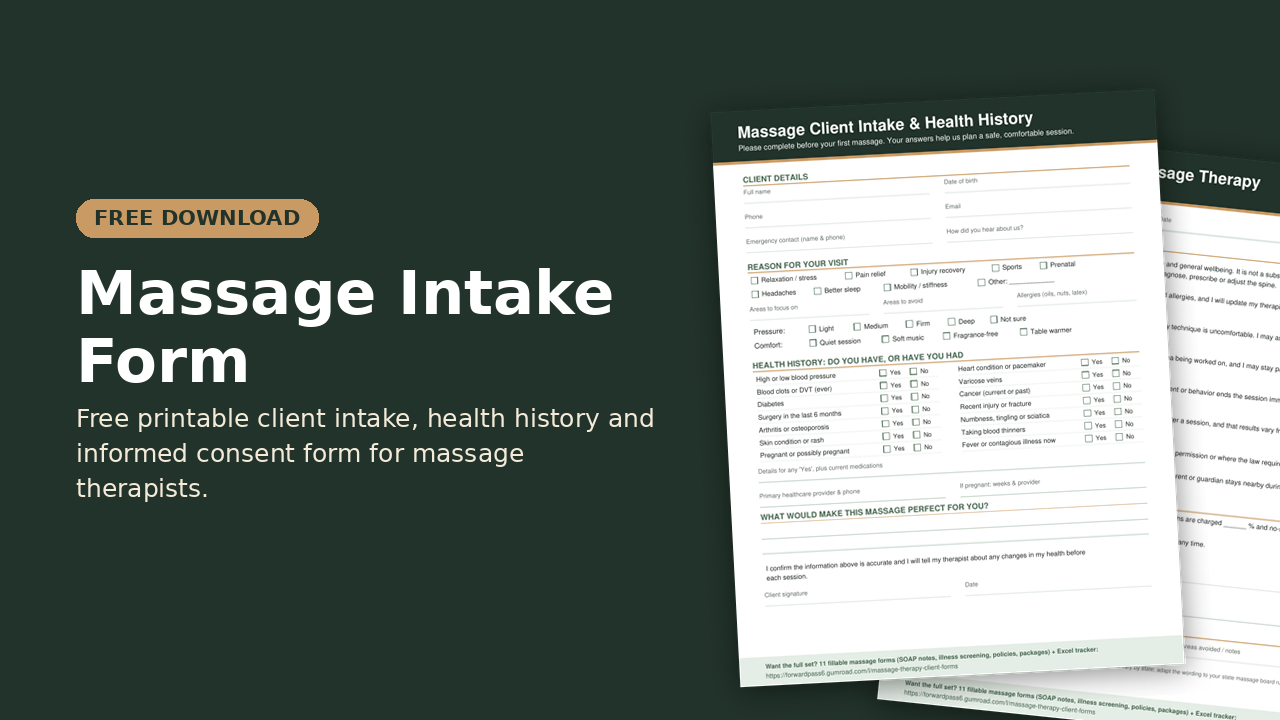
Free Massage Intake Form
A printable massage client intake and health history form plus an informed consent form for massage therapists and solo practices.
Download free →1. Gift certificate pricing and denominations vs session prices
Start from your normal price list. The simplest gift certificates match your sessions exactly: one 60-minute massage, one 90-minute massage, or one specialty session. The buyer knows what they are giving, the recipient knows what to book, and you never have to work out whether a dollar amount covers the service on the day.
If you also sell dollar certificates, choose amounts that line up with real sessions. For example, if a 60-minute massage is $90, a $100 certificate covers the session plus a small add-on or tip, and a $50 certificate is a partial gift that brings the recipient back to pay the rest. Avoid odd amounts that leave small balances nobody uses.
- Service certificates. One named session at your current price, such as a 60- or 90-minute massage.
- Dollar certificates. Two or three round amounts that match or slightly exceed your main session prices.
- Price changes. Decide in advance whether a service certificate still covers the session if your prices go up next year, and write that on the certificate.
2. Bundles and packages, such as a 3-pack
Packages are a natural holiday gift and a good way to bring a new client back more than once. A 3-pack of 60-minute massages is easy to understand and easy to price. Many therapists give a small saving on a package, or include a bonus add-on, rather than cutting the single-session price.
Keep the terms short: how many sessions are included, which length, whether sessions can be shared with another person, and how long the package is valid where your state allows a limit. Treat each session in the package as a separate redemption in your records, so you always know how many are left.
3. Expiration dates and gift card rules (check your state)
This is the part most likely to cause trouble later. Gift card and gift certificate rules are different from state to state. Some places limit or ban expiration dates on paid certificates, some limit dormancy or service fees, and some treat promotional bonuses differently from the amount the buyer paid. Unused balances can also have accounting or unclaimed property rules.
This page does not give legal advice. Before you print an expiry date, check your state's current rules on its consumer protection or attorney general website, or ask an attorney or accountant. Whatever you decide, print the terms clearly on the certificate: the value or service, any expiry date that applies, whether it can be refunded or exchanged for cash, and how to book.
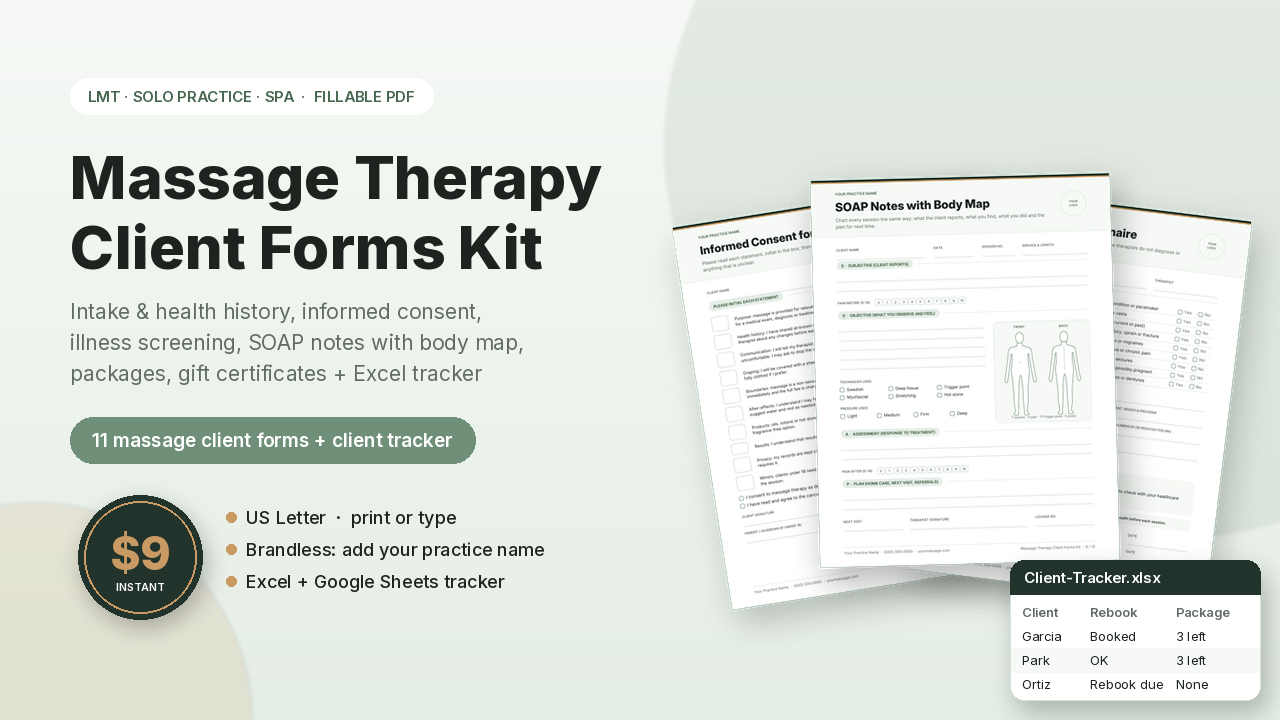
Massage Therapy Client Forms Kit
11 fillable forms (intake, health history, informed consent, cancellation and no-show policy, SOAP notes and more) plus an Excel client tracker with rebook reminders. Want every kit? See the bundle.
Get it →4. Tracking and redeeming certificates
Paper certificates get lost and duplicated, so give each one a unique number and keep a simple log. A spreadsheet with columns for certificate number, date sold, buyer, recipient, value or service, payment method, terms, and date redeemed is enough for most solo practices.
When a recipient books, ask for the certificate number, check it against the log, and mark it as used straight away. Ask new recipients to complete a client intake and health history form before the first session, just like any other new client, so contraindications and preferences are known before they get on the table.
5. Holiday add-ons: hot stone, aromatherapy and more
Add-ons are an easy way to make a holiday session feel special without changing your base prices. As an example only, a therapist might offer aromatherapy for $10, a hot stone upgrade for $20, a scalp or foot treatment for $15, or a seasonal scented oil blend at no extra cost during December.
Price add-ons so they cover the extra time and supplies, list them clearly on your booking page, and let gift buyers include one on a certificate. A certificate for a 60-minute massage with hot stone is an easy upsell from a plain session certificate.
6. Peak-date and after-hours fees
The days just before Christmas and New Year's Eve, and weekends in mid-December, often fill first. Some therapists add a small flat peak-date fee on those days, and a separate fee for early mornings, late evenings or days they are normally closed. List the exact dates and hours, show the fee before the client confirms, and apply it the same way to everyone.
Decide in advance how fees work with gift certificates. For example, a certificate covers the session, and any peak-date or after-hours fee is paid on the day. Write that on the certificate so recipients are not surprised.
7. Deposits and no-show rules for December slots
A missed December appointment is hard to refill at short notice. Many therapists take a deposit for every December booking, or for peak dates and long sessions. State the deposit amount, whether it comes off the session price, how much notice is needed to reschedule, and when the deposit is kept, such as a no-show or a cancellation inside 24 or 48 hours.
For certificate holders, decide whether a no-show uses up the certificate or part of it, and say so in your cancellation policy. Ask every client to agree to the policy when they book.
8. January redemption capacity planning
Certificates sold in December are booked in January and February, often in a rush. Before you sell, look at how many open slots you have in those months. If you have, say, 40 open hours in January and expect most certificates to be booked then, stop selling service certificates or add hours before you pass that number.
Keep some January slots for regular clients, ask certificate holders to book early, and consider a soft booking window, such as recommending booking within 90 days, where your state's rules allow it. A full January is great, but not if regulars cannot get in.
A worked example (example numbers)
Say a massage therapist charges $90 for a 60-minute massage and $125 for 90 minutes. For the holidays they sell service certificates at those prices, $50 and $100 dollar certificates, a 3-pack of 60-minute sessions for $250, aromatherapy at $10 and hot stone at $20, a $15 peak-date fee on December 20 to 24, and a $25 deposit on December bookings.
- Gift sales: 10 x 60-minute certificates = $900; 4 x 90-minute certificates = $500; 6 x $100 certificates = $600
- Packages: 5 x 3-packs at $250 = $1,250 (15 future sessions)
- December client: 90 minutes + hot stone on December 22: $125 + $20 + $15 = $160
- Total gift and package sales: $900 + $500 + $600 + $1,250 = $3,250
- January load: 10 + 4 + about 6 + 15 = about 35 sessions, so the therapist checks that 35 sessions fit in January and February alongside regular clients
These numbers are examples only, not market data. Use your own prices, costs and local rules, and remember that certificate money is for future work, so do not spend it as if the sessions were already done.
Before you start selling
Get ready before the requests arrive: a client intake and health history form, a deposit and cancellation policy, printed or digital certificates with numbers and clear terms, a tracking log, a short add-on list, your peak dates and after-hours slots, and a rough January capacity count. Tell regular clients first, then promote certificates to everyone, and December will be a busy month instead of a stressful one.
FAQ
Should a massage gift certificate be for a dollar amount or a specific service?
Both work. A service certificate, such as one 60-minute massage, is the easiest gift to understand and to redeem. A dollar certificate is more flexible and suits people who are not sure what the recipient wants. Many massage therapists offer both: service certificates that match their most popular sessions, and a few dollar amounts that cover one session plus a tip or an add-on.
Should I discount massage gift certificates for the holidays?
You do not have to. Gift certificates sell well in December without a discount because people are looking for gifts. If you want a holiday offer, a small bonus usually protects your session price better than a straight discount, for example a free add-on with a 3-pack or a bonus certificate for a set spend. Any amounts on this page are example numbers, not market data.
Can massage gift certificates have an expiration date?
It depends on where you work. Gift card and gift certificate rules differ by state, and some places limit or ban expiration dates or fees on certificates bought with money. A promotional bonus may be treated differently from a paid certificate. Check your state's rules, or ask an attorney or accountant, before printing an expiry date, and write whatever terms apply on the certificate itself.
How do I keep track of massage gift certificates?
Give every certificate a unique number and record it in one place, such as a spreadsheet or your booking software: the number, buyer, recipient, value or service, date sold, any expiry date that applies, and the date it was redeemed. Mark it as used the moment the session is booked or paid, so the same certificate cannot be used twice.
Should I take deposits for December massage appointments?
Many massage therapists do, because a no-show on a busy December day is a slot that is hard to refill. State the deposit amount, whether it comes off the session price, how much notice is needed to move or cancel, and when the deposit is kept. Have clients agree to the policy when they book or on your intake form.
How do I handle the rush of gift certificate redemptions in January?
Count how many certificates you sold and estimate how many will be booked in January and February. If that is more than your open slots, add a few extra hours, ask recipients to book early, or offer a booking window on certificates sold after a certain date. Planning ahead keeps regular clients from being pushed out by a wave of new bookings.
This page is general guidance, not legal, tax or insurance advice. Gift card, gift certificate, deposit and consumer rules vary by state and city, so check your local rules and have your policies reviewed by an attorney, accountant or insurer.
Related templates
Free Massage Intake Form
A printable massage client intake and health history form plus an informed consent form for massage therapists and solo practices.
Download free →Massage Therapy Client Forms Kit
Fillable massage therapy client forms plus an Excel client tracker.
Get it →