Daycare Incident Report: What to Write When a Child Gets Hurt (+ Free Forms)
A practical guide for home daycare providers, small childcare programs and nannies: when to write an incident report, what each section should say, how to tell parents, and how to keep the record factual and fair to every child involved.
Why every daycare needs an incident report form
Children fall, bump heads, get bitten, pinch fingers in doors and sometimes become ill suddenly. Most of these moments are small, but each one leaves a parent with questions: What happened? When? Who was watching? What did you do? An incident report answers those questions in writing, the same way every time, while the details are still fresh.
A written report also protects your program. It shows that you noticed the incident, gave appropriate care, told the parent and followed your own procedures. If a parent later asks about a bruise, if an injury turns out to be more serious than it looked, or if a licensing inspector asks to see your records, a dated, signed report is far stronger than anyone’s memory. Many licensing agencies require written incident records, and some require you to notify the agency itself about certain kinds of incidents, so check the rules that apply to your program.
This guide is about that one form. The everyday sheet parents get at pickup is covered in our daycare daily report sheet guide, and the paperwork a family completes before the first day is in the daycare enrollment form guide. For tuition and rates, see how much to charge for daycare.
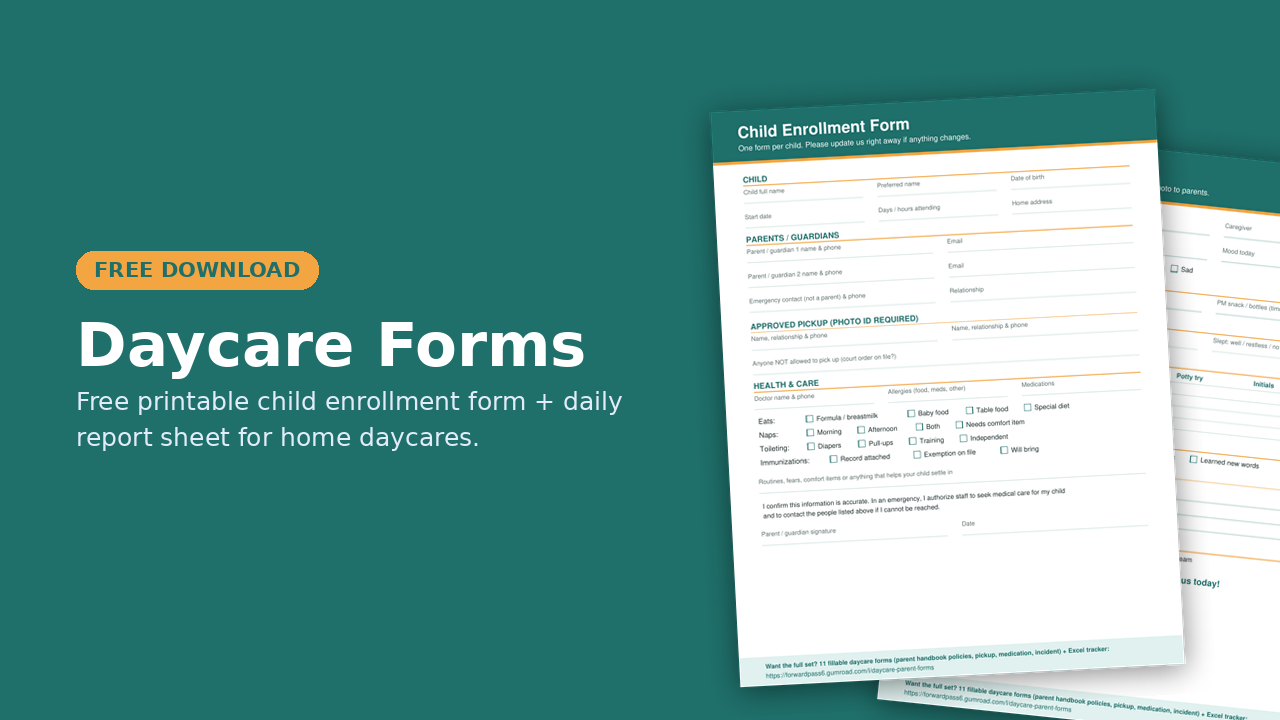
Free Daycare Forms
A printable child enrollment form plus a daily report sheet for parents.
Download free →When to write an incident report
Your policy should say clearly which events need a report, so that staff do not have to decide in the moment. Common examples include:
- Any injury that needs first aid beyond a quick comfort, such as a scrape, cut, bump to the head, bite that marks the skin, splinter, nosebleed or suspected sprain
- Any bump or blow to the head, even if the child seems fine
- Biting, scratching or hitting that leaves a mark, whether your child was hurt or did the hurting
- Sudden illness during the day: fever, vomiting, a rash, breathing difficulty or an allergic reaction
- Medication errors, such as a missed, late or wrong dose
- Exposure to something harmful, such as a child putting a cleaning product, plant or small object in their mouth
- A child leaving a supervised area or going missing, even briefly
- Any time you called emergency services or advised a parent to seek medical care
When in doubt, write it up. A short report for a minor bump costs a few minutes; having no record of an injury that later turns out to matter can cost you a family’s trust.
1. The basics at the top
Start every report with the same details so it stands on its own:
- Child’s name, age and date of birth (or a child ID)
- Date and exact time of the incident, as close as you can tell
- Location (for example back yard climbing frame, toddler room by the book shelf, bathroom, on a walk)
- Name of the person who completed the report and their role
- Names of staff who saw the incident or were supervising the area
- Number of children and adults present in that area, if your program tracks ratios
Write the time of the incident and, separately, the time you completed the report. If you cannot fill in the form straight away because you are still caring for the children, that is normal; just write it as soon as you safely can, the same day.
2. What happened: facts, not conclusions
This section is the heart of the report. Describe what you saw or heard, in order, using plain language. Stick to facts: who was doing what, where, and what happened next. If you did not see the incident, say so, and write what the child or another adult told you, noting who said it.
| Instead of | Write something like |
|---|---|
| “Was being careless and fell.” | “Running on the patio at 10:20, tripped on the edge of the mat and fell forward onto both hands and knees.” |
| “Got hurt at the slide.” | “Came down the small slide head first at 3:05 and bumped forehead on the ground at the bottom. Staff member was at the slide.” |
| “Was attacked by another kid.” | “At 11:40, during block play, another child bit [Child] on the left forearm. Staff member was two feet away and separated the children.” |
| “Seemed sick.” | “At 1:15, after nap, said tummy hurt and vomited once. Temperature taken: [reading] at 1:20.” |
Example only. Use your own wording and follow your program’s procedures.
Avoid guessing about causes, blaming anyone, or describing a child as clumsy, naughty or aggressive. Opinions do not help a parent understand what happened, and they can be hurtful when the report is read later.
3. Injury or symptoms observed
Record what you could see and what the child said, without diagnosing. Useful details:
- Body part and side (left knee, right side of forehead above the eyebrow)
- What you saw: redness, a scrape about the size of a coin, a raised bump, bleeding that stopped after a few minutes, swelling, teeth marks with or without broken skin
- What the child said or did: cried briefly then returned to play, said it hurt to stand, held their arm
- For illness: symptoms, the time they started, any temperature reading and how it was taken
- Whether the child’s behavior changed afterwards, especially after a head bump (unusual sleepiness, vomiting, confusion or crying that will not settle)
Leave diagnosis to medical professionals. “Swelling on right wrist, child would not use right hand for the rest of the morning” is more useful to a parent and a doctor than “sprained wrist”.
4. First aid and action taken
Write down what you did, and when:
- First aid given (washed with water, applied a cold pack for a few minutes, applied a bandage, pressure until bleeding stopped), following your training and the products parents have approved
- Who gave it
- Whether the child rested, was watched more closely, or went back to normal activities
- Whether you called emergency services, and the time
- Whether you advised the parent to see a doctor or collect the child early
- Any immediate change you made to prevent a repeat, such as moving a toy, closing off equipment or adjusting supervision
In an emergency, call emergency services first and complete the paperwork afterwards. If the child needs medical care, follow the medical consent and emergency contact details on their enrollment file. If you give any medication, record it on the medication log too, with the parent’s written permission as your rules require.
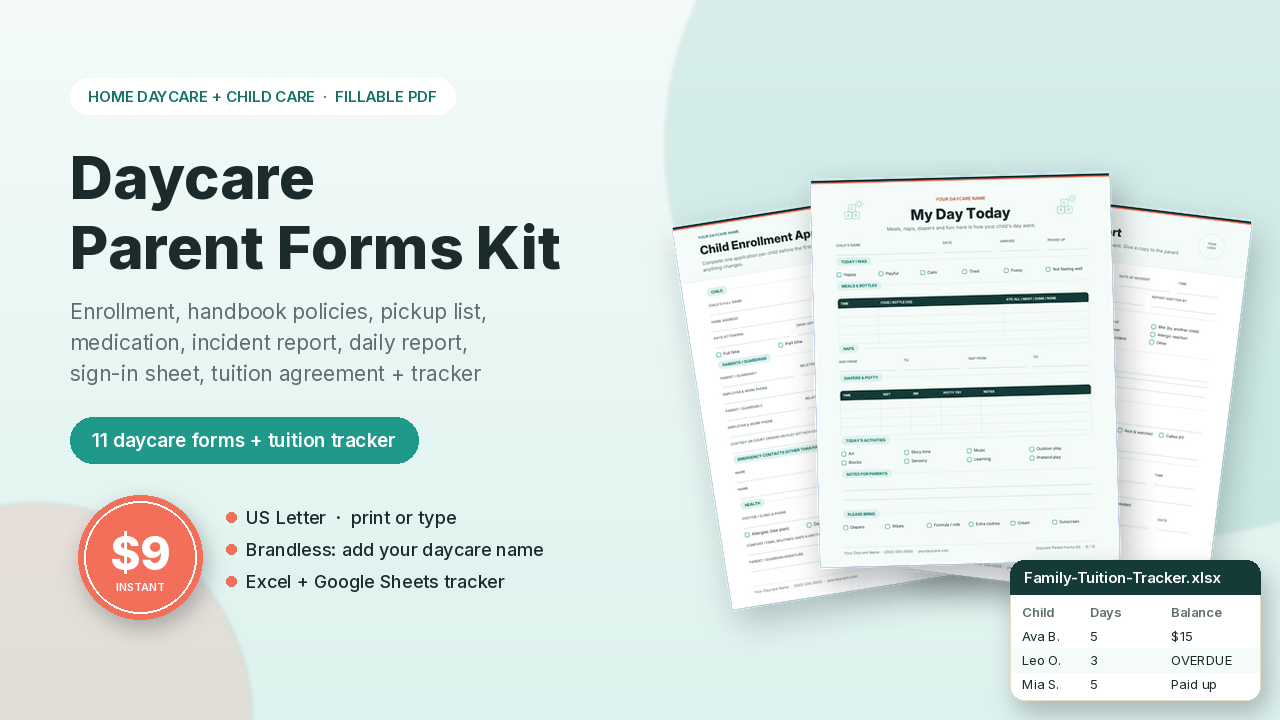
Daycare Parent Forms Kit
12 pages of fillable daycare forms (enrollment, authorized pickup, medication log, allergy plan, incident report, tuition agreement and more) plus an Excel tuition and attendance tracker.
Get it →5. Telling the parent
Most programs call or message parents right away for anything beyond a very minor bump, and always for head injuries, bites that break the skin, illness that means the child must go home, or anything that needed medical care. Your policy should say which incidents need an immediate call and which can wait for pickup. Some licensing rules set specific timeframes, so check yours.
On the report, record:
- Who was notified (name and relationship), how (phone, text, in person) and the time
- What they were told, briefly
- Anything the parent asked you to do (for example keep watching and call if anything changes, or that they would collect the child)
- If you could not reach them, each attempt and which emergency contact you tried next
When you talk to the parent, lead with how the child is now, then explain what happened and what you did. A calm, factual conversation, backed by a written report, goes much further than a hurried mention at the door.
6. Signatures and copies
The report is usually signed by the staff member who completed it, reviewed and signed by the director or owner if there is one, and signed by the parent to show they received it. The parent’s signature means they read the report, not that they agree with every detail; leave space for their comments.
Give the parent a copy (paper or a photo/scan), and keep the original in the child’s file or an incident binder for as long as your licensing rules, insurer or local law require. If a parent refuses to sign, note the date, the time and that the report was offered, and keep it on file anyway.
Biting incidents: what to write about both children
Biting is common among toddlers and is one of the hardest incidents to report well, because there are two families involved. Most programs complete a report for the child who was bitten and a separate report for the child who bit, so each family gets a record about their own child.
| Report | What to include | What to leave out |
|---|---|---|
| Child who was bitten | Time, location, body part, whether skin was broken, first aid, parent notified | The name of the child who bit |
| Child who bit | Time, location, what was happening just before (for example both reached for the same toy), how staff responded, parent notified | The name of the child who was bitten |
| Both | Steps you are taking to reduce repeats (shadowing, extra toys, changes to the room) | Labels such as “biter” or “aggressive” |
Example only. Follow your own policy and any licensing rules about what you share.
Parents often ask who bit their child. Many programs have a written policy of not sharing other children’s names, and it helps to explain that policy in your parent handbook before it ever comes up. If a bite breaks the skin, advise both families to check with their own doctor, as your policy and local health guidance suggest.
Minor bumps vs incidents that need more
Not every incident needs the same response. A simple way to think about it:
| Situation | Typical record | Typical parent contact |
|---|---|---|
| Small scrape, comforted and back to play | Short incident report or note, as your policy says | At pickup, with the report |
| Any bump to the head | Incident report, with symptoms watched afterwards | Call or message right away is common |
| Bite that breaks the skin | Incident report for each child involved | Call or message right away is common |
| Illness that means the child must go home | Incident or illness report, with symptoms and times | Call right away to arrange pickup |
| Injury needing medical care, or emergency services called | Detailed incident report, completed as soon as safely possible | Immediately; your licensing agency may also need to be notified |
| Child missing or left unsupervised, even briefly | Detailed incident report and review of what happened | Immediately; check any agency reporting rules |
Example only. Your policy, licensing rules and insurer decide what is required.
Patterns, follow-up and prevention
A single report records a moment. Looking at reports together shows patterns: the same piece of equipment, the same time of day, the same corner of a room, or the same two children. Once a month, read through your incident binder or log and ask what you could change. Note follow-up on the report or in a simple log: who checked on the child the next day, what the parent said, and what you changed.
If a report raises concerns about a child’s safety beyond an ordinary accident, such as injuries that do not match the explanation given, do not use the incident report to investigate. In many places childcare providers have legal duties to report suspected abuse or neglect to the authorities. Learn the rules where you work and follow them.
Paper, fillable PDF or app?
Paper incident forms are quick to grab in the moment and easy for parents to sign at pickup. Fillable PDFs look tidy, are easy to email, and can be stored securely in a folder for each child. Childcare apps can send reports to parents instantly, but check how long records are kept, who can see them, and whether you can export them if you change apps.
Privacy and tone
Incident reports contain health information about children. Share each report only with that child’s parents or guardians, your staff who need it, and anyone your licensing rules or the law require. Do not post about incidents on social media or discuss them with other families. Write every report as if the parent, an inspector and the child, years from now, might read it: factual, calm and respectful.
Common mistakes
- Waiting until the end of the week to write reports, when details have faded.
- Vague descriptions such as “fell down, fine” with no time, place or body part.
- Diagnosing (“sprained”, “concussion”, “allergic reaction”) instead of describing what you saw.
- Naming other children in a report that goes home to a different family.
- Blaming or labeling a child or a staff member.
- Skipping the parent’s signature or not giving them a copy.
- Changing a report after the fact without dating and initialing the correction. Do not erase or use correction fluid; cross out with a single line and add the correct information.
- Never reviewing reports, so the same hazard causes the same injury again.
One-page incident report checklist
- Child’s name, age or date of birth, date and time of incident
- Location and what the child was doing
- Staff present or supervising, and who completed the report
- What happened, in order, in plain facts (noting what was seen and what was reported by others)
- Injury or symptoms observed: body part, side, what you saw, what the child said
- First aid or action taken, by whom and when
- Emergency services called or medical care advised (yes/no, time)
- Parent or emergency contact notified: who, how, when, what was said
- Steps taken to prevent a repeat
- Signatures: staff, director/owner, parent, with space for parent comments
- Copy given to parent; original filed; agency notified if required
FAQ
What should a daycare incident report include?
At minimum: the child’s name, the date, time and place of the incident, what happened in factual terms, any injury or symptoms you observed, the first aid or action you took, when and how the parent was told, and signatures from the staff member and the parent. Many programs also record staff present and steps taken to prevent a repeat.
Do I need an incident report for a small bump or scrape?
Follow your written policy and any licensing rules. Many programs record every injury that needs first aid, and every bump to the head, even if it seems minor. A short report takes a few minutes and gives you a record if questions come up later.
Should I tell parents who bit their child?
Many childcare programs do not share the name of the other child involved, to protect both families. Explain your policy in your parent handbook in advance, write a separate report for each child, and keep the other child’s name off each family’s copy.
What is the difference between an incident report and a daily report sheet?
A daily report sheet covers the routine of every day: meals, naps, diapers, mood and activities. An incident report is a separate, signed record of one specific event, such as an injury, bite or sudden illness. The daily sheet can simply note that an incident report is attached.
Does the parent have to sign the incident report?
Most programs ask parents to sign to confirm they received and read the report, and some licensing rules require it. If a parent declines to sign, note that the report was offered and when, give them a copy anyway, and keep the original on file.
How long should I keep daycare incident reports?
It depends on your licensing agency, your insurer and local law, and some require records to be kept for years. Check the rules that apply to your program, store reports securely in each child’s file or an incident binder, and dispose of them securely when the retention period ends.
This page is general information for home daycare providers, small childcare programs and nannies, not legal, medical or insurance advice. Licensing requirements, reporting duties, notification timeframes and record retention rules vary by location and program type. In an emergency, call emergency services first. Do not diagnose injuries or illness; refer families to qualified medical providers when appropriate, and follow the rules that apply where you work.
Related templates
Free Daycare Forms
A printable child enrollment form plus a daily report sheet for parents.
Download free →Daycare Parent Forms Kit
Fillable enrollment, pickup, medication, incident and tuition agreement forms plus an Excel tuition and attendance tracker.
Get it →