Daycare Holiday Schedule: Closure Policy, Tuition Rules and a Letter to Parents (+ Free Forms)
A practical guide for home daycare providers and small child care programs: how to decide which days you close over the holidays, how tuition works for closed days, how much notice to give, and a fill-in holiday closure letter parents can read in under a minute.
Why your daycare needs a written holiday schedule
Every family in your program is planning the same weeks you are. Between Thanksgiving and New Year's Day, parents are booking flights, juggling their own work schedules and trying to work out which days they will need backup care. If your closure days live only in your head, or in a text you sent last year, you will get the same questions over and over: "Are you open Christmas Eve?" "Do we still pay for the week you are closed?" "Can we bring him on the 31st if we pick up early?"
A daycare holiday schedule answers those questions once, in writing, before anyone has to ask. It lists the days you close, says how tuition works for those days, explains early closing and late pickup on holiday eves, and goes out early enough that parents can arrange other care. It protects your own rest, too. Home daycare providers who do not plan their holiday closures often end up working straight through December because nobody said no in time.
This guide is about the holiday schedule, the closure policy and the letter you send parents. For setting your rates and fees in the first place, see daycare pricing. For the paperwork families sign when they join, see the daycare enrollment form guide, and for day-to-day records see the daily report sheet and incident report guides.
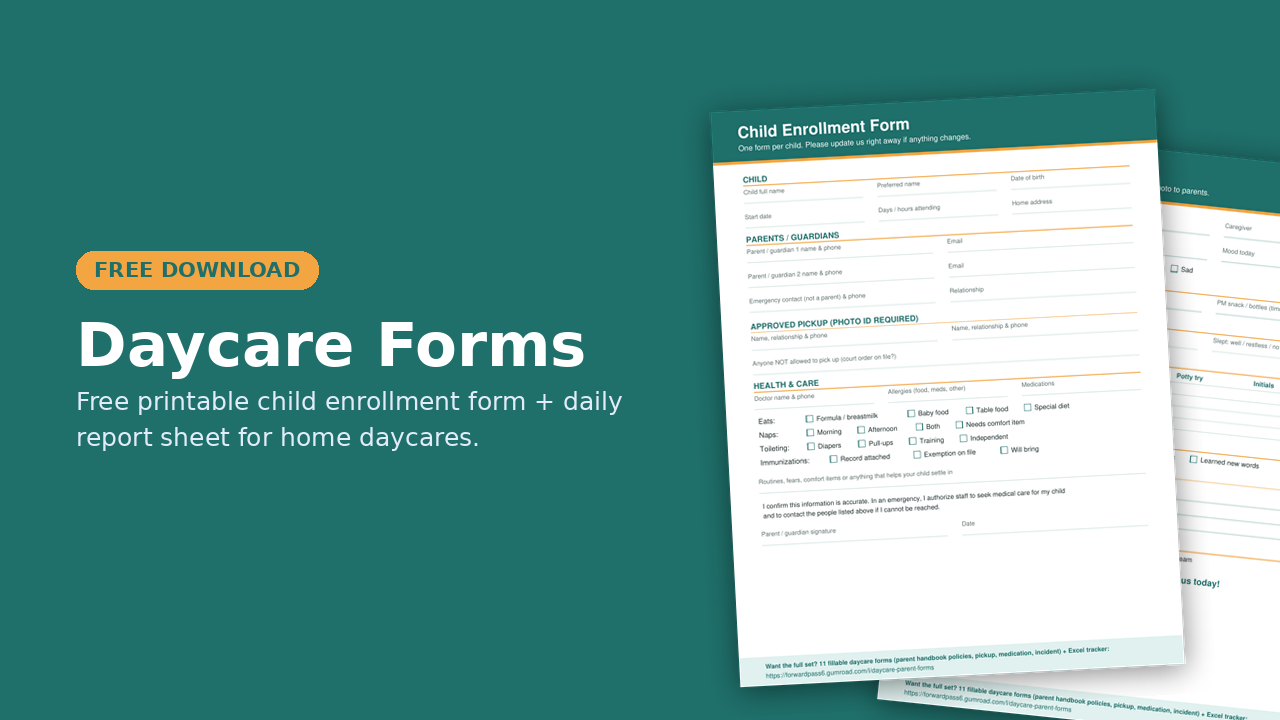
Free Daycare Forms
A printable child enrollment form plus a daily report sheet for parents.
Download free →1. Decide which days you close
Start with a full calendar year, not just December. Families sign up for a year of care, and the clearest programs publish every planned closure for the year at once, then send a reminder before each one. Many programs follow the federal holidays plus a few extra days around Christmas and New Year's, but there is no single standard. Pick the days that fit your family, your staff and the families you serve, then stick to them.
Here are the main US holiday dates for the coming months so you can check which weekday each one falls on. The "your decision" column is for you to fill in.
| Holiday | Date | Weekday | Your decision (examples) |
|---|---|---|---|
| Thanksgiving | Nov 26, 2026 | Thursday | Closed Thu; Fri open, closed or half day |
| Christmas Eve | Dec 24, 2026 | Thursday | Open, early close or closed |
| Christmas Day | Dec 25, 2026 | Friday | Closed |
| New Year's Eve | Dec 31, 2026 | Thursday | Open, early close or closed |
| New Year's Day | Jan 1, 2027 | Friday | Closed |
| Martin Luther King Jr. Day | Jan 18, 2027 | Monday | Open or closed |
| Memorial Day | May 31, 2027 | Monday | Open or closed |
| Juneteenth | Jun 19, 2027 | Saturday | Check whether you observe it on a weekday |
| Independence Day | Jul 4, 2027 | Sunday | Check whether you observe it on Mon Jul 5 |
| Labor Day | Sep 6, 2027 | Monday | Open or closed |
Two things are worth noticing for this season. Christmas Eve and New Year's Eve both fall on a Thursday, and Christmas and New Year's Day both fall on a Friday. That makes it tempting to close two full short weeks, which many parents will not expect. If you do plan to close a full week, say so as early as you can and explain how tuition works for that week. Holidays that land on a weekend, such as Juneteenth and Independence Day in 2027, need a clear line too: either "we observe it on the nearest weekday" or "we are open as usual".
Also decide in advance about the days around the holidays that are not holidays at all, such as the Friday after Thanksgiving or the days between Christmas and New Year's. Attendance is often light on those days, and some providers close or offer a reduced schedule. Whatever you choose, put it in the calendar so it is not a last-minute surprise.
2. Name your closure types
Not every closed day is the same, and parents react very differently to "we are closed for Christmas" than to "we are closed because I am on vacation". Naming each type of closure in your policy lets you set different tuition rules and notice periods for each one, and makes your holiday letter easier to write.
| Closure type | Examples | Who decides | Notice to give (example) |
|---|---|---|---|
| Paid holidays | Thanksgiving, Christmas Day, New Year's Day | Provider, listed in the annual calendar | At enrollment, plus a reminder 2-4 weeks before |
| Provider vacation | A week between Christmas and New Year's | Provider | Example: at least [30] days, ideally at enrollment |
| Early closing days | Christmas Eve, New Year's Eve | Provider | Example: at least [2] weeks |
| Training or planning days | Required training hours, deep cleaning day | Provider | Example: at least [2] weeks |
| Emergency closures | Severe weather, power loss, illness in the provider's home | Provider, as needed | As soon as possible, by your agreed method |
| Family absences | The child is away for a family trip | Parent | Example: at least [2] weeks, in writing |
Family absences are the other half of the holiday picture. Many children miss days in December because the family is travelling. Your policy should say whether a family absence changes tuition. Most programs treat a family absence differently from a provider closure, because the spot is still being held and the provider is still available to care for the child. If your rules are different, state them.
3. Decide how tuition works when you are closed
This is the question parents care about most, and it is where vague policies cause the most friction. There is no single right answer. What matters is that you pick one approach for each closure type, write it into your tuition agreement and apply it the same way for every family.
| Approach | How it works | Good for | Watch out for |
|---|---|---|---|
| Full tuition | Tuition stays the same for listed paid holidays | Predictable income; common for a set number of paid holidays | Needs a clear list and limit so it does not feel open-ended |
| Credit at a daily rate | Each closed day is credited at a daily rate set in the agreement | Provider vacation or extra closure days | Agree the daily rate up front so there is no debate |
| Partial credit | A closed week is billed at a set share of tuition, such as [50%] | Longer provider vacations | Spell out the share and how part weeks are handled |
| No charge for the period | Tuition is paused for a full closed week | Long closures you choose to take | Lower income that month; plan for it |
| Makeup days | Families can use a closed day on another date | Part-time families with flexible schedules | Only offer if you truly have open spots |
A common structure is a fixed number of paid holidays each year at full tuition, plus a clear rule for anything beyond that, such as a credit at a daily rate for provider vacation days. Whatever you choose, list the paid holidays by name in the agreement. "Up to [six] paid holidays per year" is less clear than naming the six days.
Write down how you handle tuition for family absences as well. If tuition stays the same when a child is away, say that plainly in the agreement and remind families in the holiday letter, because December travel is when this question comes up.
4. Set notice timelines and choose how you tell parents
Parents need time to find backup care, especially for full-week closures. Put your notice timelines in the policy and then beat them whenever you can. Use the same channels every time so families know where to look.
| When | What to send | How (examples) |
|---|---|---|
| At enrollment | The full annual closure calendar and tuition rules | Printed calendar in the enrollment packet, signed tuition agreement |
| 4-6 weeks before a holiday stretch | A holiday letter with every closed day, early closing times and tuition notes | Email or app message, plus a printed copy at pickup |
| 2 weeks before | A short reminder of the closed days and early closings | A note on the door or sign-in area, plus a message |
| 2-3 days before | A final reminder, including the early pickup time | Message and a word at pickup |
| On the day (emergency only) | What is happening and when you expect to reopen | Your agreed emergency method, such as a group text |
Ask parents to confirm they received the holiday letter. A quick reply, a signature on a printed copy or a checkbox on your parent app is enough. That one step stops most "nobody told us" conversations before they start.
5. A holiday closure letter to parents (fill-in template)
Keep the letter short, friendly and specific. Parents should be able to read it in under a minute and know exactly which days they need other care for. Replace everything in brackets.
Subject: [Program name] holiday schedule, [date range]
Dear families,
Thank you for a wonderful year with your children. Here is our holiday schedule so you can plan ahead.
Closed: [Thursday, Nov 26 and Friday, Nov 27]; [Thursday, Dec 24 and Friday, Dec 25]; [Thursday, Dec 31 and Friday, Jan 1].
Early closing: [Wednesday, Dec 23] we close at [3:00 PM]. Please pick up by [3:00 PM]; our usual late pickup fee applies after that time.
Tuition: [Thanksgiving, Christmas Day and New Year's Day are paid holidays, so tuition is unchanged. Christmas Eve and New Year's Eve are credited at the daily rate in your tuition agreement.] Tuition is due as usual on [due day].
If your child will be away: please let us know the dates by [date] so we can plan meals and staffing. [Tuition for family absences stays the same, as set out in your agreement.]
Weather: if we have to close for weather, we will message you by [6:30 AM] using [method].
Holiday activities: [We will have a small holiday celebration on Friday, Dec 18. Please tell us about any food allergies or anything your family does not celebrate, and we will plan around it.]
Please reply to confirm you have received this schedule. Thank you, and happy holidays!
[Your name], [Program name], [phone]
Keep a copy of each letter you send with the date and the families who confirmed it. If a question comes up in February about December tuition, you can point straight to it.
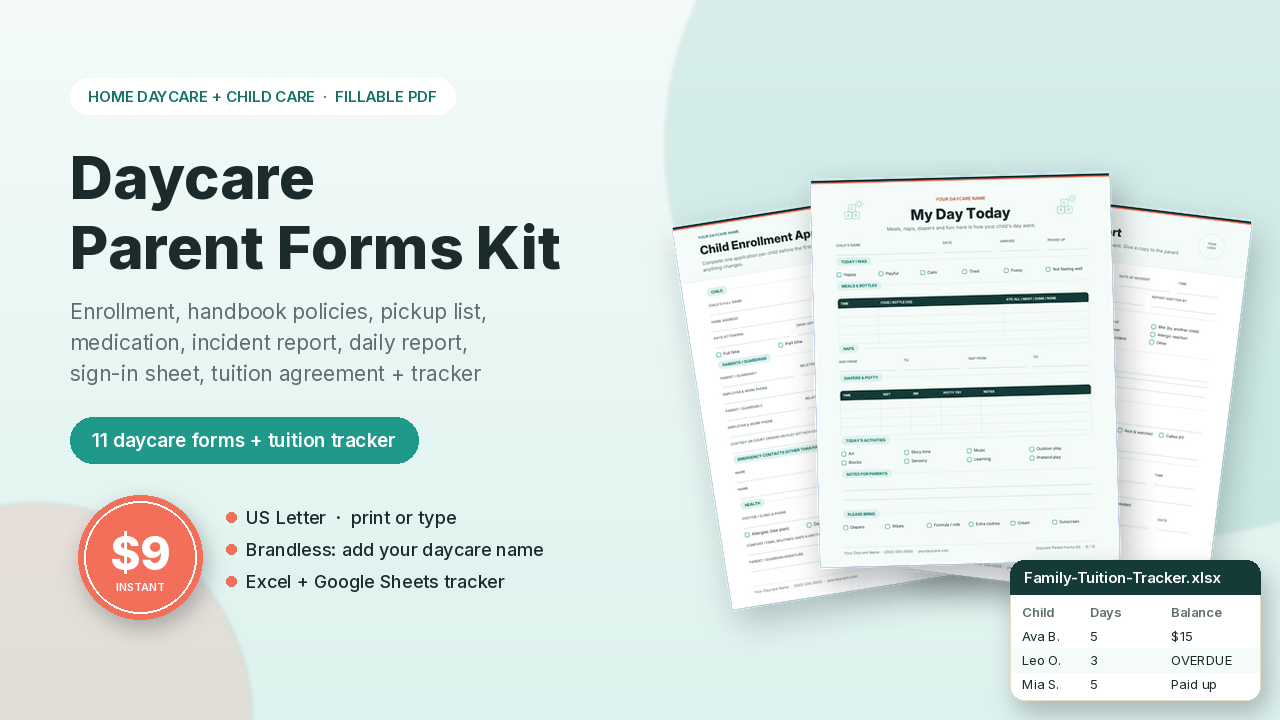
Daycare Parent Forms Kit
12 pages of fillable daycare forms (enrollment, authorized pickup, medication log, allergy plan, incident report, tuition agreement and more) plus an Excel tuition and attendance tracker.
Get it →6. Early closing days and late pickup on holiday eves
Early closing days cause more trouble than full closures, because parents still have to get across town before the cutoff on one of the busiest travel and shopping days of the year. A clear early closing policy helps everyone.
| Decision | Options (examples) | Tip |
|---|---|---|
| Closing time | [12:00 PM], [1:00 PM] or [3:00 PM] | Pick one time and use it for every early closing day |
| Meals | Lunch served or not; snack only | Say so in the letter so parents pack or plan |
| Tuition | Full day, half day or credited | Match what your agreement says for partial days |
| Late pickup | Your usual late fee, or a specific holiday fee | State the fee in the agreement, not just the letter |
| Who can pick up | Only people on the authorized pickup list | Remind families to add anyone new, such as visiting grandparents |
The authorized pickup reminder matters more than usual in December. Relatives visit, schedules change and a different adult may turn up at the door. Ask families to update their pickup list before the holidays rather than calling you from the airport, and follow your normal ID check for anyone you have not met.
Worked example 1: full-time tuition across the holidays
Maria runs a licensed home daycare. A full-time child pays a weekly tuition of [$250] for five days. Her tuition agreement says: the paid holidays of Thanksgiving Day, Christmas Day and New Year's Day are billed at full tuition; any other day she closes is credited at a daily rate of [$50]; family absences do not change tuition.
For the two weeks around Christmas, Maria closes on Thursday Dec 24 and Friday Dec 25, then on Thursday Dec 31 and Friday Jan 1.
| Week | Closed days | Paid holiday | Credited days | Tuition billed |
|---|---|---|---|---|
| Dec 21-25 | Thu Dec 24, Fri Dec 25 | Dec 25 | Dec 24 (1 day x $50 = $50) | $250 - $50 = $200 |
| Dec 28-Jan 1 | Thu Dec 31, Fri Jan 1 | Jan 1 | Dec 31 (1 day x $50 = $50) | $250 - $50 = $200 |
| Two-week total | 4 days | 2 days | 2 days = $100 | $200 + $200 = $400 |
Without the credit rule, the family would pay $250 + $250 = $500 for the two weeks. With it, they pay $400, and the $100 difference matches the two credited days (2 x $50 = $100). One family in Maria's program is also away on Monday Dec 28 for a trip. Because family absences do not change tuition, that day makes no difference to the bill, and the holiday letter already said so.
Example only. Names, prices, dates chosen and policies are made up to show the method. Use your own rates, your own contract and the licensing rules that apply where you work.
Worked example 2: a part-time child and a provider vacation
Devon's small center has a part-time child who attends Monday, Wednesday and Friday for a monthly tuition of [$600]. The agreement sets a daily credit rate of [$45] for provider vacation days and treats Christmas Day as a paid holiday. In December 2026, Devon also takes a short vacation on Monday Dec 28 and Wednesday Dec 30.
| Item | Days | Calculation | Result |
|---|---|---|---|
| Scheduled days in December (Mon, Wed, Fri) | 13 | Mon 7, 14, 21, 28 (4) + Wed 2, 9, 16, 23, 30 (5) + Fri 4, 11, 18, 25 (4) | 13 days |
| Christmas Day (Fri Dec 25) | 1 | Paid holiday, no credit | $0 |
| Christmas Eve and New Year's Eve (Thursdays) | 0 | Not on this child's schedule | $0 |
| Provider vacation (Mon Dec 28, Wed Dec 30) | 2 | 2 x $45 | $90 credit |
| December tuition | $600 - $90 | $510 |
The child attends 13 - 1 - 2 = 10 days in December, and the family pays $510. Notice that the Thursday closures do not affect this family at all, which is why it helps to work out each family's schedule before you send a letter that just says "we are closing four days". Devon adds a line to this family's letter: "Your December tuition will be $510, which includes a $90 credit for the two vacation days."
Example only. Names, prices, dates chosen and policies are made up to show the method. Use your own rates, your own contract and the licensing rules that apply where you work.
7. Holiday-season extras to plan for
The schedule is the main event, but a few other December questions come up every year. Settling them in advance keeps the season calm.
| Topic | What to decide | Where to record it |
|---|---|---|
| Holiday parties and treats | Whether families bring food, and how you handle allergies | Allergy plan, the holiday letter |
| Celebrations and beliefs | How you include families who celebrate differently or not at all | Program handbook, the holiday letter |
| Gifts for providers | Whether you accept gifts; group gift preferences | Handbook (optional) |
| Winter weather | How and when you announce weather closures and how tuition works | Tuition agreement, emergency plan |
| Illness during the season | Your usual sick child and exclusion rules still apply | Enrollment packet, health policy |
| January restart | Any tuition changes, new forms or updated contact details | A short January letter, updated enrollment form |
January is a good time to have every family update their enrollment details: phone numbers, emergency contacts, allergies and authorized pickups. People change jobs and phones over the holidays. Ask for updates on the first day back and record them before the details go stale.
Common mistakes
- Announcing closures too late. A full-week closure announced two weeks before Christmas leaves parents scrambling, and they will remember it.
- Saying "a few paid holidays" without naming them. List each paid holiday by name in the agreement.
- Different rules for different families. Apply the same tuition rule to everyone with the same schedule, or explain exactly why a schedule differs.
- Forgetting part-time schedules. Work out how each closure affects each family's actual days before you send the letter.
- Changing the rules in the letter. The holiday letter should repeat your agreement, not create new tuition rules. Change the agreement first, with proper notice, if you need different rules.
- No proof the letter went out. Ask for a confirmation and keep a record.
- Skipping the pickup list reminder. Holiday visitors are the most likely people to turn up unexpectedly at pickup.
One-page holiday schedule checklist
- Annual closure calendar written, with every paid holiday named.
- Weekday checked for each holiday, plus a rule for holidays that fall on a weekend.
- Closure types named: paid holiday, provider vacation, early closing, training day, emergency.
- Tuition rule for each closure type written into the tuition agreement, including the daily credit rate.
- Family absence rule stated.
- Notice timelines set and the holiday letter sent 4-6 weeks ahead.
- Early closing time, meals and late pickup fee confirmed.
- Each part-time family's affected days and tuition worked out.
- Parents asked to confirm receipt; confirmations recorded.
- Authorized pickup lists, allergies and emergency contacts updated.
- Weather closure method and cutoff time stated.
- January update day planned.
FAQ
Do daycares charge tuition for holidays?
Many do for a set list of paid holidays, but there is no single rule. Choose an approach for each closure type, such as full tuition for named paid holidays and a credit at a daily rate for other closed days, write it into your tuition agreement and apply it the same way for every family.
How much notice should a daycare give for a holiday closure?
Give the full annual closure calendar at enrollment, then send a holiday letter about 4-6 weeks before a holiday stretch and reminders 2 weeks and 2-3 days before. Full-week closures deserve the earliest notice you can give, because parents need time to arrange other care.
Is my daycare open on Christmas Eve and New Year's Eve?
That is your decision. In 2026 both fall on a Thursday. Common choices are to stay open, close early at a set time, or close for the day. Whatever you choose, say so in your holiday letter and explain how tuition and late pickup work that day.
What should a daycare holiday closure letter include?
The exact closed dates, any early closing times and the pickup cutoff, how tuition works for those days, a request for family absence dates, how you will announce weather closures, any holiday activities and allergy notes, and a request for parents to confirm they received it.
Do parents pay if their child is away for the holidays?
It depends on your agreement. Many programs keep tuition the same for family absences because the spot is held and the provider is available. State your rule in the tuition agreement and repeat it in the holiday letter so families know before they travel.
What happens to tuition if a holiday falls on a weekend?
Decide in advance whether you observe it on the nearest weekday or stay open as usual. In 2027, Juneteenth falls on a Saturday and Independence Day on a Sunday, so it is worth adding a clear line to your annual calendar.
This page is general information for home daycare providers and small child care programs, not legal, tax or licensing advice. Child care licensing rules, contract rules and requirements for notice, staffing and records vary by state and locality and can change. Check the current rules where you operate and talk to your licensing agency or a qualified attorney before you change your policies. All names, prices, dates chosen and policies shown are examples only.
Related templates
Free Daycare Forms
A printable child enrollment form plus a daily report sheet for parents.
Download free →Daycare Parent Forms Kit
Enrollment, authorized pickup, allergy plan, incident report, tuition agreement and an Excel tuition and attendance tracker.
Get it →