Daycare Daily Report Sheet: What to Include for Parents (+ Free Template)
A practical guide for home daycare providers, small childcare programs and nannies: what to record for each child every day, how to keep it quick during a busy day, and how to write notes parents actually find useful.
Why a daily report sheet is worth the two minutes
At pickup, most parents ask the same questions: Did she eat? How long did he nap? Any diapers? Was it a good day? When you are handing over several children at the end of a long day, answering from memory is hard, and the parent who picks up while you are settling another child gets a rushed answer. A short daily report sheet answers those questions in writing, the same way every day, for every child.
For parents of babies and toddlers, the sheet is often the only window into a day they missed. Knowing when the last bottle was and how long the afternoon nap lasted helps them plan the evening. For you, the sheet shows that the day was organized and that small things (a long nap, a skipped lunch, a diaper rash starting) were noticed and passed on. Over time it builds trust, which matters as much as tuition and policies in keeping families with you.
This guide covers what to include, how the sheet differs for infants, toddlers and older children, and how to fill it in without taking time away from the children. It is not about enrollment paperwork, which is collected once at the start and covered in our daycare enrollment form guide, or about tuition, covered in how much to charge for home daycare. If you are a parent leaving instructions for a sitter, the opposite direction, see the babysitter information sheet.
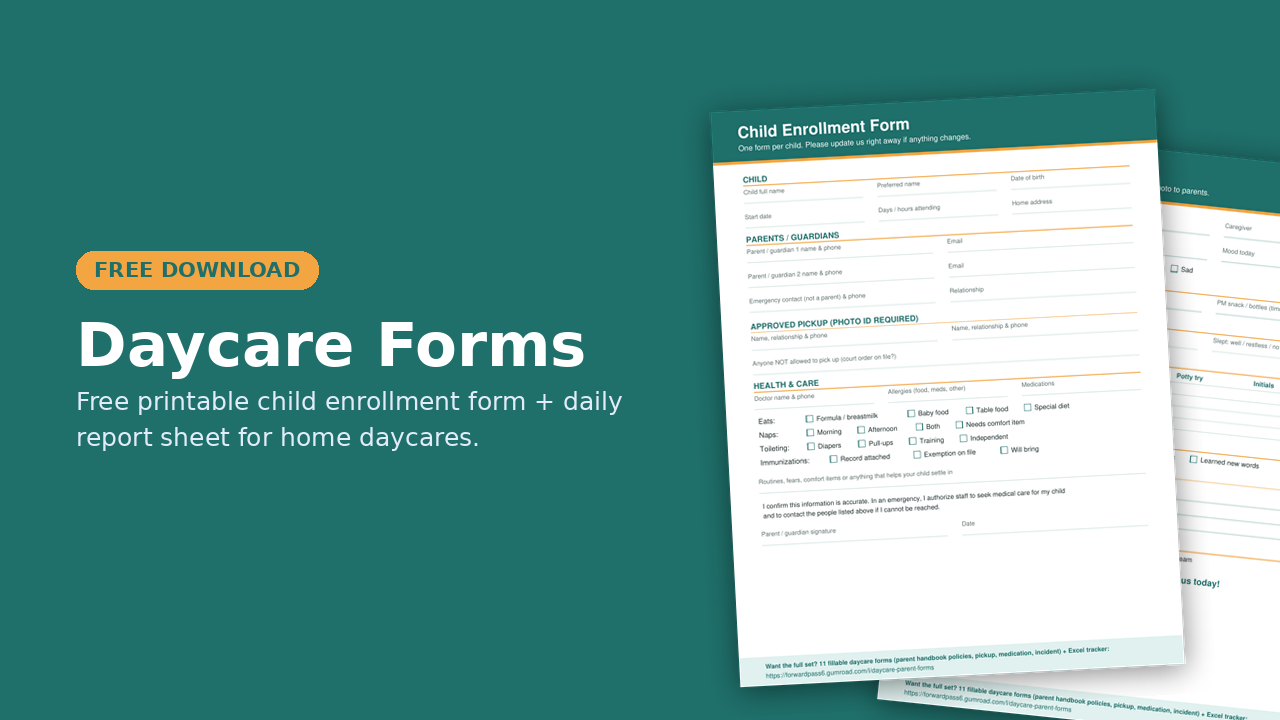
Free Daycare Forms
A printable child enrollment form plus a daily report sheet for parents.
Download free →1. The basics at the top
Start every sheet with the same few lines so parents and staff can find what they need quickly:
- Child’s name and date
- Arrival time and who dropped off
- Pickup time and who picked up
- Anything the parent told you at drop-off (a bad night, teething, a different pickup person, a medication note)
- Initials of the provider or staff member who completed the sheet
The drop-off note is easy to skip but very useful. If a parent says the child slept badly, writing it down means everyone caring for the child that day knows, and the afternoon entries make more sense to the parent later. If someone other than the usual parent will collect the child, check them against the authorized pickup list on file; the daily sheet records what happened but is not a replacement for that list or for your licensing rules on releasing children.
Keep arrival and pickup times consistent with your attendance record. If you bill by attendance or late pickup, a time on the daily sheet that does not match the sign-in sheet invites questions.
2. Meals, snacks and bottles
Food is the section parents read first. Record each meal or snack with the time, what was offered and roughly how much was eaten. You do not need to weigh anything; simple words or a tick box (all, most, some, none) are enough. For babies, note the time and amount of each bottle or nursing feed, and whether it was breast milk or formula if the family provides both.
| Instead of | Write something like |
|---|---|
| Lunch: OK | 12:00 lunch: pasta, peas, apple. Ate most of the pasta, no peas, all the apple. |
| Bottle | 9:30 bottle, 5 oz breast milk, finished. 1:15 bottle, 3 of 5 oz, fell asleep. |
| Didn’t eat much | Ate very little at lunch and snack; said tummy hurt. Drank water fine. Mentioned at pickup. |
| Snack | 3:00 snack: crackers and cheese, ate all, asked for more. |
Example entries only; use your own wording and units.
Add a line for drinks if the child is old enough for a cup, and note any food that came from home versus food you provided. Follow each child’s allergy plan and any feeding instructions from the parents or the child’s doctor; the daily sheet is a record, not the place where allergy plans or special diets are set. Where your program participates in a food program or has licensing requirements about menus and meal records, keep those records as required; the daily sheet does not replace them.
3. Naps and rest
Record when each nap started and ended. For infants who nap several times a day, a simple row per nap works well. Parents use these times to plan bedtime, so accuracy matters more than detail. A note such as “hard to settle, slept after 20 minutes” or “woke early from noise” helps them understand an overtired evening.
For infants, follow current safe sleep guidance and the safe sleep rules in your licensing requirements, and record sleep in whatever way your rules require. Some programs keep separate sleep check records for infants; the daily sheet can show nap times for parents without replacing those checks. If a child did not nap at all, say so plainly rather than leaving the section blank, so parents do not assume you forgot to fill it in.
4. Diapers, potty and toileting
For children in diapers, record the time of each change and whether it was wet, dirty or both. Note anything unusual factually, such as a rash, very loose stools or no wet diaper for a long stretch, so parents can decide whether to follow up with their doctor. Avoid medical conclusions; describe what you saw.
For children who are potty training, parents usually want to know about successes, accidents and whether the child asked to go. Keep the tone neutral and encouraging; the sheet will often be read in front of the child. A tick box for each attempt and a short line for accidents is plenty. If you are running low on diapers, wipes, cream or spare clothes, this is a good place to say so, or use the supplies section below.
5. Mood, activities and the day in a sentence
Parents love hearing what their child actually did. A short list of activities (outdoor play, painting, story time, blocks, music, a walk) and one or two sentences about the day turn a form into something families look forward to reading. Specific details are best: “Built a tall tower with Sam and was very proud of it” tells a parent far more than “Good day.”
A simple mood scale or set of faces can work for younger children, but add words if anything stood out, positive or not. Note new milestones carefully; some parents want to see the first steps themselves, so many providers mention “getting very close to walking” rather than announcing it. Keep comments about behavior factual and kind, and save longer conversations about ongoing concerns for a private talk rather than the daily sheet.
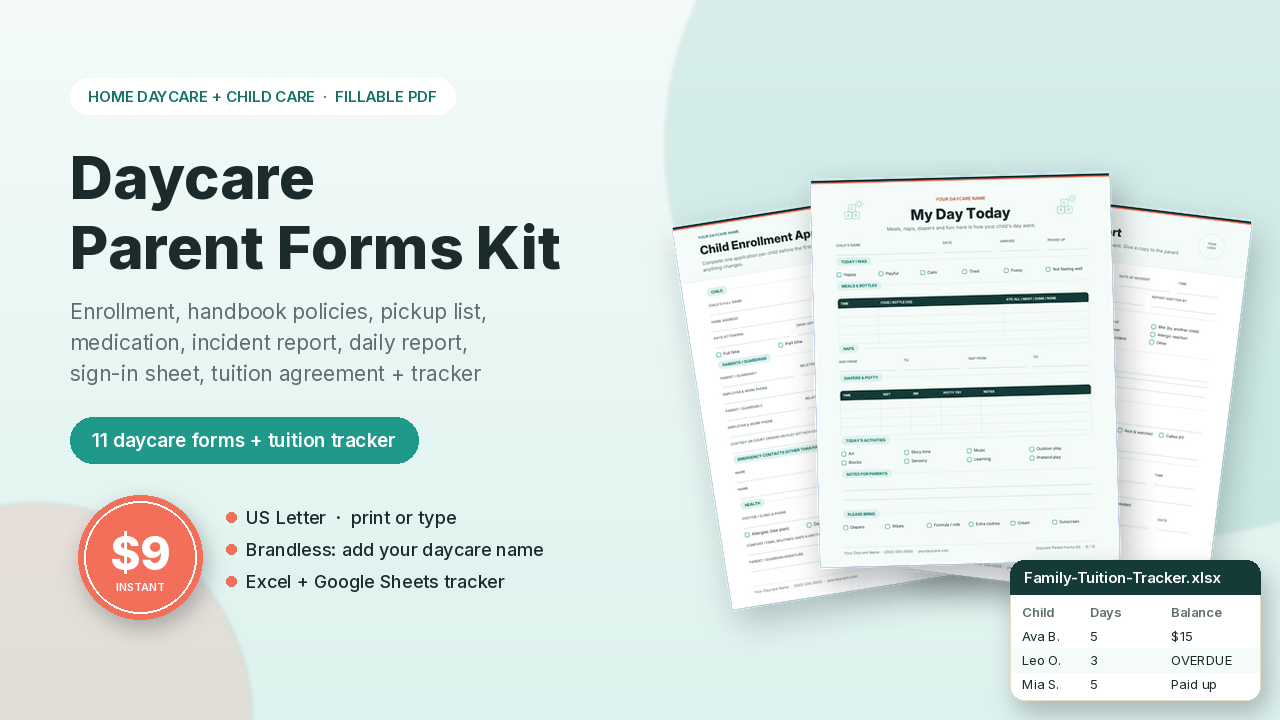
Daycare Parent Forms Kit
12 pages of fillable daycare forms (enrollment, authorized pickup, medication log, allergy plan, incident report, tuition agreement and more) plus an Excel tuition and attendance tracker.
Get it →Infant, toddler and preschool sheets compared
One sheet layout can cover every age, but most providers find it easier to use a slightly different version for babies and older children.
| Section | Infants | Toddlers | Preschool and school-age |
|---|---|---|---|
| Feeding | Each bottle or feed: time, amount, type | Meals and snacks: what and how much | Meals and snacks, briefly |
| Sleep | Every nap: start and end | One or two naps: start and end | Rest time, or “no nap” |
| Diapers / potty | Each change: wet, dirty, both | Changes plus potty attempts | Usually only accidents or concerns |
| Activities | Tummy time, play, outdoors | Activities and a highlight | Activities, learning theme, a highlight |
| Supplies | Diapers, wipes, formula, bottles | Diapers, wipes, spare clothes | Spare clothes, weather gear, forms |
Example layout only; adjust to your program, ages and licensing rules.
6. Supplies needed and notes for parents
A short “please bring” section saves many reminders: diapers, wipes, diaper cream, formula or breast milk, spare clothes, a sun hat or winter gear. Tick boxes make it quick. Add a free-text notes line for anything parents need to know or act on: a reminder about a closure day, a form that needs signing, or something the child was excited about that the parent could ask about at home.
Keep important policy messages (tuition changes, schedule changes, illness policy reminders) out of the daily sheet or repeat them in a separate written notice. A message on one child’s sheet can easily be missed, and it is better to have one clear record that every family received the same information.
7. Medication, incidents and health notes
The daily sheet can show that something happened, but the details belong on dedicated forms:
- Medication: if you give medication, record each dose on a medication log with the parent’s written authorization, following your licensing rules on what you may give and how. On the daily sheet a line such as “Medication given, see medication log” is enough.
- Injuries and incidents: bumps, scrapes, bites and falls should be written up on an incident report that the parent reads and signs, following your program’s procedures and any reporting rules that apply. The daily sheet can say “Incident report attached.”
- Illness: if a child seems unwell, follow your illness policy, contact the parents as your policy says, and note the facts on the sheet (time, what you observed, who you contacted). In an emergency, call your local emergency number first.
| Situation | Daily sheet | Separate record |
|---|---|---|
| Fever-reducer given with parent’s written permission | “Medication given 1:30, see log” | Medication log: name, dose, time, initials |
| Fell in the yard, scraped knee | “Scraped knee 10:15, cleaned, incident report attached” | Incident report signed by the parent |
| Seemed warm and tired after nap | Facts observed, time parent was contacted | As your illness policy requires |
| Bitten by another child | “Incident report attached” | Incident report (follow your policy on what you share about the other child) |
Example only. Follow your licensing rules, program policies and any instructions from the child’s doctor.
Paper, printable or app?
Many home providers still use a printed sheet per child, filled in through the day and sent home at pickup, sometimes with a photo of it texted to the parent. Paper is cheap, works without signal and is easy for any helper to use. The downside is that it can get lost in a bag and you do not keep a copy unless you photograph it or use a two-part form.
Shared documents and childcare apps make the information available to parents during the day and keep a history automatically, but they take setup time and cost money in some cases, and a phone in your hand during care has its own drawbacks. Whatever you choose, use the same layout every day so parents know where to look, and decide how long you keep copies. Licensing rules in some places specify which records must be kept and for how long, so check what applies to you.
Keep it fast during a busy day
- Keep a clipboard or binder with every child’s sheet in one spot you pass often, such as near the changing area or kitchen.
- Fill in meals, naps and diapers as they happen rather than at the end of the day; memories blur fast with several children.
- Use tick boxes and short words for routine items, and save full sentences for the highlight and anything unusual.
- Pre-fill names and dates for the week each Monday.
- Write the “day in a sentence” during quiet time or nap time, not during pickup rush.
- If you have a helper, agree who completes which section, and ask everyone to initial their entries.
Privacy and tone
Each sheet is about one child, so write only about that child. When an entry involves another child (a shared game, a disagreement, a bite), describe it without naming the other child. Parents may photograph or share the sheet, and other families have a right to privacy too.
Write as if the child, the parent and a licensing visitor may all read it. Avoid labels such as “naughty” or “difficult,” and describe behavior instead: “had a hard time sharing the trucks this morning; we practiced taking turns.” Keep sheets in a private place, not on a board where visitors can read them, and follow any privacy rules that apply to childcare records where you work.
Common mistakes
- Leaving sections blank, so parents cannot tell whether nothing happened or nobody wrote it down.
- Writing “good day” every day, which tells parents nothing and starts to feel automatic.
- Filling the whole sheet from memory at pickup time.
- Times that do not match the sign-in sheet or attendance record.
- Putting medication or injury details only on the daily sheet instead of a medication log or incident report.
- Naming other children in an incident or behavior note.
- Using the sheet for policy changes that every family needs to see.
- Using a different layout each week, so parents never know where to look.
One-page checklist
- Child’s name, date, arrival and pickup times, who dropped off and picked up
- Drop-off notes from the parent
- Meals, snacks and drinks, with roughly how much was eaten
- Bottles or feeds for infants: time, amount, type
- Nap start and end times, or “no nap”
- Diaper changes or potty attempts and accidents
- Mood, activities and one specific highlight
- Supplies needed from home
- Notes for parents, plus references to any medication log or incident report
- Initials of whoever completed each section
- A copy kept, if your records policy or licensing rules require it
FAQ
What should a daycare daily report include?
At minimum: arrival and pickup times, meals and snacks with roughly how much was eaten, nap times, diaper changes or potty use, a few words on mood and activities, supplies needed and any notes for parents. For infants, add each bottle or feed with time and amount.
Do home daycares have to send daily reports?
It depends on where you are and the ages you care for. Some licensing rules require certain daily records for infants and toddlers, and many programs send daily reports anyway because parents expect them. Check your local licensing requirements and decide what to include in your parent handbook.
Is a daily report sheet the same as an enrollment form?
No. The enrollment form is filled in once by parents when a child starts and collects contacts, health information, pickup permissions and consents. The daily report sheet is completed by the provider every day and records what happened that day.
Should I record medication and injuries on the daily sheet?
Mention them briefly, but keep the details on a medication log and an incident report, which parents read and sign as your policies and licensing rules require. The daily sheet then simply points parents to those records.
How do I write about behavior problems on a daily report?
Describe what happened and how you handled it in neutral, specific words, and leave out other children’s names. If a pattern is developing, talk to the parents privately rather than repeating it on the sheet each day.
Should I keep copies of daily report sheets?
Many providers keep a copy or a photo, and some licensing rules specify which records must be kept and for how long. Decide your own policy, check the rules that apply where you operate, and store copies privately.
This page is general information for childcare providers, not legal, medical or licensing advice. Childcare licensing, record keeping, safe sleep, medication and privacy rules vary by location and by type of program. Check the requirements that apply where you operate, follow each child’s care instructions from their parents and doctor, and in an emergency contact your local emergency services.
Related templates
Free Daycare Forms
A printable child enrollment form plus a daily report sheet for parents.
Download free →Daycare Parent Forms Kit
Fillable enrollment, pickup, medication, incident and tuition agreement forms plus an Excel tuition and attendance tracker.
Get it →