Tutoring Intake Form: What to Ask Parents and Students Before the First Session
A practical guide for private tutors: the questions to ask every new family before the first session, how to turn the answers into a learning plan and schedule, and the forms to collect before you start teaching.
Why every new tutoring student needs an intake form
Most tutoring relationships that go wrong do so in the first two weeks. The parent expected a jump from a C to an A before the next report card, the student thought sessions were optional, nobody mentioned the extended-time accommodation on tests, or the "quick online session" turned into twenty minutes of fixing a microphone. A short intake form, sent before the first session, collects the details that decide what you teach, how you teach it and how you report progress.
It also tells parents that you run a serious, organized service. Families compare tutors, and the one who asks good questions up front usually looks more trustworthy than the one who simply shows up. Below are the sections to include, the questions in each, and how to turn the answers into a plan for the first month.
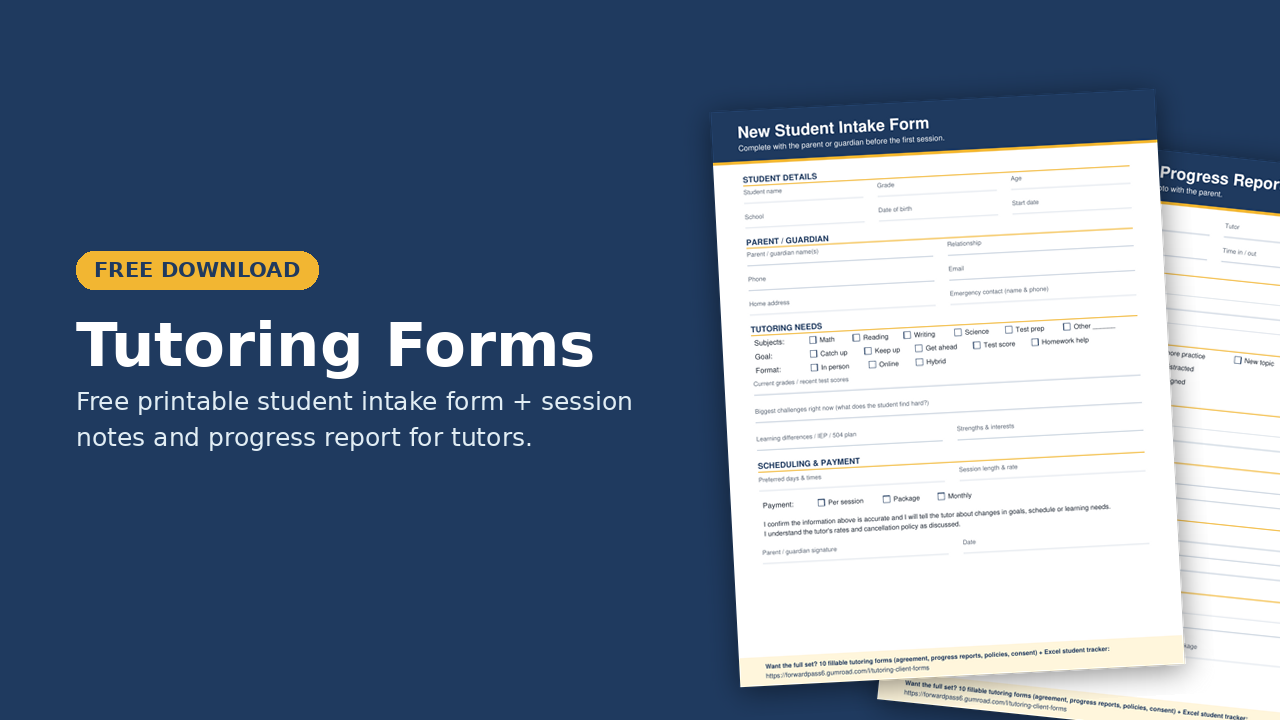
Free Tutoring Forms
A printable new student intake form plus a session notes and progress report sheet for private tutors.
Download free →Section 1: Student and parent contact details
- Student full name, preferred name and pronouns if they want to share them
- Student age and date of birth (or just grade, if you prefer to collect less)
- Parent or guardian names, phone numbers and email addresses
- Which parent is the main contact, and who is allowed to schedule or cancel
- Who is paying, and the billing email if different
- Emergency contact for in-person sessions
- Student's own phone or email, only if the parent approves contacting the student directly
- How they heard about you
For students under 18, decide in advance whether you message the student, the parent or both, and write it down. Many tutors copy a parent on every message to a minor student, which keeps communication transparent.
Section 2: Grade, school, subjects and goals
- Current grade and school (or homeschool program and curriculum)
- Subjects and specific courses (for example "Algebra 1", not just "math")
- Textbook, online platform or course syllabus the class uses
- Main reason for tutoring: catching up, keeping up, getting ahead, test prep or homework support
- The parent's goal and the student's goal, asked separately
- A measurable target and a date, such as a unit test, report card or exam
- What has already been tried (previous tutors, school help sessions, apps)
Asking the parent and the student for their goals separately is one of the most useful questions on the whole form. When the answers differ, you learn about motivation before the first session instead of halfway through the term.
Section 3: Learning needs and accommodations
- Does the student have an IEP, 504 plan or other school support plan?
- Which accommodations does the school use (extended time, breaks, read-aloud, calculator, reduced workload)?
- Would the parent like to share relevant parts of the plan with you?
- How does the student say they learn best: examples, practice problems, visuals, talking it through?
- Attention, focus or anxiety patterns the parent wants you to know about
- Anything that tends to frustrate or shut the student down
- Strategies that already work at school or at home
Keep this section optional and respectful. You are not diagnosing anything. If a student has a plan from the school, follow the accommodations the school and family have already set, and coordinate with teachers through the parent when it helps. If a parent raises concerns about a possible learning difference, suggest they speak with the school or a qualified professional rather than offering an opinion yourself.
Section 4: Current grades, tests and baseline
| Question | Why it matters |
|---|---|
| Current grade or percentage in each subject | Shows how big the gap is |
| Recent test or quiz results (photos are fine) | Reveals which topics are actually weak |
| Upcoming tests, projects and deadlines | Sets your first priorities |
| Standardized tests planned (state tests, SAT, ACT, AP) | Changes the plan and session length |
| Teacher comments or progress reports | Gives an outside view of the problem |
| Homework completion: on time, late or missing | Separates skill gaps from organization gaps |
Ask permission to see the online gradebook or recent graded work. Ten minutes looking at actual tests usually tells you more than any description. Plan a short baseline check in the first session too, so you can show measurable progress later.
Section 5: Schedule, location and online setup
- Preferred days and time windows, and how often (weekly, twice weekly, before tests only)
- Session length: 45, 60 or 90 minutes
- Start date and whether tutoring continues over school breaks and summer
- Location: your space, the student's home, a library or online
- For in-home sessions: address, parking, who will be home, pets
- For online sessions: device, webcam, microphone, internet reliability and a quiet space
- Video platform and whiteboard tool you will use, and whether the student has used them
- Known busy weeks: sports seasons, holidays, exam periods
For online students, a five-minute tech check before the first paid session saves a lot of frustration. Ask for a pen-and-paper or a writing tablet for math, since typing equations slows everything down.
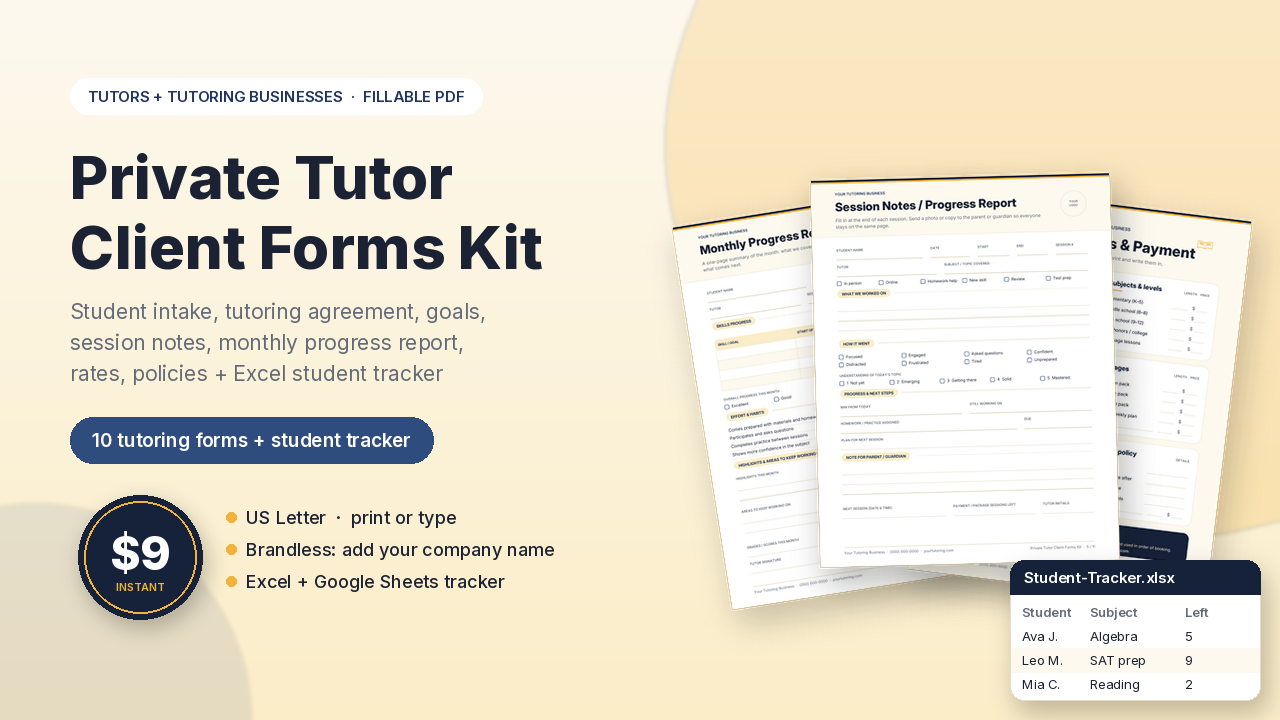
Tutoring Client Forms Kit
10 fillable forms (student intake, tutoring services agreement, learning goals and baseline assessment, session notes, monthly progress report for parents, homework tracker and more) plus an Excel student tracker with package sessions left.
Get it →Section 6: Parent communication preferences
- Preferred channel: email, text or a parent portal
- How often they want updates: after each session, weekly or monthly
- What a good update includes for them: topics covered, homework, concerns, scores
- Whether they want to sit in on the first session or a short check-in at the end
- Whether you may contact the teacher, and through whom
- Best time to reach them for scheduling changes
Agree on a simple rhythm such as a two-line note after each session and a short progress report each month. Parents who hear from you regularly are much less likely to cancel when progress feels slow.
Section 7: Policies preview
End the intake form with a short preview of your policies so nothing in the agreement surprises the family. Example placeholder wording only; write your own terms and have them reviewed for your location.
| Policy | Placeholder wording |
|---|---|
| Rates and packages | [Sessions are ___ per ___ minutes, or a package of ___ sessions for ___.] |
| Payment | [Payment is due ___ by ___.] |
| Cancellation | [Cancellations with less than ___ hours notice are billed ___.] |
| Late arrival | [Sessions start on time; late arrivals end at the scheduled time.] |
| Package expiry | [Package sessions expire ___ after purchase.] |
| Communication | [Messages to students under 18 include a parent / guardian.] |
The full terms belong in your tutoring agreement. For setting the numbers, see how much to charge for tutoring.
Turning the answers into a plan (example only)
| Intake answer | What it changes in the plan |
|---|---|
| Grade 9, Algebra 1, C average, unit test in 3 weeks | Weekly 60-minute sessions focused on the test topics first |
| 504 plan with extended time and breaks | Build short breaks into sessions; practice tests use the same timing the school allows |
| Parent goal: B on report card; student goal: less homework stress | Track grades and add a homework planning routine |
| SAT in the spring | Separate test-prep block later; see SAT pricing |
| Online, shared laptop, weak Wi-Fi | Tech check, phone backup plan, worksheets sent ahead |
| Parent wants weekly email updates | Short note after each session plus a monthly report |
These rows are illustrations, not recommendations for any particular student. Build each plan from your own assessment and the family's goals.
Using the intake form in the first session
The intake form is only useful if it changes what happens in the first lesson. Before you meet, read it once and write three things on a single page: the student's next deadline, the two or three topics that look weakest from their recent work, and anything you need to do differently because of accommodations or communication preferences. That page becomes the agenda.
Spend the first five minutes on the student, not the subject. Ask what they think is going well, what feels hardest, and what a good result would look like by the end of the term. Students who feel heard in the first session tend to engage more in the next ten. Then run a short baseline check of ten to fifteen minutes using problems from their actual course, and teach one small topic properly so the family sees real progress on day one.
Finish with a two-minute summary for the parent: what you covered, what you noticed, the plan for the next few weeks and what the student should practice before the next session. Save the intake form, your baseline notes and that summary together. When you send your first monthly progress report, you can compare against the baseline instead of relying on memory, which makes progress easy for parents to see and makes renewing a package an easy decision.
Common mistakes and a one-page checklist
- Starting sessions without seeing recent graded work or test results
- Only asking the parent for goals, never the student
- Not asking about IEP or 504 accommodations, then practicing under conditions the student never faces at school
- Leaving the cancellation and package rules vague until the first missed session
- Messaging a minor student privately without a clear parent agreement
- Skipping the online tech check
- Promising a specific grade or score
Checklist before the first session: intake form returned; main parent contact confirmed; subjects, courses and goals listed; accommodations noted (if shared); recent grades or tests reviewed; schedule and location set; online setup tested; update rhythm agreed; agreement signed; first payment or package received.
FAQ
What should a tutoring intake form include?
Student and parent contact details, grade, school, subjects and goals, learning needs and accommodations, current grades and upcoming tests, schedule and location or online setup, communication preferences, and a short preview of your policies.
Should I ask about IEPs and 504 plans?
Yes, as an optional question. Knowing the accommodations a student uses at school helps you practice under the same conditions. Follow the plan the school and family have set and do not try to diagnose or treat anything yourself.
Who should fill out the intake form, the parent or the student?
For younger students, the parent. For middle and high school students, have the parent complete contact, billing and policy sections and ask the student to answer the goals and learning-style questions in their own words.
When should I send the intake form?
After the family books a consultation or first session, and at least a day or two before you meet, so you have time to review grades and plan the first lesson.
Is an intake form the same as a tutoring agreement?
No. The intake form collects information. Rates, payment, cancellation, package and communication terms belong in a separate signed agreement.
How do I keep student information private?
Collect only what you need, store forms securely, share details only with the parent's permission, and delete records you no longer need. Check any privacy rules that apply where you work.
This page is general information for private tutors, not legal, educational-compliance or medical advice. Rules on working with minors, background checks, privacy and business licensing vary by location, so check local requirements and have your own forms and agreement reviewed.
Related templates
Free Tutoring Forms
A printable new student intake form plus a session notes and progress report sheet for private tutors.
Download free →Tutoring Client Forms Kit
10 fillable tutoring forms (intake, agreement, progress report, session notes) plus an Excel student tracker.
Get it →