Tutoring Progress Report: What to Include for Parents (+ Free Template)
A practical guide for private tutors and small tutoring businesses: what to record after each session, how to turn those notes into a short monthly progress report, and how to write about slow progress honestly and kindly.
Why tutors should send progress reports
Parents pay for tutoring because they want to see a change: a better grade, a passed test, less stress at homework time. But they are rarely in the room. Between sessions, most of what they know comes from a quick chat at pickup or a one-word answer from their child. A short, regular progress report fills that gap. It shows what you worked on, what has improved, what still needs work and what happens next.
Reports also help you. Writing a few lines after each session forces you to plan the next one, and a monthly summary makes it obvious when a student has stalled and the plan needs to change. When a parent asks whether tutoring is worth continuing, you can point to specific skills and results rather than a general impression. And clear, professional updates are one of the reasons families renew packages and recommend you to friends.
This guide is about the ongoing report: session notes plus a short monthly summary. It is not about the first conversation with a new family, covered in our tutoring intake form guide, or about your terms, payment and cancellation rules, covered in the tutoring agreement template. For rates and packages, see how much to charge for tutoring and SAT tutoring rates.
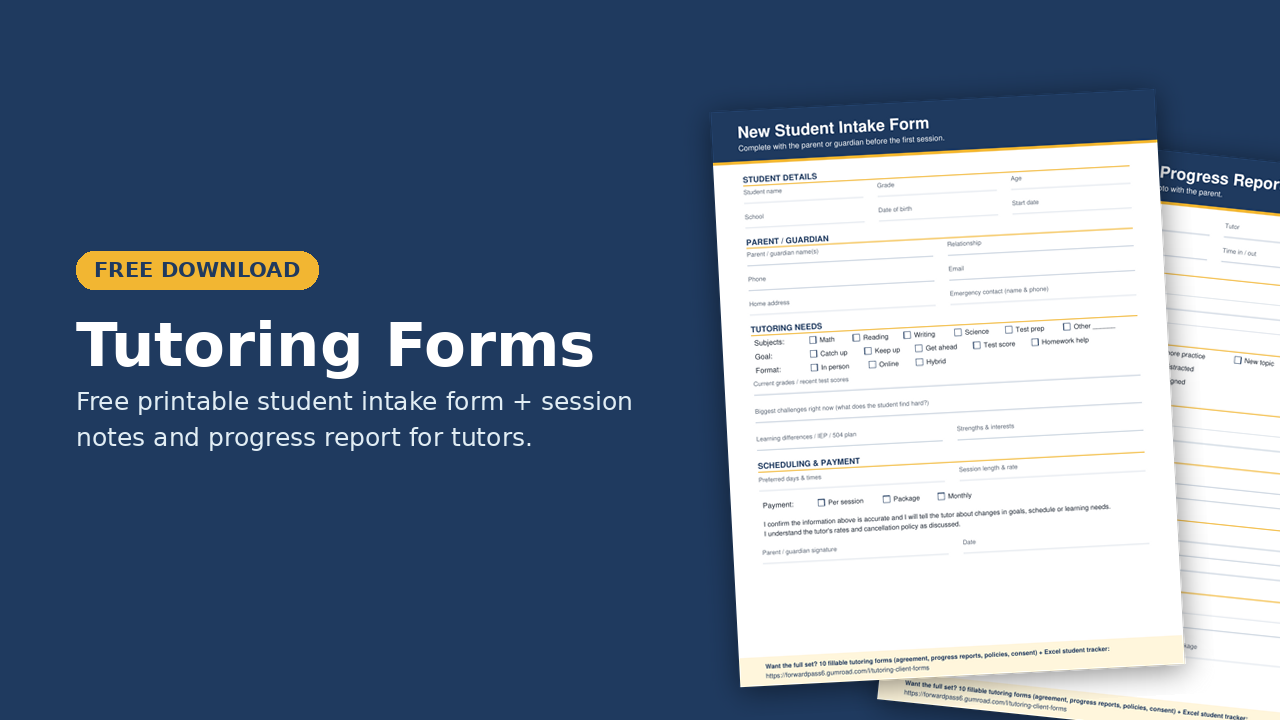
Free Tutoring Forms
A printable new student intake form plus a session notes and progress report sheet for private tutors.
Download free →1. Start with session notes
A good monthly report is built from good session notes. Spend two or three minutes at the end of each session recording the same few things:
- Date, start and end time, in person or online
- What you worked on (topic, chapter, skill, test section)
- What went well and where the student got stuck
- Homework or practice set, and whether last week’s was done
- Plan for next session
Keep notes factual and specific. “Worked on fractions” is hard to build on a month later. “Adding fractions with unlike denominators: 6 of 8 correct by the end, still forgets to simplify” tells you exactly where to start next time.
| Instead of | Write |
|---|---|
| Good session | Finished practice set on comma rules; got 9 of 10, explained the one mistake herself |
| Struggled with reading | Main idea questions: picked supporting details instead of the main idea on 3 of 5 passages; practiced underlining topic sentences |
| Did homework | Homework done; 2 errors on word problems, both from misreading the question |
| Test prep | Timed math section 1: finished with 4 minutes left, missed questions mostly geometry |
Example entries only. Record what you actually observed, and keep notes for each student separate and private.
2. The basics at the top of the report
The monthly report should open with a few lines a parent can scan in seconds:
- Student name, grade and subject(s)
- Reporting period (for example, the month or a block of sessions)
- Sessions scheduled, attended, cancelled and rescheduled
- Sessions remaining in the current package, if you sell packages
- Your name and how to reach you
Keep attendance consistent with your invoices and package tracking. If a session was missed under your cancellation policy, say so plainly and neutrally. Parents generally prefer one clear record to a surprise when the package runs out.
3. Goals and where the student is now
The heart of the report is a simple comparison: what we set out to do, where the student started and where they are now. This is why a baseline at the start matters. If you recorded a starting point during intake (a recent grade, a diagnostic quiz, a practice test score, a reading level from the school), you can show change honestly instead of relying on memory.
Write two to four goals in plain language and give each one a short status: on track, improving, needs more time, achieved. Use the student’s own work as evidence where you can, such as a quiz score, a timed practice result or a skill they can now explain on their own.
| Goal | Starting point | Now | Status |
|---|---|---|---|
| Solve two-step equations without help | Needed a prompt on most problems | Solves most independently; occasional sign errors | Improving |
| Write a clear thesis statement | Thesis often restated the prompt | Drafts an arguable thesis with one revision | On track |
| Finish timed reading section | Ran out of time on the last passage | Finishes with a few minutes to spare on practice tests | Achieved |
| Memorize multiplication facts 6–9 | Slow on 7s and 8s | 7s solid, 8s still slow | Needs more time |
Example only. Use your own baseline and results; do not estimate scores you have not measured.
4. Skills covered this period
Give a short list of what you actually taught or practiced, grouped by topic. Parents do not need every worksheet, but they do like to see how tutoring connects to what is happening in class. If you have the class syllabus or the teacher’s upcoming unit list, mention how your sessions lined up with it.
A short bullet list works well: “Linear equations and inequalities; graphing lines from slope-intercept form; review for the unit test on the 14th.” For test prep, list the sections and question types you covered.
5. Homework, practice and effort
Note whether practice between sessions is happening, because it often explains progress better than anything else. Keep the tone factual, not judgmental: “Practice sets completed 3 of 4 weeks” is more useful than “needs to try harder”. If missing practice is holding things back, suggest something concrete and small, such as ten minutes of flashcards on school nights.
Effort and confidence are worth a line too. Many parents care as much about a child who now asks questions in class, or no longer melts down over homework, as they do about a grade. Describe what you saw: “Starts problems on his own now instead of waiting for a hint.”
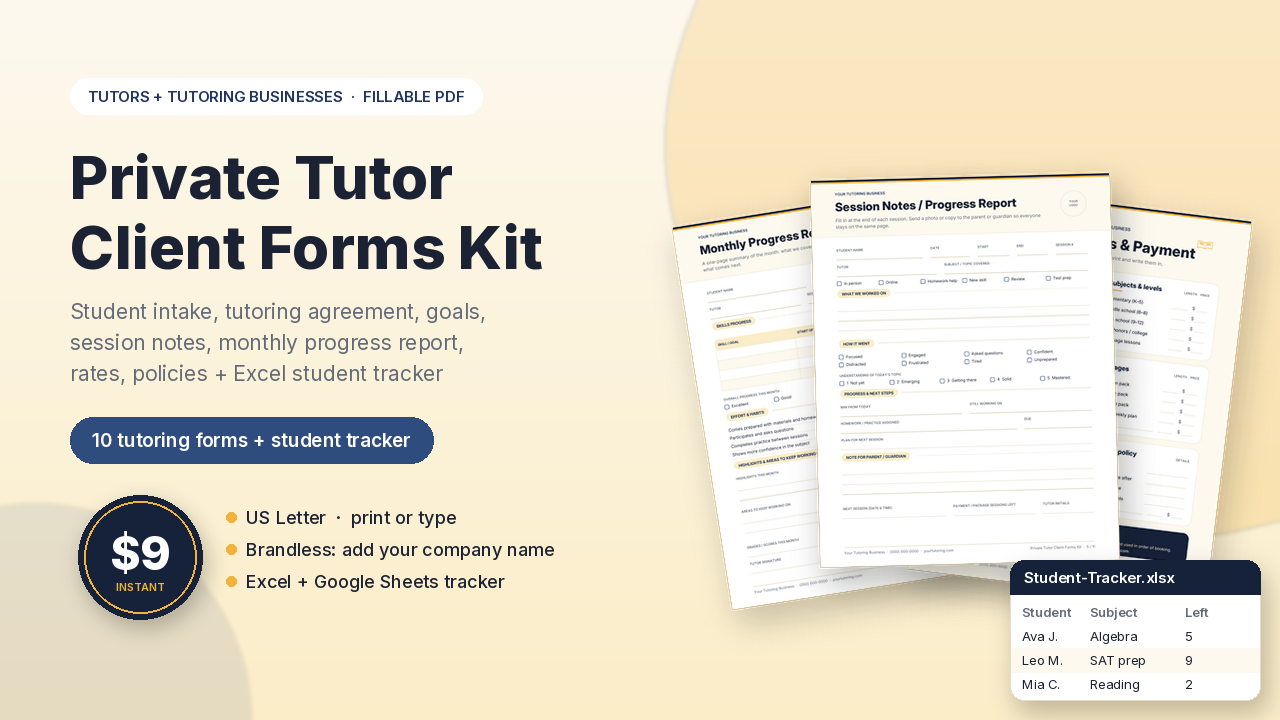
Tutoring Client Forms Kit
10 fillable forms (student intake, tutoring services agreement, learning goals and baseline assessment, session notes, monthly progress report for parents, homework tracker and more) plus an Excel student tracker with package sessions left.
Get it →6. School grades and test results
If the parent shares report card grades, test results or teacher comments, you can reference them, but be careful about what you claim. Grades depend on many things outside tutoring, including the teacher, the unit and the student’s week. Write what happened and what you will do about it rather than taking credit or blame: “Unit test grade went up from the last test; we will keep working on word problems, which were most of the points lost.”
Only use school information the family has chosen to share with you, and do not contact the school or teacher unless the parent has asked you to and agreed how. If the student has an IEP, 504 plan or other accommodations, follow what the family has told you and keep that information private.
7. Next steps and what parents can do
End every report with a short plan for the next period: two or three focus areas, any upcoming tests you will prepare for, and whether you recommend changing anything (more sessions before an exam, fewer sessions once a goal is met, a different focus). Be honest if you think the student no longer needs as much help. Families remember that and refer you for it.
Add one or two simple, optional ways parents can help at home, like checking that practice is done, asking their child to explain one problem out loud, or keeping a quiet place for online sessions. Keep it light; parents are not your co-teachers.
Writing about slow progress
Every tutor eventually writes a report where the honest answer is “not much has changed yet”. Avoid hiding it in vague praise, and avoid making it the student’s fault. Describe what you see, what you think is getting in the way, and what you will try next.
| Situation | What to write |
|---|---|
| Steady effort, little change in grades yet | What has improved in the work itself, why grades may lag, and the next focus area |
| Practice between sessions is not happening | The facts, how it is affecting progress, and one small, realistic suggestion |
| Student seems to struggle in ways tutoring is not addressing | What you observed, factually, and a suggestion to talk with the school or a qualified professional; no diagnosis |
| Goal achieved | Celebrate it, then propose the next goal or a lighter schedule |
Example only. Do not diagnose learning differences or medical conditions; describe what you observe and leave assessment to qualified professionals.
If a report contains difficult news, consider a short call or conversation alongside the written report so the parent can ask questions.
Weekly notes vs monthly report vs term summary
Different families want different levels of detail. The table below shows a common way to layer updates:
| After each session | Monthly report | End of term or package | |
|---|---|---|---|
| Length | 2–4 lines | About one page | One page plus goals for next term |
| Main content | What we did, homework, next time | Goals, baseline vs now, attendance, next steps | Overall progress, results, recommendation |
| Format | Text or email summary | PDF or printed sheet | PDF and a short call if needed |
| Who reads it | Parent (and older students) | Parent | Parent and student together |
Example only. Agree the frequency and format with each family when they sign up.
Paper, email or app?
There is no single right format. A one-page PDF or printed sheet is easy to read and easy to keep. A short email with the same headings works for weekly notes. Tutoring platforms and learning apps can generate reports automatically, which saves time, but you depend on their format and pricing.
Whatever you choose, keep the headings the same every time so parents learn where to look, and keep a copy for yourself. Student information, grades and any learning needs are private. Store them securely, share them only with the parent or guardian (or an adult student), and keep them only as long as you need them. Privacy rules for student information vary by location and by whether you work independently or through a school or agency, so check what applies to you.
Keep it quick
Reports only work if you keep sending them. Some habits that help:
- Write session notes before the next student, not at the end of the week
- Use the same template for every student, with short sections and tick boxes
- Build the monthly report from your session notes; most of it should already be written
- Lead with facts, then one specific positive, then next steps
- Send reports on a predictable day, such as the first weekend of the month
Common mistakes
- Generic praise only. “Doing great!” every month stops meaning anything.
- No baseline. Without a starting point, progress is hard to show and easy to doubt.
- Promising grades or scores. You can describe progress and plans, not guarantee outcomes.
- Blaming the student, or the teacher, in writing.
- Diagnosing. Describe what you see; leave assessment to the school or qualified professionals.
- Attendance that does not match invoices or the package balance.
- Sharing a student’s information with anyone other than the family without permission.
One-page progress report checklist
- Student name, grade, subject(s) and reporting period
- Sessions attended, cancelled, rescheduled and remaining in the package
- Two to four goals with starting point, current level and status
- Skills and topics covered this period
- Homework and practice completion
- School grades or test results the family shared, described carefully
- Effort and confidence, in specific observations
- Next steps for the coming period and any recommendation
- One or two optional ways parents can help
- Your contact details and the date of the next report
FAQ
What should a tutoring progress report include?
The student’s name, subject and reporting period, attendance and sessions remaining, two to four goals with the starting point and current level, skills covered, homework completion, any grades or test results the family shared, and clear next steps. One specific positive observation is worth including in every report.
How often should tutors send progress reports?
A common approach is a short note after each session and a fuller report once a month, with a summary at the end of a term or package. Agree the frequency and format with each family at intake so expectations are clear.
Is a progress report the same as session notes?
No. Session notes are a few lines written after every session about what you did and what comes next. The progress report rolls those notes up into a summary of goals, progress and next steps for the parent, usually monthly.
How do I write a progress report when the student is not improving?
Describe the facts calmly, explain what you think is getting in the way, and say what you will change. Highlight any improvements in the work itself, even if grades have not moved yet. For anything that may need assessment beyond tutoring, suggest the parent talks with the school or a qualified professional rather than offering a diagnosis.
Should I include school grades in a tutoring report?
You can, if the family shares them with you. Describe them carefully, since grades depend on many factors besides tutoring, and avoid promising future grades or scores. Do not contact the school unless the parent asks you to.
Should students see their progress report?
For older students it often helps, because seeing goals and progress in writing can build motivation. Agree with the parent first, keep the tone encouraging and specific, and for younger children share the main points in conversation instead.
This page is general information for private tutors and small tutoring businesses, not legal or educational advice. Rules on student privacy, record keeping and working with minors vary by location and by whether you work independently or through a school or agency. Do not diagnose learning differences or medical conditions, follow the family’s instructions about accommodations, and keep student information secure.
Related templates
Free Tutoring Forms
A printable new student intake form plus a session notes and progress report sheet for private tutors.
Download free →Tutoring Client Forms Kit
10 fillable tutoring forms (intake, agreement, progress report, session notes) plus an Excel student tracker.
Get it →