How Much to Charge for a Tattoo: Hourly vs Flat Rates, Shop Minimums, Deposits, Touch-Ups and Cover-Ups (Plus a Free Tattoo Consent Form)
How tattoo artists can set prices: work out your costs and hourly floor, choose hourly, flat or day-session pricing, set a shop minimum, take deposits that protect your time, and price custom design, touch-ups and cover-ups, with a worked example and a free printable tattoo consent and release form.
Why tattoo pricing goes wrong
Many artists price by copying the shop down the road or by guessing on the spot when a client shows a reference photo. That leaves out the hours spent drawing custom designs, the needles, ink, barrier film and sterilization supplies used on every piece, the chair rent or shop split, and the clients who book a slot and never show up. A busy book can still pay badly. A clear method fixes this: know your costs and hourly floor, choose a pricing model that fits each kind of piece, set a shop minimum, take deposits, and put your policies in writing before the needle touches skin.
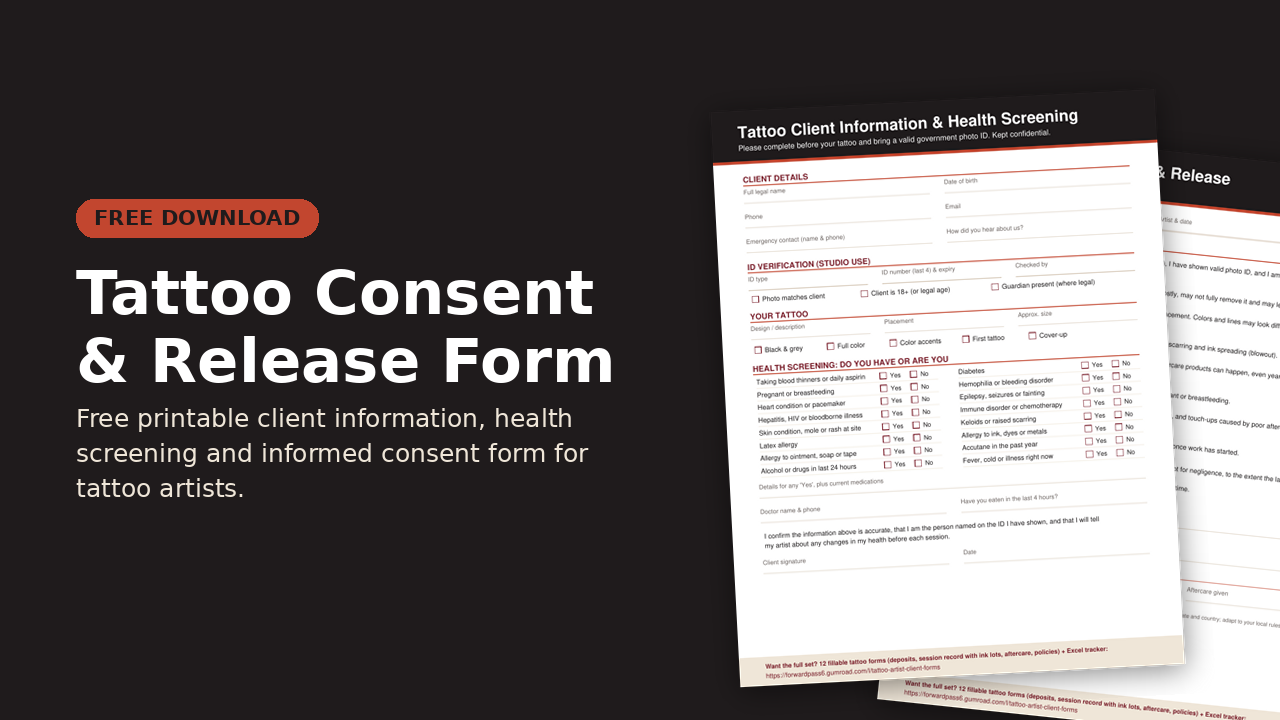
Free Tattoo Consent & Release Form
A fillable, printable tattoo consent and release form with client information, ID verification and a health screening, for tattoo artists and studios.
Download free →1. Work out your costs and hourly floor
Add up your yearly chair rent or shop percentage, machines, power supplies and maintenance, needles, cartridges, ink and grips, barrier film, gloves, cleaning and sterilization supplies, stencil paper and drawing tools or tablet apps, licenses, health permits and bloodborne pathogen training, insurance, booking software, card fees and marketing, and self-employment taxes where they apply. Add the income you want, then divide by the hours you can realistically tattoo in a year. Count unpaid time too: consultations, drawing, setup and breakdown all eat into the hours you can bill. That gives you an hourly floor, the least you can charge for an hour of tattooing and still make your numbers work.
2. Compare local rates
Look at what shops and independent artists near you list on their websites, booking pages and social profiles: hourly rates, minimums, day rates and flash prices. Note who they are. A new artist, an established artist with a waitlist and a specialist in fine line, realism or color work are all priced differently. Compare like with like, then decide where you fit. You can price above your area when your portfolio, hygiene standards and client experience clearly justify it, but if you are well below your floor, the fix is your pricing, not working longer hours.
3. Choose hourly, flat or day-session pricing
Hourly pricing suits large custom pieces and work where the time is hard to predict; give clients an estimated range of hours and explain what can change it, such as skin type, placement and breaks. Flat pricing suits small pieces and flash designs where you know the time well; clients like knowing the total up front. Day or half-day session rates suit sleeves, back pieces and other multi-session work; they reward clients for long sittings and give you a predictable day. Many artists use all three: flat for flash and small pieces, hourly or day rates for big custom work. Whatever you choose, check that the price works out to at least your hourly floor.
4. Set a shop minimum
Even a tiny tattoo takes setup, a fresh needle, ink caps, barrier film, breakdown and cleaning, often half an hour or more of your time before any lines go on. A shop minimum covers that. Set it so the smallest booking still pays at least your floor for all the time it blocks plus supplies. Say it clearly on your booking page so clients asking for a small script or symbol are not surprised. If you run walk-in or flash days, a set price list at or above your minimum keeps things simple.
5. Take deposits and set cancellation rules
Deposits are standard in tattooing because a no-show leaves an empty chair and often wasted drawing time. Many artists take a non-refundable deposit at booking that comes off the final price, with a larger deposit for big custom pieces where design time is significant. Spell out the rules: how much notice is needed to reschedule, how many times a deposit can move to a new date, and when it is lost. State the rule at booking, have the client sign a deposit and booking agreement, and track which deposits are paid, applied or forfeited.
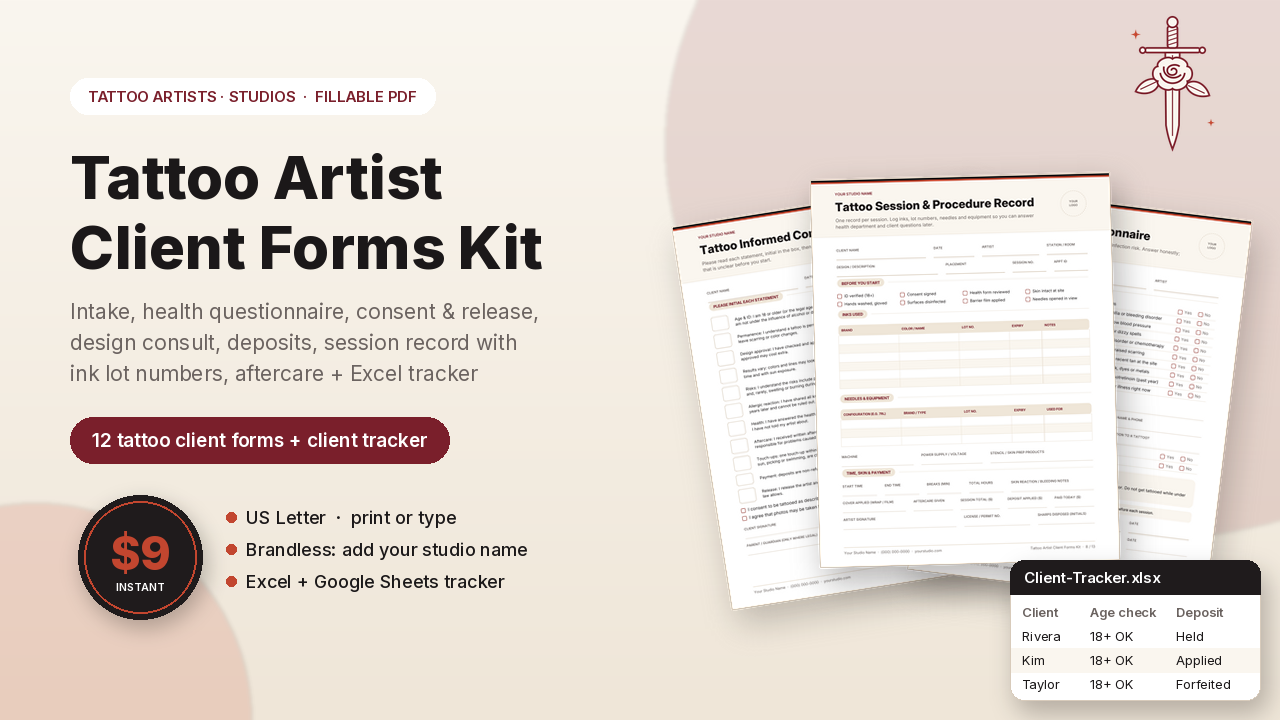
Tattoo Artist Client Forms Kit
12 fillable forms (new client intake, health questionnaire, consent and release, design and placement consultation with body outline, deposit and booking agreement, session record with ink lot numbers, aftercare and more) plus an Excel client tracker with 18+ age checks, deposit status and an ink lot log.
Get it →6. Price custom design, touch-ups and cover-ups
Custom design time can be built into the deposit or the hourly estimate, or charged as a separate drawing fee for complex pieces, and many artists include one or two rounds of changes before charging for more. Touch-ups: many artists offer a free touch-up within a set window after healing for their own work if the client followed aftercare, and charge for touch-ups after that or on other artists' work. Cover-ups and reworks usually take longer and need more planning and larger designs, so they are often priced higher or hourly only, after an in-person consultation. Put each rule in writing so there is no argument later.
7. Raise prices as your book fills
Review your prices at least once a year, or sooner when rent, supply or insurance costs go up. If your books are full weeks or months ahead and you are turning people away, that is usually a sign you can raise your rate. Announce changes ahead of time, honor quotes and deposits already taken, and apply new prices to new bookings. Raising your minimum and hourly rate in steps is easier for regulars than one big jump.
Worked example (example numbers)
These are example numbers to show the method, not a recommended price. Say your yearly costs, including chair rent and supplies, come to $24,000 and you want to earn $56,000, so you need $80,000. If you can bill about 800 hours of tattooing a year, your floor is about $100 an hour. A small piece that takes 30 minutes of tattooing but blocks an hour with setup, consultation and breakdown, plus $15 in supplies, needs about $115, so a minimum below that loses money. A custom forearm piece estimated at 4 hours of tattooing plus 2 hours of drawing would need about 6 x $100 = $600 plus supplies, so a quote around $620 to $650 covers your time before you compare with local rates.
Put your prices and policies in writing
Most tattoo disputes start with nothing on paper: a client who says the deposit was refundable, a touch-up they thought was free forever, or a health condition that was never mentioned. A signed consent and release form records the client's age and ID check, health screening and agreement to the risks. A deposit and booking agreement sets your cancellation and reschedule rules. A design consultation form records placement, size and changes, and a session record with ink lot numbers keeps your records clean. Clear forms make clients trust you and make your policies easy to enforce.
FAQ
How much should a tattoo artist charge per hour?
Work out your hourly floor from your yearly costs and income goal divided by the hours you can bill, then compare with what artists of similar experience and style charge in your area.
Is it better to charge hourly or a flat rate for tattoos?
Many artists use flat prices for small pieces and flash where the time is predictable, and hourly or day-session rates for large custom work where the time is hard to estimate.
What is a tattoo shop minimum?
It is the lowest price for any tattoo, set to cover setup, supplies, breakdown and cleaning time even for very small pieces.
Should tattoo deposits be refundable?
Many artists take a non-refundable deposit that comes off the final price, with rules on how much notice is needed to reschedule. Tell clients the rule at booking and have them agree in writing.
Do tattoo artists charge for touch-ups?
Many offer a free touch-up within a set window after healing for their own work if aftercare was followed, and charge for later touch-ups or touch-ups on other artists' work.
Do I need a tattoo consent form?
A signed consent and release form records the client's age and ID check, health screening and agreement to the risks, which protects you and the client. Check your local health and licensing rules.
This page is general guidance, not legal, tax, medical or licensing advice. Rules on tattoo licensing, age requirements, deposits and fees vary by location, so check the rules where you work.
Related templates
Free Tattoo Consent & Release Form
A fillable, printable tattoo consent and release form with client information, ID verification and a health screening, for tattoo artists and studios.
Download free →Tattoo Artist Client Forms Kit
Fillable tattoo client forms plus an Excel client tracker with deposit status and ink lot log.
Get it →