Tattoo Client Questionnaire: What to Ask Before You Quote and Book
A practical guide for tattoo artists and small studios: the questions to put on your booking inquiry form or consultation before you give a price or take a deposit, how each answer changes the quote, and what to confirm before you start drawing.
Why you need a questionnaire before you quote
"How much for a small rose on my forearm?" is one of the most common messages a tattoo artist gets, and it is almost impossible to answer well. Small to the client might mean the size of a coin or the size of a palm. The rose might be fine-line black and grey, bold traditional with color, or a realistic piece with shading that needs a long session. The forearm might be bare skin, or it might already have a tattoo the client wants to work around. The client sees one question. You see several very different appointments.
A tattoo client questionnaire is the set of questions you ask on your booking form, in your DMs or email, or at a short consultation, before you give a price, hold a date or take a deposit. It tells you whether the project fits your style and your schedule, how much drawing time and tattoo time to plan, and what you need from the client before you start designing. Good answers mean fewer back-and-forth messages, fewer surprises on the day and quotes that hold up.
This guide covers the pre-booking questions only. For how to build the price itself (hourly vs flat rates, shop minimums, deposits and touch-ups), see the tattoo pricing guide. For the form the client signs on the day, with ID and age checks, health screening and release wording, see the tattoo consent form guide. For what to give the client after the session, see the tattoo aftercare instructions handout.
Keep the first contact short. Ask for the idea, the placement, the approximate size, whether it is color or black and grey, and one or two reference images. That is usually enough to say "yes, that is a good fit for me, here is a rough range and my next openings" or "that style is not my specialty, here is who I would suggest." Save the rest for your full booking form or a consultation once the client wants to go ahead.
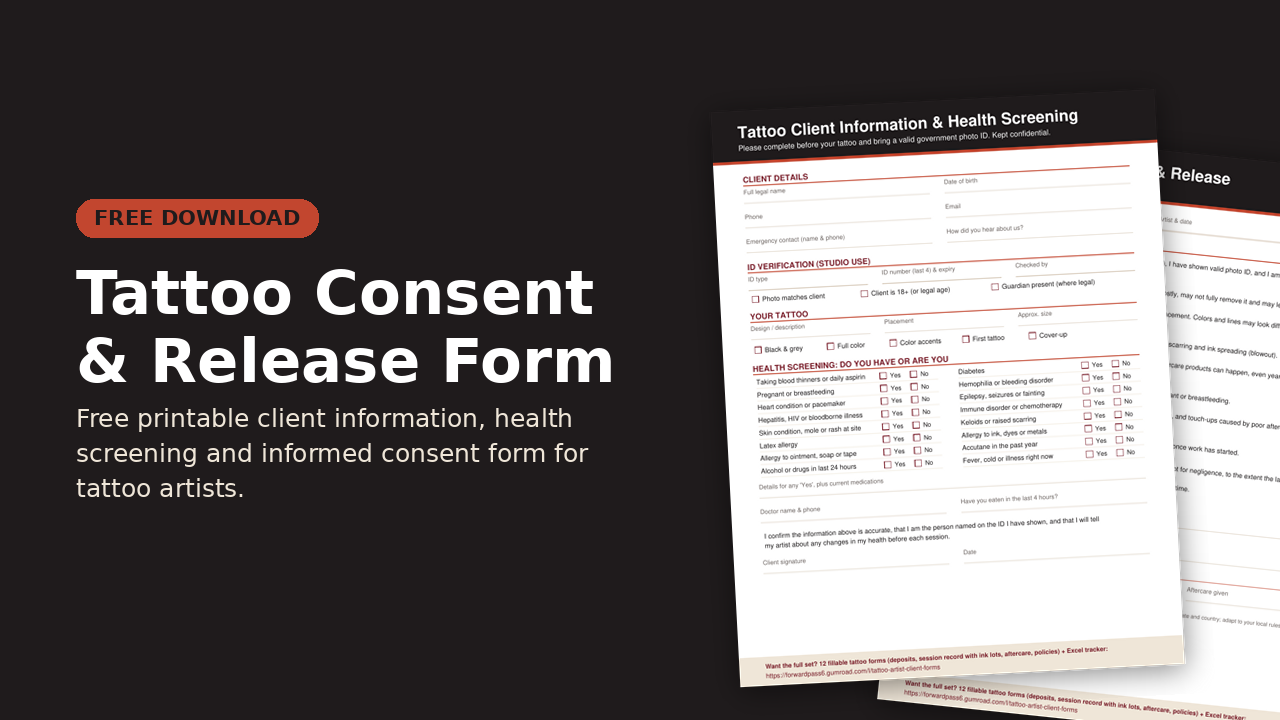
Free Tattoo Consent & Release Form
A fillable, printable tattoo consent and release form with client information, ID verification and a health screening, for tattoo artists and studios.
Download free →Section 1: Contact details and the basics
Start with the information that tells you whether you can take the booking at all, and how to reach the client while you work on the design.
- Full name and the name they prefer to be called
- Phone number, email and preferred contact method (many artists keep design files and approvals in email so nothing gets lost in DMs)
- Confirmation that the client meets the minimum age you tattoo and can bring valid photo ID on the day (follow the law where you work and your studio policy; do not assume)
- Is this their first tattoo? (First-timers often need more explanation about sizing, sessions and aftercare.)
- Have they been tattooed by you or your studio before?
- Which artist are they asking for, if your studio has more than one?
- How did they find you: Instagram, a friend, a walk-in, a convention or a search? (Useful for your marketing, not the quote.)
Keep detailed health questions out of the first inquiry form. Ask them privately on your consent and health form at the appointment, where you can handle them properly and store them securely. On the inquiry, a simple line such as "Is there anything about your skin or health you would like to discuss with the artist before booking?" lets the client raise something early without filling in medical details on a public form.
Section 2: The idea, style and color
This is the heart of the questionnaire. You want enough detail to judge whether the piece fits your style and how long it will take to draw and tattoo, without asking the client to design it for you.
- Describe the tattoo in a few sentences. What should be in it?
- Is there a meaning or story behind it you would like the artist to know? (Optional. Some clients want to share, others do not.)
- Which style are they hoping for: fine line, traditional, neo-traditional, realism, black and grey, blackwork, lettering, illustrative, Japanese-inspired or something else?
- Color, black and grey, or open to the artist’s suggestion?
- Is it custom, or are they choosing from your flash?
- How much creative freedom do they want to give you: exact idea, loose direction or "your style, your call"?
- Any lettering? If so, the exact wording, spelling and font direction, written out in the form rather than typed from memory at the appointment.
- Anything they definitely do not want in the design?
| What the client says (example) | Follow-up question to ask |
|---|---|
| "Just something small and simple" | About how big, in inches or compared with something like a coin or a credit card? Line work only, or some shading? |
| "Realistic portrait of my dog" | Can you send a few clear, well-lit photos? Color or black and grey? Roughly how big? |
| "Same as this one I found online" | Is this another artist’s custom work? I can design something original in a similar direction instead of copying it. |
| "A quote from my grandmother" | Please type the exact words and check the spelling. Do you have her handwriting, or do you want a font? |
| "I trust you, do whatever" | Which of my past pieces do you like most? Anything you do not want? |
The table is an example of how follow-up questions work, not a script. The aim is to turn a vague idea into something you can size, schedule and price.
Section 3: Placement and size
Placement and size change almost everything: drawing time, tattoo time, how many sessions, how the design has to flow and what the client should wear. Ask for both, even if the client is unsure.
- Where on the body do they want it? Be specific: inner or outer forearm, upper or lower back, left or right side.
- Approximate size in inches or centimeters, or "about the size of my palm" with a photo
- A photo of the area, if they are comfortable sending one, so you can see the space, the shape and anything already there
- Are there existing tattoos nearby that this should match, work around or connect to later?
- Is this part of a larger plan, such as a future sleeve or back piece?
- Do they need it easy to cover for work or family, or visible?
- Any scars, birthmarks or skin changes in the area they would like the artist to know about? (The artist decides whether and how to work over or around them, at a consultation if needed.)
| Placement detail (example) | Why it matters for the quote and plan |
|---|---|
| Wraps around the arm or leg | More drawing and stencil time; may need fitting on the body; often longer sessions. |
| Over a joint or on a curved area | Design may need to flow with movement; placement is often finalized at the appointment. |
| Next to an older tattoo | You may need to match line weight or style, or plan space for future work. |
| Large back or chest piece | Usually several sessions; deposit and scheduling work differently from a single small piece. |
| Hands, fingers, feet or face | Many artists have their own policies on these areas; tell the client yours before you quote. |
These rows are examples to help you explain the quote, not rules. Your own experience, style and studio policies decide how each placement is handled.
Section 4: Reference images and original work
Reference images save a lot of messages, but they need a little guidance. Ask the client to send a small number of images and to say what they like about each one.
- Two to five reference images, with a note on each: "I like the line weight," "I like this flower but not the colors," "this is roughly the size I want"
- Photos of any real subject: a pet, a person, a place or an object (clear, well-lit, from the angle they want)
- Links to pieces from your own portfolio they like, so you can see what drew them to you
- Any images of things they do not want
If a reference is another artist’s custom piece, many tattooers will not copy it. Say so politely on your form, and explain that you will draw an original design in a similar direction. Stating this up front avoids an awkward conversation after the deposit is paid.
Also tell the client when they will see the design. Some artists share a drawing a few days before the appointment, some only on the day, and some allow a set number of revisions. Whatever you do, put it in your booking terms so the client is not expecting something different.
Section 5: Cover-ups, reworks and touch-ups of other work
Cover-ups and reworks need their own questions, because the existing tattoo limits what is possible. Never quote one from a description alone.
- Clear, well-lit photos of the existing tattoo, straight on and from a short distance, with something in the frame for scale
- How old is the existing tattoo, and has it been lightened with laser or another removal method? (The artist decides whether more fading is needed first.)
- Do they want it completely covered, reworked and brightened, or blended into a new piece?
- How open are they to a larger or darker design? Cover-ups usually need to be bigger and bolder than the original.
- Was it done by another artist who might be asked to fix it instead? (This is the client’s choice; just know who you are working with.)
Be honest early about what a cover-up can and cannot do. If you think a light design over dark work is unlikely to work, say so before the client books, and suggest an in-person consultation so you can look at the skin and the existing ink yourself.
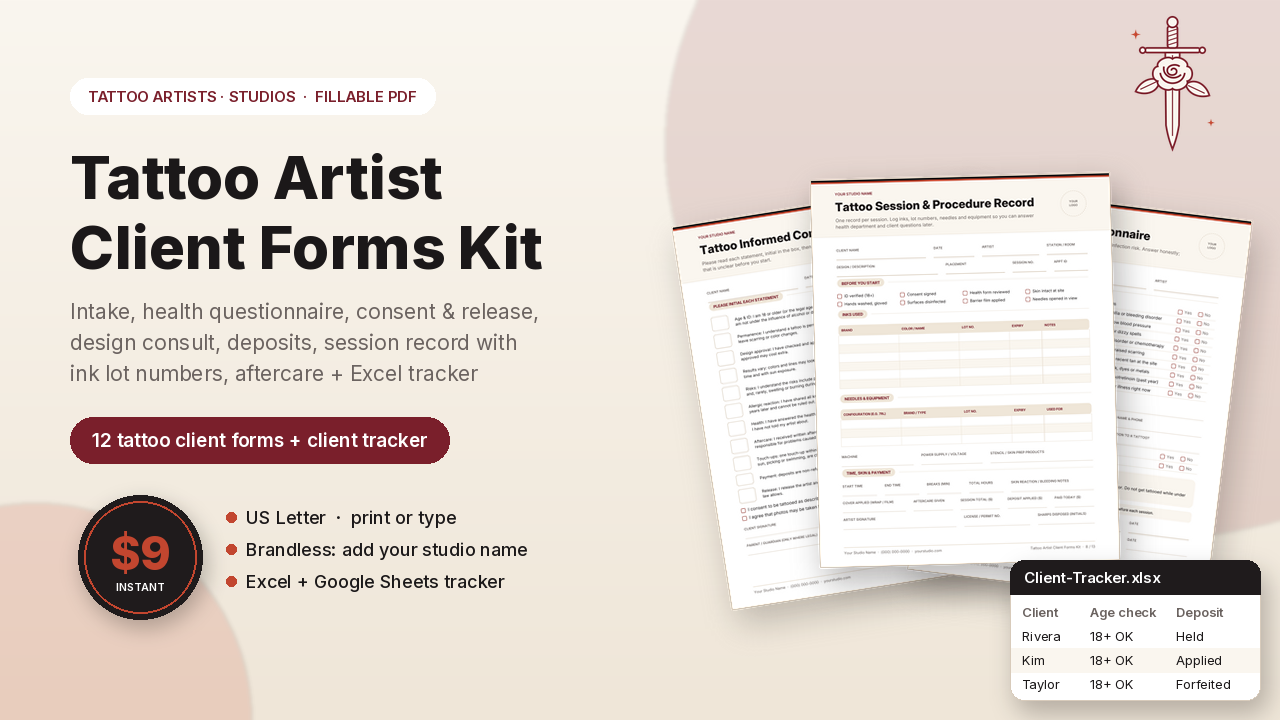
Tattoo Artist Client Forms Kit
12 fillable forms (new client intake, health questionnaire, consent and release, design and placement consultation with body outline, deposit and booking agreement, session record with ink lot numbers, aftercare and more) plus an Excel client tracker with 18+ age checks, deposit status and an ink lot log.
Get it →Section 6: Budget, sessions and availability
You do not need a client’s exact budget, but you do need to know whether their expectations and your rates are in the same range. Ask gently and give them a way to answer without feeling judged.
- Do they have a budget range in mind? (Offer ranges they can pick from, or let them leave it blank.)
- Are they open to multiple sessions if the piece needs it?
- Which days and times usually work for them? Any dates they cannot do?
- Do they have a deadline, such as a trip, event or anniversary? (If the healing time matters for the date, mention that it is their responsibility to plan around it and follow aftercare.)
- Are they willing to go on a waitlist or take a short-notice opening?
Then preview your terms in plain language before you send a formal quote. A short preview means the client is not surprised by the deposit or the cancellation policy when they come to book.
| Term to preview (example placeholders) | What to tell the client |
|---|---|
| Pricing method | [Hourly at your rate / flat price for this piece / shop minimum applies] |
| Deposit | [Amount or percentage], due to hold the date; [applied to the final price / non-refundable / transferable once with notice] |
| Design review | [Drawing shared X days before / on the day], [number] of revisions included |
| Rescheduling and no-shows | [Notice required] to move the date; [what happens to the deposit] |
| Payment on the day | [Accepted payment methods]; balance due [at the end of each session] |
| Touch-ups | [Your touch-up policy and time window], if aftercare is followed |
Every item in brackets is a placeholder for your own policy, not a recommendation. For how to set the numbers themselves, see the tattoo pricing guide and the deposit policy template.
Section 7: What to confirm before the appointment
Once the client accepts the quote and pays the deposit, the questionnaire turns into a short checklist of what they need to know and bring. Confirm these in writing.
- Date, start time, studio address, parking and how to get in
- Valid photo ID requirement and your minimum age policy
- That they will complete your consent and health form at the appointment (or ahead of time, if you send it securely)
- What to wear so the placement is easy to reach
- Your guidance on eating beforehand and staying comfortable during a long session
- That they should tell you before the appointment if anything changes about the area or their health, so you can decide together whether to go ahead or reschedule
- Your policy on guests, children and pets in the studio
- How and when they will see the design
The consent form guide covers what belongs on the form they sign at the appointment, and the aftercare handout covers what to give them when they leave.
Turning the answers into a quote
Once you have the answers, you can usually sort the request into one of a few kinds of booking and decide how to quote it. The table below is an example of how that decision might work, not a pricing rule.
| If the answers show (example) | You might |
|---|---|
| Small flash piece, clear placement, no existing work nearby | Quote a flat price or your shop minimum and offer the next opening. |
| Custom piece, medium size, single session likely | Give a range based on estimated hours, take a deposit and schedule the drawing time. |
| Large piece, several sessions | Quote an hourly rate with an estimated number of sessions, and explain how the deposit applies. |
| Cover-up or rework | Ask for an in-person consultation before giving a firm number. |
| Style outside your specialty | Say so honestly and suggest another artist whose work fits. |
| Very vague idea, no references | Send a few follow-up questions or examples from your portfolio before quoting. |
Whatever you decide, write the quote down and send it in the same thread as the questionnaire answers, so you both have one record of what was agreed.
When an in-person consultation is worth it
Many bookings can be handled entirely by form and messages. Some are better seen in person, even briefly:
- Cover-ups, reworks and pieces next to existing tattoos
- Large or multi-session work, such as sleeves and back pieces
- Placement on curved areas or where the design needs to be fitted to the body
- Work over scars, stretch marks or other skin changes, where the artist needs to see the area
- Clients who are unsure about size or placement and want to try a printed sizing
- Anyone who seems unsure overall. A short chat often helps them decide, either way.
Decide whether your consultations are free or paid, how long they last and whether a consultation fee goes toward the tattoo. Put that in your booking information so clients know before they ask.
Common mistakes with tattoo inquiries
- Quoting from one line of text. Without size, placement and style, any number you give is a guess and is likely to change.
- Asking for medical details on a public form. Keep health screening for your consent form, and store it securely.
- Not stating your policy on copying other artists’ work. Say it on the form, not after the deposit.
- Taking the lettering from a DM. Have the client type the exact wording and confirm the spelling in writing.
- Skipping photos for cover-ups. You cannot judge what is possible without seeing the existing tattoo.
- Leaving the deposit terms vague. Preview what the deposit holds, when it is lost and whether it moves with a reschedule.
- Saying yes to every style. Turning down work that is not a good fit protects your reputation and the client’s skin.
- Scattering the conversation across apps. Keep the answers, the quote and the design approval in one place.
One-page tattoo client questionnaire checklist
- Name, preferred name, phone, email, preferred contact method
- Meets your minimum age; will bring valid photo ID
- First tattoo? Returning client? Artist requested
- Description of the idea; meaning (optional)
- Style; color or black and grey
- Custom or flash; level of creative freedom
- Exact lettering, spelling confirmed
- Anything they do not want
- Placement (specific side and area) and approximate size
- Photo of the area (optional)
- Existing tattoos nearby; part of a bigger plan?
- Needs to be easy to cover?
- Scars or skin changes to discuss (details on consent form)
- Two to five references with notes; photos of real subjects
- Cover-up or rework: photos, age, any laser lightening
- Budget range; open to multiple sessions?
- Available days; deadline or event
- Pricing method, deposit, design review, rescheduling, touch-up policy previewed
- Consultation needed?
Keep this list in your booking form or link-in-bio form. Ask the first few items on the first message, then fill in the rest before you take the deposit.
FAQ
What should a tattoo client questionnaire include?
Contact details, age and ID confirmation, the idea and style, color or black and grey, placement and approximate size, reference images, any existing tattoos or cover-up details, budget range and sessions, availability, and a preview of your deposit, design review and rescheduling policies.
Is a tattoo client questionnaire the same as a consent form?
No. The questionnaire collects what you need to quote, design and schedule the tattoo. The consent form is signed at the appointment and covers ID, health screening, release wording and acknowledgment of aftercare.
Should I ask health questions on my inquiry form?
Keep detailed health questions for your consent and health form at the appointment, where you can store them securely. On the inquiry, a general line inviting the client to mention anything they would like to discuss with the artist is usually enough.
How do I handle clients who send another artist’s tattoo as a reference?
Say on your form that you design original work, and offer to draw something in a similar direction. Ask what they like about the reference so your design keeps those elements without copying the piece.
When should I ask for a consultation instead of quoting by message?
For cover-ups and reworks, large or multi-session pieces, placements that need fitting on the body, work over scars or skin changes, and any client who is unsure about size or placement.
Should I give a price before I see reference images?
You can give a rough range for simple flash or small pieces. For custom work, ask for references, size and placement first, so your quote is close to the final price.
This page is general information for tattoo artists and studios, not legal, medical, health or licensing advice. Rules on minimum age, ID, consent, health screening, record keeping, studio licensing, deposits and cancellations vary by location. Check the current requirements that apply where you work, follow your local health department’s guidance and have your own forms and agreements reviewed.
Related templates
Free Tattoo Consent & Release Form
A fillable, printable tattoo consent and release form with client information, ID verification and a health screening, for tattoo artists and studios.
Download free →Tattoo Artist Client Forms Kit
Intake, health questionnaire, consent and release, design consultation, deposit agreement, session record, aftercare sheet and more, plus an Excel client tracker.
Get it →