Makeup Artist Client Questionnaire: What to Ask Before Bridal and Event Bookings
A practical guide for bridal, event and freelance makeup artists: the questions to ask every client before you quote, how to turn the answers into an accurate price and day-of schedule, and the forms to collect before the trial.
Why every bridal and event booking needs a client questionnaire
Most makeup bookings that go wrong were set up badly long before the big day. The bride said "about five people" and seven showed up. The ceremony moved an hour earlier and nobody told you. A bridesmaid mentioned a lash glue allergy while you were already holding the tweezers. The "hotel suite" turned out to be a dim corner with one outlet and no table. A short questionnaire, sent before you quote, catches these problems while they are still easy to fix.
It also helps you sell the booking. Brides and event clients often compare several artists, and the one who asks clear, organized questions usually looks more professional than the one who sends a single price in a text message. The answers give you what you need for an accurate quote, a realistic schedule and a smooth trial. Below are the sections to include, the questions to ask in each, and how to turn the answers into a quote.
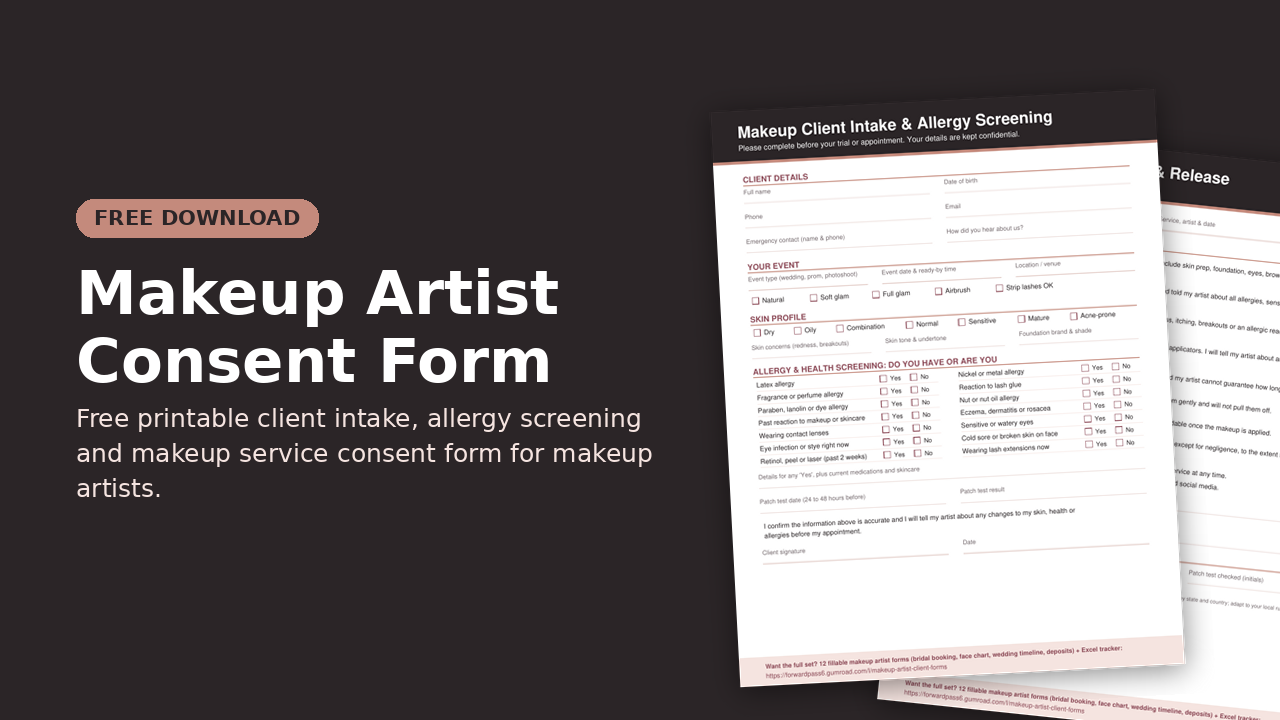
Free Makeup Artist Consent Form
A fillable, printable makeup consent form with client intake, skin profile and allergy and patch test screening, for bridal, event and freelance makeup artists.
Download free →Section 1: Contact and event details
- Client full name, phone number and email address
- Preferred contact method and the best times to reach them
- Who is the main contact (the bride, a parent, a planner) and who is paying
- Event type: wedding, engagement shoot, prom, gala, photoshoot, birthday, corporate event
- Event date and the start time of the ceremony or main event
- Venue name and the address where makeup will be done, if different
- Photographer and planner names, so you can coordinate the timeline
- How they found you, and whether they have seen examples of your work
Ask for the date first. Many artists check availability before sending the rest of the form, so a client does not fill out ten questions only to find you are already booked. If the date is open, tell them you hold it only once the signed agreement and deposit are in.
Section 2: Party size and timeline
Party size and timing decide how many hours you work, whether you need an assistant and what the booking is worth. Ask:
- How many people need makeup, including the main client
- Who they are: bride, bridesmaids, mothers, flower girls, other family members
- Who also wants lashes, airbrush or touch-up kits
- What time everyone must be fully ready (often the photographer's first shot, not the ceremony)
- Whether hair is happening at the same time, and the name of the hair stylist
- Whether anyone needs to leave early or arrive late
- Whether they want you to stay for touch-ups, and for how long
Work backward from the "ready by" time. If each full face takes about 45 minutes and the main client needs about 75, six people plus the bride is roughly six hours of work for one artist, before setup and buffer time. When the math does not fit the morning, you either start earlier or add an assistant artist, and the client should know that before they book. Leave the main client close to last so her makeup is freshest for photos, but not so late that a delay pushes her past the first look.
Section 3: Skin type, allergies and sensitivities
This is the section you should never skip. Ask each person who will be in your chair, not only the main client:
- Skin type: dry, oily, combination, normal, sensitive
- Current skin concerns they want you to know about, such as breakouts, redness or very dry patches
- Known allergies or reactions to makeup, skincare, fragrance, latex or lash adhesive
- Recent facials, peels, waxing, laser treatments, injectables or new prescription skincare
- Whether they wear contact lenses or have sensitive eyes
- Whether they want or need a patch test before the event
Keep this practical, not medical. You are recording what the client tells you so you can choose products and avoid known triggers. You are not diagnosing skin conditions or giving medical advice. If a client mentions an active skin condition, an infection, a recent procedure or a serious allergy, ask them to check with their doctor or dermatologist before the event, and note that you may need to skip certain products or areas.
Offer a patch test for anyone with sensitive skin or a known reaction, especially for lash adhesive. Many artists do it at the trial or send a small sample a few days before. Write down what was tested, the date, and the client's confirmation that there was no reaction, or that they declined the test. A separate consent form with this screening is worth having on file for every face you work on.
Section 4: Look preferences and inspiration
Most disappointments come from a gap between what the client pictured and what you created. Close that gap in writing:
- Overall look: natural, soft glam, full glam, editorial, vintage
- Two or three inspiration photos, ideally of people with a similar skin tone and eye shape
- Looks they definitely do not want (photos help here too)
- Coverage preference: light, medium or full
- Finish: dewy, satin or matte
- Lashes: none, natural strip, dramatic strip or individual clusters
- Lip color direction, and whether it needs to last through eating and kissing
- Dress color, flowers, the color palette of the event, and whether the event is indoors or outdoors
- Whether they usually wear makeup, and what they wear day to day
Ask how the client usually wears makeup. Someone who never wears foundation may feel "overdone" in a look that photographs perfectly, and you want to know that at the trial, not at 9 a.m. on the wedding day. For bridal parties, ask whether bridesmaids should match or can each choose their own look.
Section 5: Trial session
A trial is where you test the look, the products and the timing. Ask:
- Do they want a trial, and for whom (usually the bride, sometimes mothers or the maid of honor)
- Preferred trial dates, ideally a few weeks to a couple of months before the event
- Whether they can come to your studio, or need you to travel
- Whether they will bring inspiration photos, a photo of the dress and any jewelry or hair accessories
- Whether they can schedule the hair trial the same day, so they see the full look together
Use the trial to take notes and photos on a face chart: products, shades, lash style and how long the look took. Those notes are your recipe for the event day. Be clear in advance whether the trial fee is separate or included in the bridal package, and whether one round of changes is included.
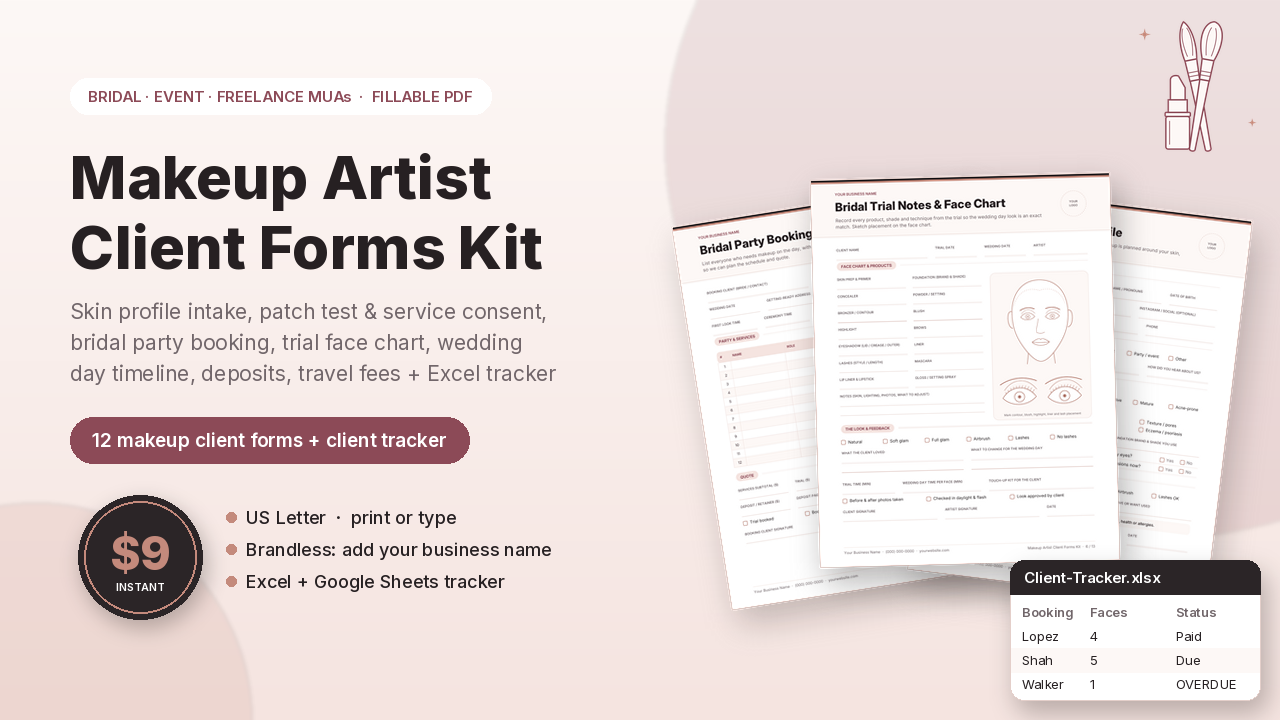
Makeup Artist Client Forms Kit
12 fillable forms (client intake and skin profile, allergy and patch test consent, bridal party booking form, trial face chart, wedding day timeline, booking agreement with deposit and cancellation policy, travel fee sheet, kit hygiene log and more) plus an Excel tracker with bridal party pricing and deposit status.
Get it →Section 6: Location, travel and setup
On-location work adds time and cost that should be in your quote, not a surprise. Ask:
- The full address where makeup will be done and the distance from your base
- Parking details, parking cost and how far you will carry your kit
- Access time: when the room or suite is available, and any building check-in rules
- Setup space: a table, two chairs, good natural light near a window and at least one outlet
- Whether the space will be shared with hair stylists, photographers and guests
- If the event is far away or very early, whether an overnight stay is needed
Many artists charge a travel fee by distance, add an early-start fee before a certain hour and ask for a hotel room when the start time or distance makes same-day travel unsafe. Put your exact rates on your own fee sheet and quote them up front.
Section 7: Deposit and cancellation policy preview
Show your main policies in the questionnaire so there are no surprises when the agreement arrives. Keep wording short and fill in your own terms. The table below uses bracketed placeholders only; it is not recommended wording.
| Policy | What to show (placeholders) |
|---|---|
| Booking deposit | A non-refundable deposit of [amount or %] is due to reserve the date. |
| Balance due | The remaining balance is due by [date or number of days before the event]. |
| Party size changes | Final headcount is due by [date]. Reductions after that date are [policy]. |
| Client cancellation | If the client cancels [timeframe], [what happens to deposit and payments]. |
| Rescheduling | Date changes are subject to availability; [fee or policy]. |
| Late start / waiting time | If the schedule is delayed by the client, [waiting fee or policy]. |
| Travel and early start | Travel over [distance] and start times before [time] add [fee]. |
| Patch test and reactions | Clients are asked to disclose allergies and may request a patch test; [your policy]. |
The policies themselves belong in a signed booking agreement. The questionnaire just previews them so the client is not surprised later.
Turning the answers into a quote
Once the questionnaire is back, you can build an itemized quote in a few minutes. The example below is for illustration only. The prices are made up; set your own based on your market and experience.
| Questionnaire answer | How it affects the quote (example only) |
|---|---|
| Bride, full glam with lashes | Bridal makeup line item, e.g. $[bridal rate] |
| 5 bridesmaids + 2 mothers | 7 x party rate, e.g. 7 x $[party rate] |
| Ready by 10:30 a.m., 7 faces | Start around 4:30 a.m.; adds early start fee or assistant artist |
| Hotel 35 miles away | Travel fee per your distance chart |
| Trial wanted 6 weeks out | Trial fee or included in the bridal package |
| Stay for touch-ups 2 hours | Touch-up hourly rate x 2 |
| 2 people with lash glue sensitivity | Patch test at trial; latex-free adhesive or skip lashes |
Send the quote with a short summary of the schedule: when you arrive, the order of faces and when the main client will be finished. A client who sees the plan is far more likely to sign quickly than one who only sees a total.
Common mistakes to avoid
- Quoting before you know the headcount. "A few bridesmaids" can mean three or nine. Get names, or at least a number, before you quote.
- Asking only the main client about allergies. Every person in your chair needs their own skin and allergy answers.
- Ignoring the photographer's timeline. The "ready by" time is often an hour before the ceremony.
- No setup details. Bad light and no table slow you down and hurt the result.
- Leaving travel and early-start fees vague. Put them in the quote, not on the final invoice.
- Skipping notes at the trial. Without a face chart, you rebuild the look from memory on the wedding day.
- Holding the date without a deposit. A date is only booked once the agreement is signed and the deposit is paid.
One-page makeup client questionnaire checklist
- Contact details, main contact and who is paying
- Event type, date, ceremony time and venue address
- Number of people, names and services for each
- "Ready by" time and photographer and hair stylist contacts
- Skin type, allergies, sensitivities and recent treatments for each person
- Patch test offered, done or declined, with date
- Look preferences, inspiration photos and looks to avoid
- Trial wanted, dates and location
- Makeup location, parking, setup space and light
- Travel distance, early start and overnight needs
- Deposit, balance and cancellation policy acknowledged
- Signed agreement and consent forms on file
Send the questionnaire as soon as a client asks about your availability, review it before you quote, and keep it with the signed agreement and consent forms for every booking.
FAQ
What should a makeup artist ask a bridal client before booking?
Ask for the event date, venue, ceremony and "ready by" times, how many people need makeup, the look they want with inspiration photos, skin type and allergies for each person, whether they want a trial, and the location and setup details for the day.
Should I ask every bridesmaid about allergies?
Yes. Each person in your chair should answer their own skin and allergy questions and confirm whether they want a patch test. Do not rely on the main client to answer for everyone.
Is a client questionnaire the same as a makeup consent form?
No. The questionnaire collects booking and look details so you can quote and plan. A consent form records each person's skin and allergy screening and their consent to the service. Most artists use both.
Do I need to do a patch test?
It is a good idea for anyone with sensitive skin or a known reaction, especially for lash adhesive. Record the date and result, or that the client declined. For serious allergies or skin conditions, ask the client to check with their doctor first.
When should I send the questionnaire?
As soon as a client asks about your availability and the date is open, and before you send a quote. For weddings, ask for a final headcount and timeline update a few weeks before the event.
Should deposit and cancellation terms go in the questionnaire?
Preview them so there are no surprises, but put the full terms in a separate signed booking agreement. The agreement, not the questionnaire, is what sets the rules.
This page is general information for makeup artists, not legal or medical advice. Rules on contracts, deposits, consumer protection, cosmetology licensing and product safety vary by location. Clients with allergies, skin conditions or recent procedures should consult a qualified medical professional. Check local requirements and have your own forms and agreement reviewed.
Related templates
Free Makeup Artist Consent Form
A fillable, printable makeup consent form with client intake, skin profile and allergy and patch test screening, for bridal, event and freelance makeup artists.
Download free →Makeup Artist Client Forms Kit
12 fillable makeup artist forms (intake, patch test consent, bridal party booking, timeline, agreement) plus an Excel tracker.
Get it →