Photography Contract Template: What Every Photography Services Agreement Should Include (Clauses, Payment Terms, Copyright, Cancellations and a Free Booking Form)
A plain-English walkthrough of the clauses portrait, family, event and small-business photographers put in their client agreements: scope, retainers and payment schedules, cancellations and rescheduling, gallery delivery, copyright and usage rights, model releases, liability limits and more, with a worked example and free photography forms.
Why every photographer needs a written contract
Most photography disputes are not about the photos. They are about expectations: how many images the client gets, when the gallery arrives, whether the retainer comes back after a cancellation, whether the client can print a photo on a billboard, or what happens when the session is rained out. A short, clear photography contract answers those questions before anyone pays, so you are not negotiating them by text message after the shoot.
A contract also makes you look established. Clients who receive a tidy booking form, a quote and a services agreement to sign tend to treat the booking as a real commitment, which means fewer no-shows and fewer last-minute reschedules. This guide walks through the clauses most portrait, family, event, headshot and small-business photographers include, explains why each one matters and shows example wording you can adapt.

Free Photography Forms
A printable client inquiry and booking form plus an adult model release.
Download free →1. Parties, session details and scope of work
Start with the basics, written so a stranger could understand them:
- Who. Your business name and the client’s full name, email and phone. For events, name the person responsible for payment, not just the couple or the company.
- What and when. Session type (family portraits, headshots, event coverage, product photos), date, start time, hours of coverage and location(s).
- What is included. Number of edited images or a minimum guaranteed count, number of outfits or set-ups, travel radius, second shooter, and whether raw files are excluded (most photographers state that unedited files are not delivered).
- What is not included. Prints, albums, extra editing such as heavy retouching or object removal, permit fees and travel beyond the stated radius. Listing exclusions is the easiest way to prevent arguments later.
If your package details are not settled yet, work through our photography pricing guide first, then copy the final package into the contract.
2. Retainer, deposit and payment schedule
The payment clause protects your calendar. When a client books a date, you turn away other work for it, so most photographers take a non-refundable retainer to reserve the date.
- Retainer. State the amount or percentage (for example, 25–50% of the session fee as an example range), that it reserves the date and that it is non-refundable except where you cancel. Some photographers prefer the word “retainer” over “deposit” because a deposit can be treated as refundable in some places, so check local rules.
- Balance due date. For example, the balance is due 7 days before the session for portraits, or 30 days before the event for larger events.
- Payment methods and late fees. List accepted methods and what happens if the balance is not paid on time, such as the session being postponed or a flat late fee.
- Payment plans. If you allow installments, write the dates and amounts in a short schedule rather than “pay as you go”.
3. Cancellations, rescheduling and no-shows
This is the clause clients read most closely, so keep it fair and specific:
- Client cancellation. The retainer is kept; any amount paid beyond the retainer is refunded or credited if the client cancels before a stated notice window (for example, 14 days before the session).
- Rescheduling. Allow one free reschedule with a stated notice period, subject to availability, and charge a rebooking fee or a new retainer after that.
- No-shows and late arrivals. If the client arrives late, the session still ends at the scheduled time. A no-show is treated as a cancellation without notice.
- Photographer cancellation. If you must cancel because of illness or emergency, you will try to reschedule or recommend a replacement, and refund all payments if that is not possible. Many contracts also limit your total liability to the amount paid.
4. Weather, location and outdoor sessions
Outdoor portrait photographers should add a weather clause: who decides whether to reschedule (usually the photographer, with a set decision time such as 24 hours before), that weather reschedules carry no fee, and that a light-rain or cloudy-day session is not grounds for a refund. Add a location clause too: the client is responsible for any location permits or entry fees unless your package includes them, and you may need to adjust the plan if a location is closed or crowded.
5. Image delivery, timelines and backups
Set a delivery window you can meet even in your busiest weeks. For example: sneak peeks within 72 hours, full online gallery within 2–3 weeks for portraits and 6–8 weeks for large events. Then add:
- Format. High-resolution JPEGs via an online gallery, with download period (for example, 90 days) and whether there is a fee to restore an expired gallery.
- Selection and editing style. You choose which images to deliver and edit them in your style; requests for extra edits are billed at a stated rate.
- Backups. How long you keep files after delivery, and that the client should save their own copies.
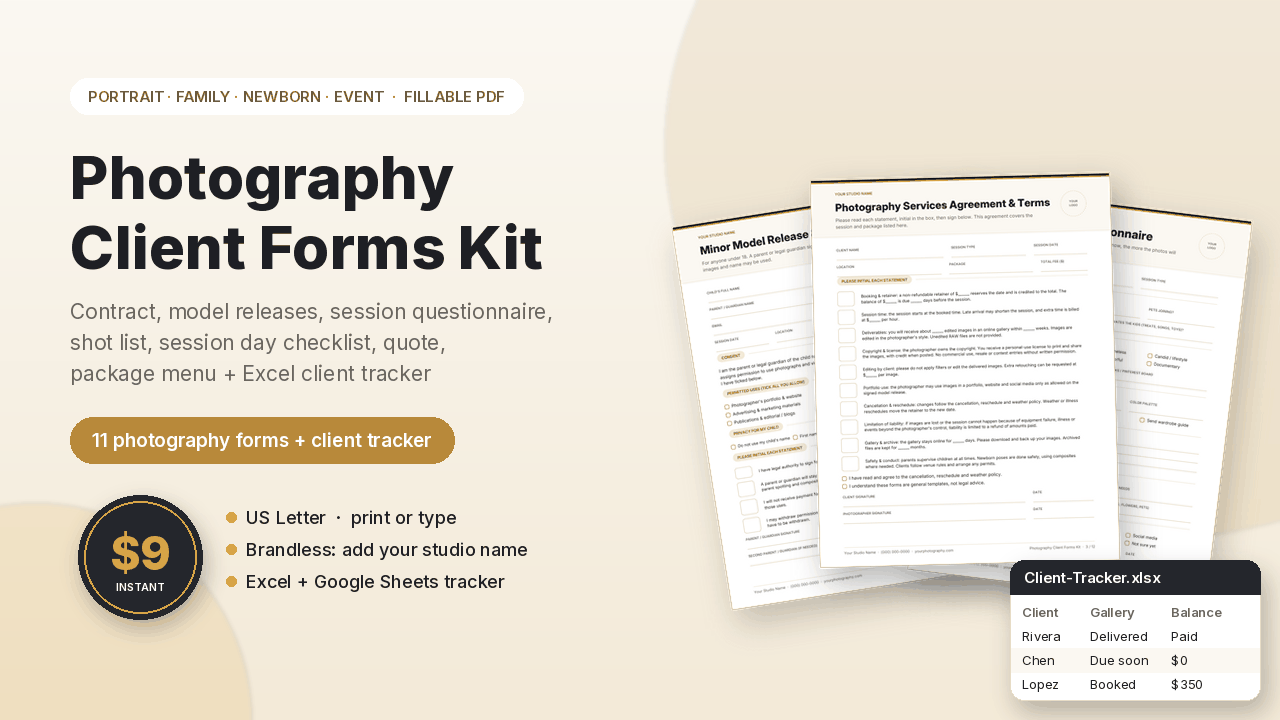
Photography Client Forms Kit
11 fillable and printable photography forms (inquiry & booking form, services agreement, session planning questionnaire, adult and minor model releases, shot list, session day checklist, quote and more) plus an Excel client tracker with retainers, balances, overdue flags and gallery due dates.
Get it →6. Copyright and usage license
In many countries, including the United States, the photographer owns the copyright to the images by default, and the client receives a license to use them. Your contract should spell out that license clearly:
- Personal use license. Clients may print, share on social media and make personal gifts, but may not sell the images, enter them in contests or use them in advertising.
- Commercial use. Headshots and business photos often need a commercial license for websites, ads and marketing. Price it separately or include it in your business packages, and state any limits on duration, territory or media.
- Credit and editing. Ask clients not to apply filters to images they post, or to tag your business if they do.
- Your portfolio use. State whether you may use the images on your website, social media and marketing, and how a client can opt out. This links directly to the model release.
7. Model releases (adult and minor)
A model release is a separate permission for you to use a person’s likeness to promote your business. Get one from every adult you plan to feature, and from a parent or guardian for any minor. Keep the release separate from the contract or as a clearly marked section, so a client can sign the agreement while declining portfolio use. Our photography model release guide explains what a release should cover.
8. Liability, conduct and equipment
A few short clauses can save a lot of stress:
- Limitation of liability. If images are lost or damaged because of equipment failure or circumstances beyond your control, your liability is limited to a refund of amounts paid.
- Safety and conduct. You may end a session early if the location is unsafe or if anyone behaves abusively, without a refund.
- Guest photographers. At events, guests with cameras should not block or interfere with your coverage.
- Meals and breaks. For events over a set length (for example, 5 hours), the client provides a meal or a short break.
- Insurance. Some venues require a certificate of insurance; note who arranges it.
9. Session planning and client responsibilities
The contract tells clients what they must do, not only what you will do: arrive on time, provide a shot list or family-group list by a stated date, share venue rules, and name a contact person for events. A client questionnaire sent after booking collects these details in one place and makes the session go much more smoothly.
10. Common contract mistakes to avoid
- Vague image counts. “Lots of photos” invites disappointment; give a minimum number or a range.
- No delivery date. Clients chase you when there is no written timeline; give one you can meet in peak season.
- Copying a contract from another country. Copyright, deposit and consumer rules differ, so adapt wording to where you work.
- Mixing the release into the fine print. Clients may object later; keep portfolio permission clearly separate.
- Not updating prices. Make sure the contract, quote and invoice always show the same package and fee.
- Starting work before signing. No shooting, editing or holding of dates until the signed agreement and retainer are in.
Worked example (example numbers only)
Here is how one portrait photographer might fill in the key terms. All numbers are an example only; set your own prices, timelines and policies.
- Package: 1-hour family session, one location, 30 edited images minimum, online gallery. Example fee: $450.
- Retainer: $150 (non-refundable, reserves the date). Balance: $300, due 7 days before the session.
- Rescheduling: one free reschedule with 7 days’ notice; after that, $50 rebooking fee.
- Weather: photographer decides by 6 pm the day before; weather reschedules are free.
- Delivery: sneak peeks in 3 days, full gallery in 3 weeks, 90-day download window.
- License: personal use; commercial license available for an example $150 add-on.
- Liability limited to amounts paid; model release signed separately (optional).
Written down, these terms fit on two pages. The client knows what they get and when, and you know what happens in every common scenario.
How to send and store your contract
Send the agreement with the quote or invoice for the retainer, and do not hold the date until both the signed contract and the retainer are in. A fillable PDF or e-signature tool works well; keep a signed copy for each client along with their booking form, questionnaire and release. Review your template once a year, and after any situation that the contract did not cover, so each new booking benefits from what you learned. For other service businesses with similar agreements, see the event planner contract guide.
FAQ
Do I need a contract for a short mini session?
Yes, even a one-page agreement helps. It confirms the fee, the number of images, the delivery date, the cancellation policy and the usage license, which are the same questions that cause disputes for long sessions.
Should a photography retainer be refundable?
Most photographers make the retainer non-refundable because it reserves a date they would otherwise sell. Refund it if you cancel. Wording and enforceability vary by location, so check local rules.
Who owns the copyright to photos, the photographer or the client?
In many places, including the United States, the photographer owns the copyright by default and the client gets a license to use the images. Your contract should state the license terms clearly.
Is a model release the same as a photography contract?
No. The contract covers the service and payment. A model release gives you permission to use a person’s likeness to promote your business. Many photographers use both.
Do I have to deliver raw files?
No, unless your contract says so. Most photographers state that only edited images are delivered and that raw files are not included.
What happens if I get sick on the day of a shoot?
Your contract should say you will try to reschedule or arrange a replacement photographer, and refund payments if neither is possible. A limitation of liability clause caps your liability at the amount paid.
This page is general guidance, not legal advice. Contract, consumer, copyright and privacy rules vary by location. Have a qualified professional review your photography contract and releases before you use them.
Related templates
Free Photography Forms
A printable client inquiry and booking form plus an adult model release.
Download free →Photography Client Forms Kit
Fillable services agreement, booking form, questionnaire, adult and minor model releases, shot list, quote plus an Excel client tracker.
Get it →