Pet Sitter Vet Release Form: Emergency Authorization, Spending Limits and What to Include (+ Free Forms)
A practical guide for independent pet sitters, house sitters and dog walkers: what a vet release form should say, how to set an emergency spending limit that actually works when the owner is on a plane, what to do step by step if a pet gets sick on your watch, and how to prepare for the holiday travel season, with worked examples you can copy.
Why every pet sitter needs a signed vet release
Most pet sits are uneventful: meals, walks, litter, a few photos for the owner. The one that is not uneventful usually happens at the worst time. The dog eats something off the counter on Christmas Eve, the cat stops eating on day four of a ten-day trip, or a senior dog collapses while the owner is somewhere over the Atlantic with their phone switched off.
In that moment you need three things: a vet who will see the pet, permission to say yes to treatment, and a clear answer to "who is paying, and how much?" A veterinary release and emergency authorization form gives you all three in writing, signed by the owner before they leave. Without it you may lose precious time trying to reach someone, or the clinic may be unable or unwilling to go ahead on your word alone.
This guide covers the vet release form and your emergency plan. It does not repeat your full service terms: for those, see the pet sitting contract template. The meet and greet checklist covers the first visit where you usually collect this form, the pet sitter report card covers daily visit notes, and pet sitting holiday rates covers what to charge for December stays.
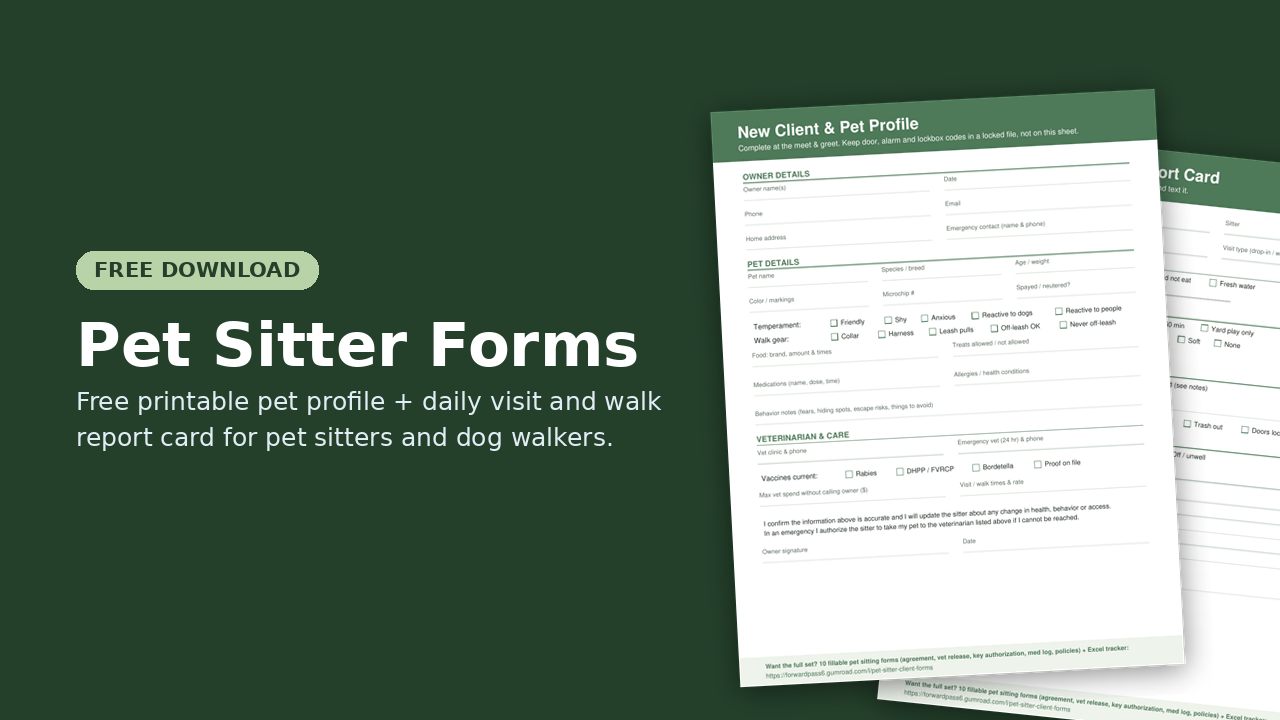
Free Pet Sitter Forms
A printable new client & pet profile plus a daily visit and walk report card for pet sitters and dog walkers.
Download free →What a vet release does (and what it does not)
A vet release is a short, signed permission slip from the owner. It names you as someone who may bring the pet to a vet and approve care while the owner is away, up to limits the owner chooses. It is not a guarantee that a clinic will treat the pet on credit, and it does not move the responsibility for the pet's health or the bill onto you.
| A vet release does | A vet release does not |
|---|---|
| Give you written permission to seek care for a named pet | Make you the owner or the pet's legal decision-maker in every situation |
| Set a dollar limit you may approve without reaching the owner | Promise that a clinic will accept it (clinics set their own policies) |
| Name the regular vet and a 24-hour emergency clinic | Replace the clinic's own consent or estimate paperwork |
| Record how the owner will pay, and who is responsible for the bill | Make you responsible for vet costs (unless you agree to that in writing) |
| Record the owner's wishes for serious or life-threatening situations | Replace a conversation with the owner whenever they can be reached |
Because clinics differ, the best version of this form is one the owner has also mentioned to their own vet. A simple step is asking the owner to call their regular clinic before the trip, say that you will be caring for the pet, and ask whether the clinic wants anything else on file, such as a card authorization or its own consent form.
1. Owner, backup contact and travel details
In an emergency the first question is always "can we reach the owner?" Put everything that helps you answer it at the top of the form.
| Field | Why it matters |
|---|---|
| Owner name(s), mobile numbers and email | Two owners means two chances to get through |
| Travel dates, destination and time zone | So you know if it is 3 AM where they are, or if they are flying |
| Flight numbers or "unreachable" windows | Tells you when not to keep waiting for a call back |
| Best way to reach them (call, text, messaging app) | Some travelers only have data abroad, not calls |
| Local backup contact with authority to decide | A neighbor, friend or relative who can approve care if the owner cannot |
| Backup contact's spending authority | Whether the backup may approve costs above your limit, and up to how much |
| Address where the pet is staying | The clinic will ask, and it matters if you need a mobile vet |
Ask the owner to tell their backup contact that they have been named. A backup who does not know they are on the form, or who has no idea what the owner would want, is not much of a backup.
2. Pet details and medical history
One form per pet keeps things clear, especially in multi-pet homes where it is easy to mix up who takes which medication. The vet will want most of this the moment you walk in.
| Field | Notes |
|---|---|
| Pet name, species, breed, sex, spayed or neutered | Plus a recent photo, useful if a pet gets out |
| Age and approximate weight | Vets use weight for many medication doses |
| Microchip number and registry | Lets a clinic or shelter match a found pet to the owner |
| Vaccination status and where records are kept | Some clinics and boarding facilities ask for proof |
| Current medications, doses and times | Copy exactly from the label; link to your medication log |
| Known conditions, past surgeries, allergies | Include drug allergies and food allergies |
| Behavior at the vet | "Needs a muzzle", "very stressed in carriers", "bites when in pain" |
| Pet insurance company and policy number | So the owner can claim later; check if a pre-approval number is needed |
If the pet takes medication during the stay, a dated medication log (what was given, when, by whom) is a useful companion to this form. Vets often ask what was given and when, and "I think I gave it this morning" is not a great answer.
3. Regular vet and 24-hour emergency clinic
Your regular vet is the first call during opening hours. But many emergencies happen in the evening, on weekends and on public holidays, which is exactly when a lot of regular clinics are closed or running reduced hours. That is why the form should always name two clinics.
| Field | Regular vet | 24-hour or emergency clinic |
|---|---|---|
| Clinic name, phone and address | Yes | Yes |
| Usual hours, and holiday closures for the stay | Yes | Confirm it really is open overnight and on holidays |
| Driving time from the pet's home | Yes | Yes: note it, so you can plan |
| Is the owner an existing client there? | Usually yes | Often no: ask the owner to register or call ahead if possible |
| Name the pet is registered under | Yes | If applicable |
| Payment policy | Ask the owner if they know | Many emergency clinics ask for payment or a deposit before or at treatment; ask the clinic |
Before a long stay, especially over the holidays, check both clinics' hours for the exact dates you will be sitting, and save both numbers in your phone under the pet's name. Plan how you will get there too: does the dog fit in your car, do you have a crate, and is there a carrier for the cat?
4. Treatment authorization and the spending limit
This is the heart of the form. The owner states what you may approve when they cannot be reached, and up to what amount. A vague line like "do whatever is needed" helps nobody: the clinic wants a number, and you do not want to guess what "whatever" means at midnight.
There are three common ways to set the limit. Pick one and write it down clearly.
| Limit type | How it works | Good for | Watch out for |
|---|---|---|---|
| Per incident | Up to $[X] for each separate emergency | Single-pet homes, short stays | Two problems in one stay can add up |
| Per pet, per incident | Up to $[X] for each pet, each emergency | Multi-pet homes where pets differ in age or health | Total exposure is higher than it looks |
| Per stay (total cap) | Up to $[X] in total for the whole stay, all pets | Long holiday stays, owners who want a firm ceiling | Once used up, you need the owner or backup for anything more |
Whichever type you choose, the form should also say:
- Whether the limit covers exam and diagnostics only, or treatment and hospitalization as well.
- What you may do if the vet's estimate is above the limit and nobody can be reached (for example: approve stabilizing care up to the limit only, or move to the backup contact's higher authority).
- That you will always try the owner, then the backup contact, before approving anything, and that you will record when you tried.
- That the owner understands vet estimates can change once treatment starts.
The owner picks the number, not you. Your job is to make sure there is a number, that it is written in figures and words, and that both of you have initialed it.
5. Payment: who pays the vet, and how
Payment is where good intentions fall apart. If the clinic asks for a deposit at the front desk, whose card is it? Settle this on the form, not in the waiting room.
| Payment option | How it works | Notes |
|---|---|---|
| Owner's card on file at the regular vet | Owner sets it up with the clinic before the trip | Often the simplest option for the regular vet; ask the owner to confirm |
| Owner pays the clinic by phone | Clinic calls the owner or backup for payment | Only works if someone is reachable |
| Sitter pays and is reimbursed | You pay, the owner repays you | Only if you agree to it; state how fast you will be repaid and that it is added to your invoice |
| Pet insurance | Owner usually pays and claims later | Insurance rarely pays the clinic on the spot; check the owner's policy |
Many independent sitters choose not to put vet bills on their own card at all, and say so on the form. If you are willing to advance money, put a cap on it, require receipts, and add the amount to your invoice with a clear due date. Either way, include a line stating that the owner is responsible for all veterinary costs for their pet, including costs above the authorized limit that they or their backup approve.
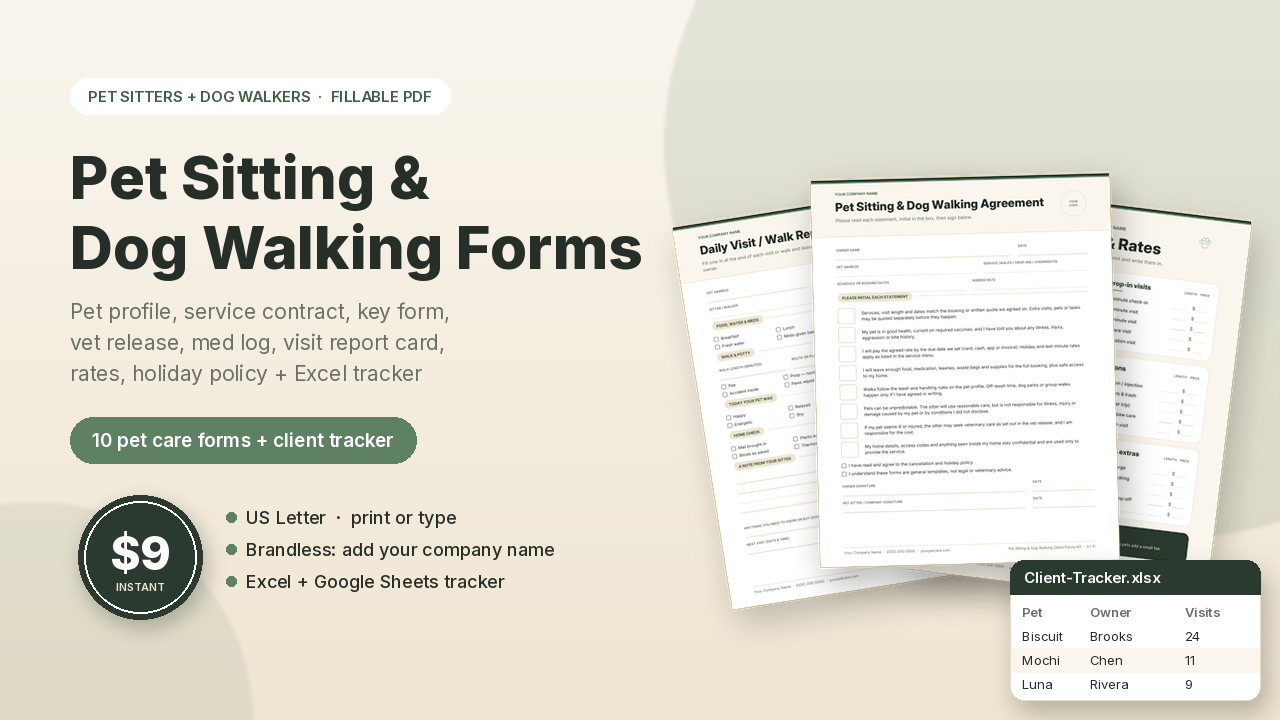
Pet Sitting & Dog Walking Client Forms Kit
10 fillable forms (client & pet profile, service agreement, key and alarm authorization, veterinary release & emergency authorization with spending limit, medication log, visit report card, meet & greet checklist, services and rates, cancellation & holiday policy, photo release) plus an Excel client and pet tracker.
Get it →6. The owner's wishes in serious situations
Nobody likes this part of the form, which is exactly why it gets skipped. But if a pet has a life-threatening emergency and the owner cannot be reached, the vet may ask what the owner would want, and you should not be the one guessing. A calm, plain set of choices works best.
| Question on the form | Example choices the owner can tick |
|---|---|
| If life-saving treatment is needed and I cannot be reached | Follow the vet's recommendation up to my limit / Stabilize and keep trying to reach me / Contact my backup, who may decide |
| If the vet recommends ending suffering and I cannot be reached | Only my backup contact may make this decision / Do not proceed without speaking to me or my backup |
| Resuscitation (CPR) if the pet stops breathing | Yes / No / Follow the vet's advice |
| Aftercare wishes | Free-text: the owner writes what they want |
| Anything else the vet should know | Free-text: for example, an existing end-of-life plan with their vet |
Keep the wording neutral and let the owner decide every choice. For a senior or chronically ill pet, suggest the owner talk this through with their own vet before the trip, so the form matches what the vet already knows.
What to do in an emergency: a step-by-step contact ladder
When something goes wrong, the form tells you what you are allowed to do. A short, written contact ladder tells you in what order, so you are not making it up under stress. Agree it with the owner and print it on the form.
| Step | What you do | What you record |
|---|---|---|
| 1. Keep the pet and yourself safe | Move the pet away from the hazard, keep other pets apart, use a muzzle or towel if the owner says the pet may bite when in pain | Time and what happened |
| 2. Call the vet | Regular vet if open, otherwise the 24-hour clinic; describe symptoms and ask whether to come in | Time, who you spoke to, their advice |
| 3. Contact the owner | Call, then text, then the messaging app they listed | Each attempt and its time |
| 4. Contact the backup | If the owner does not answer within the window you agreed | Each attempt and its time |
| 5. Approve care within the limit | Sign or confirm the clinic's estimate, up to the authorized amount | Estimate amount, what it covers, time approved |
| 6. Keep trying and update | Message the owner with the clinic name, what is happening and the estimate | Every message sent |
| 7. Write it up | Same day: a short incident note plus copies of estimates and receipts | A full timeline for the owner |
If a pet may have eaten something toxic, call the vet straight away, or a pet poison control service such as the ASPCA Animal Poison Control Center (which may charge a consultation fee). Do not try home remedies or make a pet vomit unless a vet or poison control tells you to.
The "window you agreed" in step 4 is up to you and the owner. Some owners want you to move to the backup almost immediately in an emergency; others want a few minutes of retries first. Write the answer on the form so you are not deciding it on the spot.
Worked example 1: one emergency, one spending limit
Here is how a per-incident limit plays out in practice.
| Detail | Example |
|---|---|
| Pet | Biscuit, 6-year-old Labrador, no known conditions |
| Stay | Dec 22–Dec 29, owners abroad (5 hours ahead) |
| Authorized limit | $500 per incident (written and initialed) |
| Backup contact | Owner's sister, may approve up to $1,500 more |
| Incident | Dec 24, 7:10 PM: Biscuit eats a plate of party food left on a low table, then vomits twice |
| Clinic | Regular vet closed for the holiday; 24-hour clinic 20 minutes away |
Example only. Pets, names, times, vet estimates and limits are made up to show the method. Real vet costs vary widely by clinic, location and the pet's condition; use the limits your client actually signs.
The timeline, using the contact ladder:
- 7:15 PM — You call the 24-hour clinic, which tells you to bring Biscuit in.
- 7:17 PM — You call and text both owners. It is 12:17 AM where they are; no answer.
- 7:25 PM — No reply, so you call the backup contact. Voicemail; you leave a message and text.
- 7:45 PM — At the clinic, the first estimate for the exam and initial treatment is $350.
$350 is within the $500 limit, so you approve it and note the time. That leaves $500 − $350 = $150 of the limit unused.
At 9:30 PM the vet recommends keeping Biscuit overnight for monitoring, with a further estimate of $600. The total would now be $350 + $600 = $950, which is $950 − $500 = $450 over your limit. You cannot approve the full amount yourself, so you go back up the ladder: you call the backup contact again, who answers at 9:40 PM and approves the extra amount (well within her additional $1,500). You record her name, the time and the amount, and message the owners a summary they will see when they wake up.
Without the form, you would have been at the clinic desk with no permission, no limit and nobody who could say yes.
Worked example 2: a multi-pet holiday stay, three ways to set the limit
Now a household with two dogs and a cat on a nine-night holiday stay. Suppose, over the stay, one dog and the cat both need the vet: the dog's care is estimated at $300 and the cat's at $450. How much could you approve yourself under each type of limit?
| Limit on the form | Dog ($300) | Cat ($450) | You can approve | Needs owner or backup |
|---|---|---|---|---|
| $400 per incident (all pets) | 300 ≤ 400: yes | 450 > 400: up to $400 | $300 + $400 = $700 | $50 for the cat |
| $400 per pet, per incident | 300 ≤ 400: yes | 450 > 400: up to $400 | $300 + $400 = $700 | $50 for the cat |
| $1,000 per stay (total cap) | Yes | Yes | $300 + $450 = $750 | Nothing; $1,000 − $750 = $250 left for the rest of the stay |
Example only. Pets, names, times, vet estimates and limits are made up to show the method. Real vet costs vary widely by clinic, location and the pet's condition; use the limits your client actually signs.
Two things stand out. First, per incident and per pet give the same answer here because the two pets had separate emergencies; they differ when two pets are hurt in the same incident (say, both dogs eat the same thing). Under "$400 per incident" you could approve $400 in total for both dogs; under "$400 per pet, per incident" you could approve up to 2 × $400 = $800. Second, a per-stay cap is simple to follow, but you must keep a running total, because whatever you approve early in the stay reduces what is left later.
Neither option is "right". The point is that you and the owner choose one on purpose, and the form spells it out so the clinic, the backup contact and you all read it the same way.
Holiday travel season: extra things to check
Late November through New Year is the busiest stretch of the year for many pet sitters, with longer stays, owners further away and clinics on holiday hours. A few extra checks go a long way.
| Check | Why it matters in December |
|---|---|
| Clinic hours for each date of the stay | Regular vets often close or shorten hours around Thanksgiving, Christmas and New Year |
| Owner's flights and time zones | Long-haul flights and overnight time differences create long "unreachable" windows |
| Backup contact actually in town | Friends and relatives travel for the holidays too |
| Household hazards for this home | Ask the owner about holiday foods, decorations, plants, candles and guests coming and going, and how the pet usually behaves around them |
| Medication supply for the whole stay, plus a margin | Pharmacies and clinics may be closed when you run out |
| Keys and access if you need to leave in a hurry | So you can get the pet, the carrier and the paperwork out quickly |
| A copy of the signed form on your phone and on paper | Take the paper copy to the clinic, keep the photo as a backup |
A short pre-trip message to every holiday client works well: "Before you go, please confirm your vet release, your backup contact and their phone number, and whether your regular vet is open on the dates you are away." It takes a minute and catches most of the gaps.
Common vet release mistakes
- No spending limit, or "whatever is needed". Clinics need a number, and you need protection from guessing.
- Only the regular vet listed. Emergencies happen after hours; always name a 24-hour clinic.
- A backup contact who does not know they are the backup, or who is traveling at the same time as the owner.
- One form for three pets. Use one per pet, with medications and conditions for that pet only.
- Unclear payment. If you are not willing to put a vet bill on your card, say so in writing.
- Signed once, never updated. Review it at every booking: new medications, new vet, new phone number, new backup.
- Form left in a drawer at the client's house. Keep a copy with you and a photo on your phone.
- No record of what happened. Times, estimates, approvals and messages protect you and help the owner if they need to make an insurance claim.
One-page vet release checklist
Use this as a quick check before every stay:
- Owner names, numbers, email, travel dates, time zone and unreachable windows
- Local backup contact, phone, and what they may approve
- One page per pet: name, breed, age, weight, microchip, vaccines, photo
- Medications and doses, conditions, allergies, behavior at the vet
- Regular vet and 24-hour clinic: names, phones, addresses, hours for the stay dates
- Treatment authorization: what you may approve without reaching the owner
- Spending limit type (per incident, per pet or per stay) and amount in figures and words
- What happens if an estimate is over the limit
- Payment method and a line that the owner is responsible for vet costs
- Pet insurance details, if any
- Owner's wishes for serious situations, ticked by the owner
- Contact ladder and the waiting window before calling the backup
- Owner signature and date; your copy on paper and on your phone
FAQ
What is a vet release form for a pet sitter?
It is a signed document from the pet owner that lets the sitter take a named pet to a vet and approve care while the owner is away, up to a limit the owner sets. It usually lists the owner and backup contacts, the regular vet and a 24-hour emergency clinic, the pet's medical details, a spending limit, how the bill will be paid and the owner's wishes in serious situations.
How much should the emergency spending limit be?
That is the owner's decision, not the sitter's. Vet costs vary widely by clinic, location and the pet's condition, so the owner may want to ask their own vet what an emergency visit typically costs near them. The important thing is that the form has a clear number, written in figures and words, and says what happens if an estimate is higher.
Will a vet clinic accept a pet sitter's vet release?
Policies vary by clinic. Many clinics will work with a signed release, but some may also want the owner to call, keep a card on file or sign their own consent form. The safest step is for the owner to contact their regular vet before the trip, and if possible the emergency clinic too, to ask what they need.
Who pays the vet bill when a pet gets sick during a pet sit?
Normally the owner is responsible for their pet's veterinary costs, and the form should say so. Decide in advance how payment will be made: a card on file with the clinic, payment by phone, or the sitter paying and being reimbursed if the sitter agrees. Many independent sitters choose not to pay vet bills themselves.
Is a vet release part of the pet sitting contract?
It can be a section of your contract, but many sitters keep it as a separate one-page form per pet, because it is the page you hand to the clinic. Your pet sitting contract covers the service terms; the vet release covers emergency care for each pet.
How often should the vet release form be updated?
Review it at every booking, and at least whenever something changes: a new medication, a new vet, a new phone number, a new backup contact or a change in the pet's health. For long holiday stays, confirm it again a few days before the owner leaves.
This page is general information for independent pet sitters, house sitters and dog walkers, not legal, veterinary or insurance advice. Rules for releases, consent and liability vary by state and locality, and veterinary clinics set their own policies on consent and payment. Have your forms reviewed by a qualified local professional, carry appropriate insurance, and always follow the veterinarian's advice in an emergency. All names, times, estimates and limits shown are examples only.
Related templates
Free Pet Sitter Forms
A printable new client & pet profile plus a daily visit and walk report card for pet sitters and dog walkers.
Download free →Pet Sitting & Dog Walking Client Forms Kit
Veterinary release with spending limit, service agreement, key and alarm authorization, medication log and an Excel client and pet tracker.
Get it →