Massage SOAP Notes: What to Write After Each Session (+ Free Template)
A practical guide for massage therapists and small practices: what goes in each part of a SOAP note, how to keep notes short but useful, and how to stay within your scope when you write them.
Why SOAP notes matter for massage therapists
Every session teaches you something about a client: where they hold tension, what pressure they like, what helped last time and what did not. Without notes, most of that is gone by the next appointment, especially if you see many clients a week or the client only books every few months. SOAP notes are a simple, widely used structure for writing it down so the next session starts where the last one ended.
Good notes also protect you and your practice. They show what the client told you, what you checked before working, what you did and how the client responded. If a client has a reaction, makes a complaint, or asks for records for another provider, a clear and dated note is far more useful than your memory. And where massage is regulated, licensing boards, employers and insurers may expect treatment records to be kept in a particular way.
This guide is about the note you write after each session. It does not cover the one-time paperwork a new client completes, which is in our massage intake form guide, or the handout you give clients to take home, covered in massage aftercare instructions. For rates and packages, see how much to charge for massage.
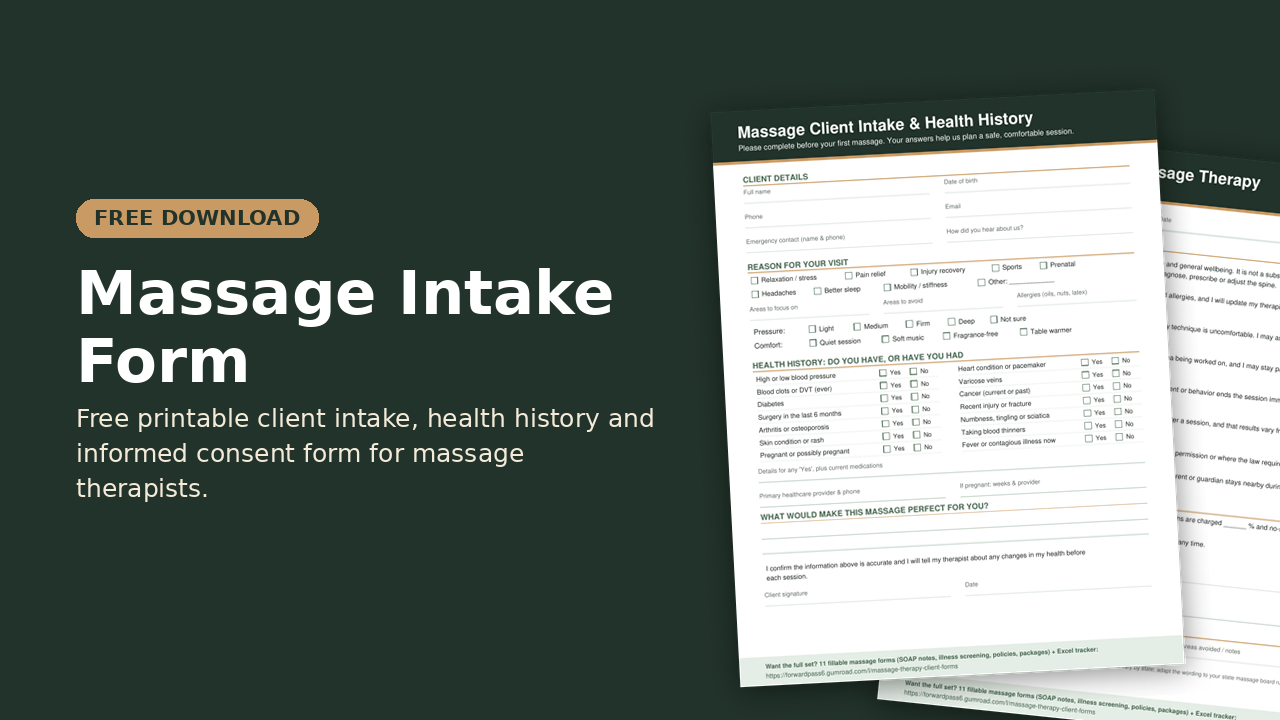
Free Massage Intake Form
A printable massage client intake and health history form plus an informed consent form for massage therapists and solo practices.
Download free →What SOAP stands for
SOAP is an acronym for the four parts of the note. Each part answers a different question:
| Part | Question it answers | Typical content |
|---|---|---|
| Subjective | What does the client say? | Reason for the visit, symptoms in their words, changes since last time, goals for today, pressure preferences |
| Objective | What did you observe and do? | What you saw and felt (tension, tenderness the client reported on palpation, range of motion you checked), techniques, areas worked, duration, pressure |
| Assessment | How did the client respond? | Changes during and after the session, client feedback at the end, anything that did not help |
| Plan | What happens next? | Focus for next session, suggested rebooking interval, self-care you suggested, referrals |
Example layout only. Some therapists and schools use variations (for example adding a separate section for the pre-session health check); use the format your training, employer or regulator expects.
The value of SOAP is consistency. When every note has the same four headings, you can scan a client’s history in seconds and see patterns across visits.
Before the S: session basics
Start each note with a few lines of basic information so it stands on its own:
- Client name (or client ID) and date of session
- Start and end time, and the length of hands-on time
- Type of session (for example relaxation, deep tissue, prenatal, sports, chair massage, mobile/in-home)
- Your name or initials, and credentials if you work in a team
- A quick confirmation that you checked for changes in health, medications or contraindications since the last visit
That last line is easy to forget and important. A health history form is only accurate on the day it was filled in. A short spoken check at the start of each session (“Any new injuries, medications, surgeries or health changes since last time?”) and a one-line note of the answer keeps the record current. If anything has changed, update the health history itself, not just the SOAP note.
S: Subjective
The subjective section records what the client tells you, in their words where practical. Keep it short and specific:
- Why they came in today and what they want from the session
- Where they feel discomfort or tightness, how they describe it, and what makes it better or worse
- What has changed since the last session, including how they felt in the days after
- Activities that may be relevant: a new job at a desk, a race, a move, a long flight
- Pressure, areas to focus on and areas to avoid
Quote the client when it helps: “Client reports right shoulder ‘tight and achy’ after long days at the computer; better on weekends.” Avoid turning what they say into a diagnosis. If a client tells you their doctor has diagnosed a condition, you can record that as reported (“Client reports diagnosis of plantar fasciitis by physician”).
| Instead of | Write |
|---|---|
| Back pain | Client reports lower back stiffness on waking, eases after walking; asks for focus on low back and hips |
| Neck issues | Client reports tension at base of skull and left side of neck after long drives; mild headache today |
| Same as last time | Client reports shoulders felt looser for about three days after last session; tightness has returned |
| Wants deep tissue | Client requests firm pressure on back and legs, lighter on neck; no work on feet today |
Example entries only. Record what your client actually tells you.
O: Objective
The objective section records what you observed and what you did. This is where many notes are too vague. Useful items include:
- What you observed before and during the session (for example posture you noticed, areas that felt tight or warm to the touch, tenderness the client reported when you pressed)
- Any simple range-of-motion checks you did, if they are within your training and scope
- Techniques used (for example Swedish, myofascial, trigger point, stretching), areas worked and roughly how long on each
- Pressure used and any changes the client asked for during the session
- Products used, especially if the client has allergies or sensitivities (oils, lotions, essential oils, hot stones)
- Areas you avoided and why
Write what you found in descriptive terms, not medical conclusions. “Palpable tension in right upper trapezius; client reported tenderness at two points near shoulder blade” is observation. “Rotator cuff tear” is a diagnosis, and outside the scope of massage therapy in most places.
Using a body map
A simple front-and-back body outline makes notes faster and easier to read later. Mark the areas the client mentioned, the areas you worked and any areas to avoid, using a small set of symbols you use every time. Write the key on the form so anyone reading the note understands it.
| Symbol | Meaning | Example use |
|---|---|---|
| Circle | Area of client-reported discomfort | Circle around right shoulder |
| Shading | Areas worked this session | Shade upper back and neck |
| X | Area to avoid | X over a recent bruise or skin irritation |
| Arrow | Direction of referred sensation the client described | Arrow from shoulder blade toward neck |
| T | Point the client reported as tender | T near left hip |
Example key only. Use symbols that match your training or clinic, and keep the key on the form.
A body map does not replace written notes. Add a line or two explaining anything a symbol cannot show, such as how the client described the sensation or why you avoided an area.
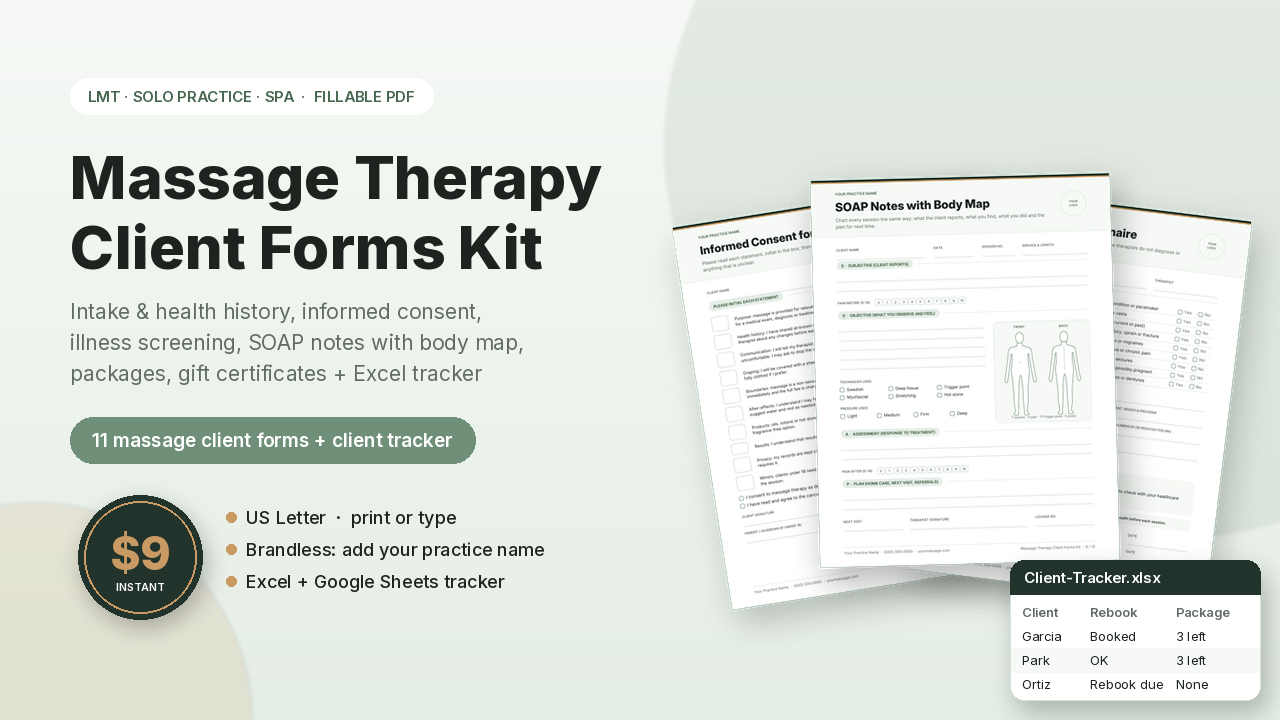
Massage Therapy Client Forms Kit
11 fillable forms (new client intake, health history questionnaire, informed consent, pre-session illness and contraindication check, SOAP notes with body map, treatment session log, cancellation and no-show policy and more) plus an Excel client tracker with rebook reminders.
Get it →A: Assessment
The assessment section records how the client responded to the session. In massage therapy this is about response and change, not diagnosis. Note things like:
- Changes you noticed during the session (tension eased in an area, client relaxed into pressure, breathing slowed)
- What the client said at the end (“shoulder feels lighter”, “still tight on the left”)
- Anything that did not help or that the client did not like
- Any reaction or discomfort during or after the session and what you did about it
Be careful with wording. Phrases like “fixed”, “cured” or “corrected” suggest treatment outcomes you cannot promise and may be outside your scope. “Client reported reduced tightness in neck at end of session” is accurate and safer.
| Situation | What to write |
|---|---|
| Client felt better | Client reported neck felt looser and turned head more easily by end of session |
| Little change | Low back tension unchanged by client report; suggested lighter pressure and heat next session |
| Client uncomfortable with an area | Client asked to stop work on abdomen; switched to back, no further discomfort reported |
| Possible reaction | Client reported lightheadedness on sitting up; rested, water given, symptoms eased before leaving |
Example entries only. If a client reports a reaction or symptoms that worry you, follow your training and local requirements, and suggest they contact a doctor or emergency services as appropriate.
P: Plan
The plan section tells you, and anyone who reads the note later, what comes next:
- Focus for the next session (areas, techniques, pressure)
- Suggested timing for the next visit, if the client asked for a recommendation
- Self-care you suggested, kept within your scope (for example gentle stretches you are trained to show, drinking water, rest)
- Referrals you suggested to a doctor or other professional, and why
- Anything to check before the next session, such as a follow-up on a new medication
Write recommendations as suggestions, not prescriptions, and record that you gave them. “Suggested client discuss ongoing numbness in right hand with physician before next session” is a clear, responsible plan entry. It also explains why the next session might be different.
A complete SOAP note: example
Here is what a short, complete note might look like for a follow-up relaxation and back session. Most notes do not need to be longer than this.
| Section | Example note |
|---|---|
| Basics | [Client ID], [date], 60 min (55 min hands-on), Swedish with focus on back. Health check: no changes since last visit. |
| S | Reports upper back and shoulders tight after long week at computer; wants medium-firm pressure, lighter on neck. No work on feet today. |
| O | Tension noted in both upper trapezius areas, more on right. Client reported tenderness at one point near right shoulder blade. Swedish and myofascial on back, neck and shoulders (about 40 min), arms and legs (about 15 min). Unscented lotion. |
| A | Client reported shoulders felt looser at end; right side still slightly tight. No discomfort or reaction reported. |
| P | Next session: continue upper back focus, add gentle neck stretches if client wants. Client plans to rebook in about three weeks. |
Example only, with placeholder details. Write your own notes based on the actual session, and follow your employer’s or regulator’s documentation rules.
Relaxation, spa and clinical settings
How much detail you need depends on where and how you work. A spa relaxation massage may only need a short note focused on preferences, areas worked and any reaction. Clinical, sports or injury-focused work, and any work billed to insurance or done alongside other providers, usually needs more detail and more careful wording. If you bill insurance or work in a medical setting, find out exactly what documentation is required before you start, because requirements vary by insurer, employer and location.
Whatever the setting, the four headings stay the same. Only the amount of detail changes.
Privacy, storage and access
SOAP notes contain health information, so treat them with care. Keep paper notes in a locked place and digital notes behind a password, with backups. Share them only with the client or with others the client has authorized in writing, unless the law requires otherwise. Do not leave notes visible in a treatment room or discuss a client’s details with other clients.
Rules about how long to keep records, whether clients can request copies, and which privacy laws apply to you vary by location, licensing body and how your practice is set up (for example whether you bill health insurance). Check your licensing board, professional association or a qualified adviser for the rules that apply to you. If you correct a note, add a dated correction rather than erasing what was there.
Paper, fillable PDF or software?
Paper SOAP forms are quick and work anywhere, including mobile massage. Fillable PDFs are tidy and easy to store, and you can complete them on a tablet between clients. Practice management software can link notes to bookings and payments, which saves time, but you depend on the provider’s format, pricing and data export options.
The best format is the one you will actually use after every session. Whatever you choose, keep the same headings and body map every time, and make sure you can find any client’s notes quickly when they book again.
A two-minute note routine
Notes only help if you write them. Some habits that make it easier:
- Write the note right after the session, before the next client or before you leave a mobile appointment
- Fill in the basics and the subjective section during the pre-session check
- Use the body map and short phrases, not paragraphs
- Read the last note before each session so you can ask about changes
- Use the same wording for common items, so patterns are easy to spot
- Leave room for a quick note if the client calls or messages after the session
Common mistakes
- Notes that only say “full body, relaxation”. They say nothing useful at the next visit.
- Diagnosing. Describe what the client reported and what you observed; leave diagnosis to qualified medical providers.
- Promising outcomes, such as writing that a problem was fixed or cured.
- Skipping the health check on return visits, or not updating the health history when something changes.
- Writing notes days later, when the details are gone.
- Judgmental or personal comments about the client. Write as if the client may read the note, because they may ask to.
- Leaving notes unsecured, on a shared tablet without a password or a clipboard in the treatment room.
- Erasing mistakes. Add a dated correction instead.
One-page SOAP note checklist
- Client name or ID, date, start and end time, session type
- Health and medication changes checked since last visit
- S: reason for visit, client-reported symptoms, changes since last time, goals and preferences
- O: observations, techniques, areas worked and time, pressure, products used, areas avoided
- Body map with a written key
- A: client response during and after the session, any reaction and what you did
- P: focus for next session, suggested timing, self-care suggestions within scope, referrals
- Your name or initials, and any dated corrections
FAQ
What are SOAP notes in massage therapy?
SOAP notes are a short record written after each session, organized into four parts: Subjective (what the client reports), Objective (what you observed and did), Assessment (how the client responded) and Plan (what happens next). The structure makes it easy to see a client’s history at a glance.
How long should a massage SOAP note be?
For most sessions, a few lines per section plus a body map is enough. Relaxation sessions can be brief. Clinical, injury-focused or insurance-billed work usually needs more detail, so check what your employer, insurer or regulator expects.
Can massage therapists diagnose in SOAP notes?
In most places, diagnosis is outside the scope of massage therapy. Record what the client tells you, including any diagnosis from their doctor as reported, and describe what you observed. If something concerns you, suggest the client see a qualified medical provider and note that you did.
What is the difference between an intake form and SOAP notes?
The intake form is completed once, at the start, and covers contact details, health history, medications and consent. SOAP notes are written after every session and record what happened that day. Update the intake or health history whenever the client reports a change.
How long should I keep massage SOAP notes?
It depends on where you practice and how your business is set up. Licensing boards, professional associations, insurers and privacy laws may set minimum periods. Check the rules that apply to you, keep notes securely for that time, and dispose of them securely afterwards.
Can clients ask to see their SOAP notes?
In many places clients have a right to request their records, and the rules depend on your location and how your practice is set up. Write every note as if the client may read it: factual, respectful and free of personal comments.
This page is general information for massage therapists and small massage practices, not legal, medical or professional advice. Scope of practice, documentation requirements, record retention periods and privacy laws vary by location, licensing body, employer and insurer. Do not diagnose medical conditions; refer clients to qualified providers when appropriate, and keep client records secure.
Related templates
Free Massage Intake Form
A printable massage client intake and health history form plus an informed consent form for massage therapists and solo practices.
Download free →Massage Therapy Client Forms Kit
11 fillable massage forms (intake, health history, consent, SOAP notes with body map, session log) plus an Excel client tracker.
Get it →