Handyman Client Questionnaire: What to Ask Before You Quote a Job
A practical guide for handymen and small home repair businesses: the questions to ask every client before you quote, how to turn the answers into an accurate estimate and schedule, and the forms to have ready once the job is booked.
Why every handyman job should start with a client questionnaire
"Can you fix a few things around the house?" is one of the most common messages a handyman gets, and one of the hardest to quote. A few things might mean hanging two shelves, or it might mean a sagging deck stair, a running toilet, a ceiling fan on a vaulted ceiling and a door that sticks because the frame has shifted. Quote from that one line and you either pad the number until the client walks away, or underprice and make unpaid trips to the hardware store.
A short client questionnaire, sent before you quote or visit, fixes most of that. It turns a vague list into specific tasks with photos, measurements and access details. It shows which jobs need a site visit, flags work that may be outside your scope or license, and shows the client you run an organized business. Below are the sections to include, the questions in each, and how to turn the answers into a clear quote.
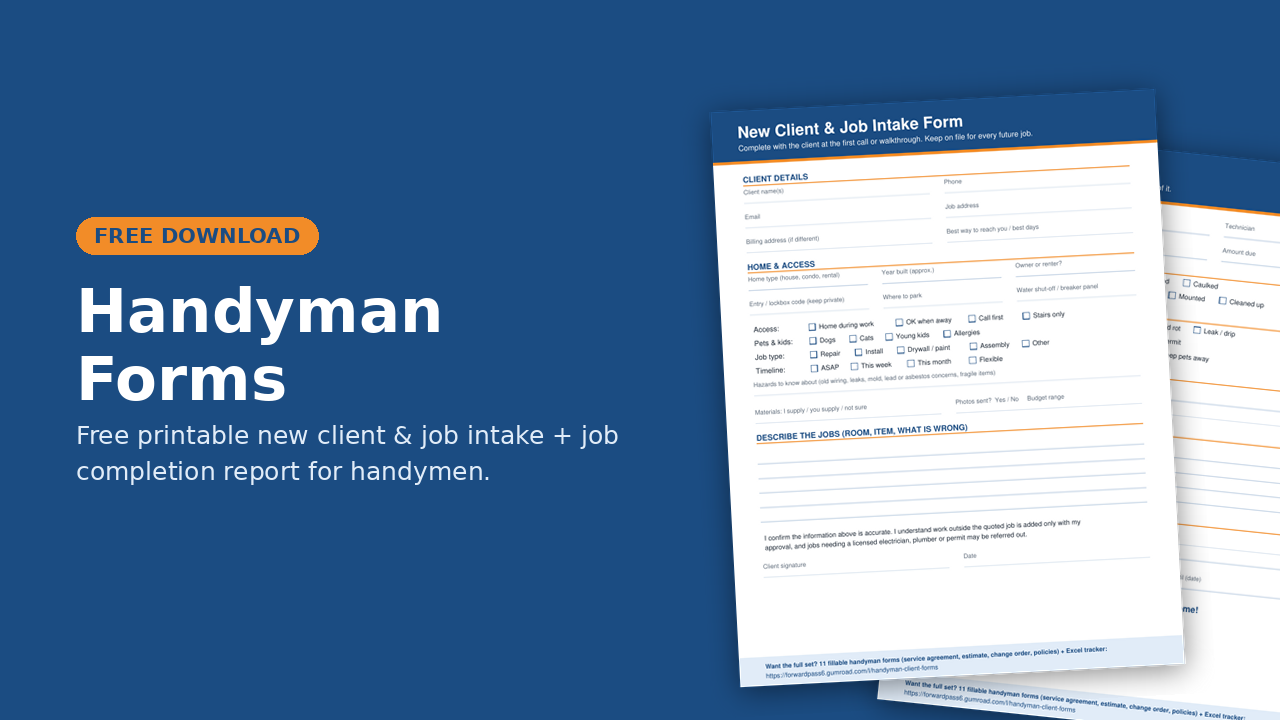
Free Handyman Forms
A printable new client and job intake form plus a job completion report for handyman businesses.
Download free →Section 1: Contact and property basics
- Client full name, phone number and email address
- Preferred contact method and best times to reach them
- Property address and type: house, townhouse, condo, apartment or rental unit
- Whether they own the property or rent it, and if they rent, whether the landlord has approved the work
- HOA or condo association rules on contractors, work hours or parking
- Who will be home during the job, and who can approve changes on the spot
- Pets, children or anyone working from home that you should plan around
The owner or renter question matters more than it looks. A tenant may not be allowed to approve wall anchors, fixture swaps or anything that changes the property, and you do not want to find out when the landlord calls. If a property manager is involved, confirm who pays the invoice.
Section 2: The task list, one job per line
The heart of the questionnaire is a numbered task list. Ask the client to describe each job on its own line rather than in one paragraph. For every task, ask:
- What needs doing, in plain words (repair, replace, install, assemble, patch, adjust)
- Which room or area, and roughly where in that room
- What is wrong now, if it is a repair: leaking, loose, cracked, stuck, not working
- Whether anyone has tried to fix it already
- What a finished job looks like to them
- Which tasks are most important if the budget or time runs short
A numbered list makes everything after it easier. You can price each line, tell the client which items are quick and which need a visit, and later use the same numbers on your estimate, change orders and completion report. It also stops "while you are here" creep: anything not on the list is a new item.
Section 3: Photos, measurements and site visits
Good photos can save you a trip and make your quote far more accurate. Ask the client to send:
- A wide photo of each area so you can see the space and access
- A close-up of the problem: the crack, the leak, the damaged trim, the old fixture
- Photos of model numbers or labels for fixtures, appliances or items to assemble
- Rough measurements: wall length, door size, window width, ceiling height
- For mounting jobs, the wall type if known (drywall, plaster, brick, tile) and what is being mounted
- For plumbing jobs, a photo under the sink or of the shutoff, if safe to take
Then decide, per task, whether photos are enough. Simple, visible jobs can often be priced from pictures with a note that the price assumes conditions match the photos. Anything involving water damage, rot, structure or hidden wiring usually needs a site visit before a firm number. Say in your questionnaire whether you charge for estimate visits and whether that fee is credited if the client books.
Section 4: Materials: who supplies what
Materials cause more billing disputes than labor. Ask clearly who is buying what:
- Has the client already bought the fixture, shelf, faucet, flooring or paint?
- Do they want you to supply materials, and do they have brand, color or finish preferences?
- Are there leftover materials on site, such as spare tiles, touch-up paint or trim?
- Do they want to approve product choices or receipts before purchase?
- Who removes old fixtures, packaging and debris, and is haul-away wanted?
| Materials setup | What it usually means for the quote (example only) |
|---|---|
| Client already bought the item | Labor-only line; note that you are not responsible for defects in client-supplied parts |
| You buy to the client's spec | Materials at cost plus a [markup or handling fee], plus shopping time |
| You choose and supply | Materials allowance of $[amount]; overages approved in writing |
| Mix of both | List each item and who supplies it on the quote |
| Old items to haul away | Add a disposal line or note the client keeps them |
Whatever you choose, put it on the quote line by line. "Install client-supplied faucet" and "Supply and install faucet up to $[allowance]" are very different jobs, and both sides should know which one was agreed.
Section 5: Home age, condition and hidden problems
Older homes hide surprises. A few questions up front help you price for them and keep everyone safe:
- Approximate year the home was built
- Known water damage, leaks, mold, soft floors or rot in the work area
- Previous repairs or DIY work in the same area
- For homes built before 1978, whether painted surfaces will be sanded, cut or scraped
- Any known asbestos-containing materials, such as old flooring, popcorn ceilings or pipe insulation
- Whether the electrical panel, wiring or plumbing has been updated
In the United States, work that disturbs painted surfaces in many pre-1978 homes may fall under the EPA Renovation, Repair and Painting (RRP) rule, which can require certification and lead-safe work practices. Suspect asbestos materials should not be disturbed without proper testing. Rules vary by location, so check what applies to you. This is general information, not legal advice.
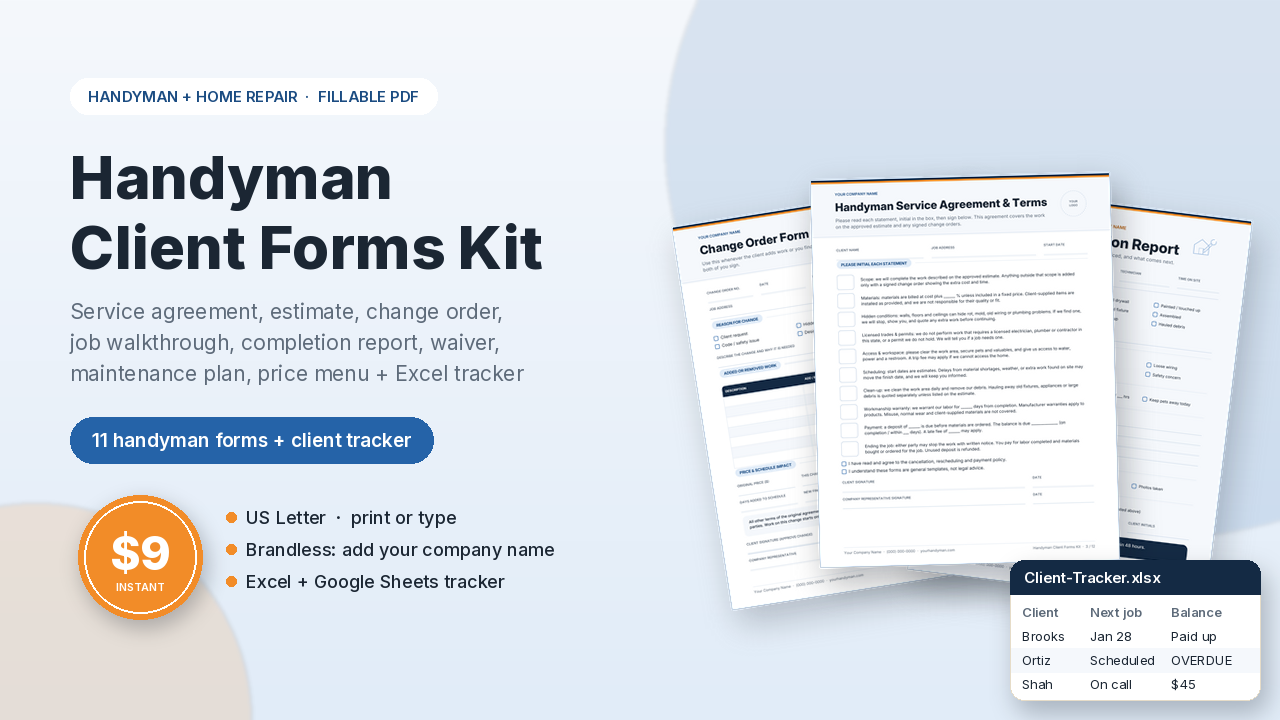
Handyman Client Forms Kit
11 fillable and printable handyman forms (new client & home profile, service agreement, job walkthrough with room sketch grid, estimate / quote, change order, job completion report, home maintenance plan and more) plus an Excel client tracker with balances, next-visit dates and overdue payment flags.
Get it →Section 6: Scope, licensing and permit limits
Many areas limit what a handyman can do without a contractor license, a trade license or a permit, often based on the type of work or the job value. Electrical, plumbing, gas, HVAC, structural and roofing work commonly fall into licensed categories. Use the questionnaire to spot these early:
- Does any task involve new wiring, circuits, panels, gas lines or moving plumbing?
- Does any task involve removing walls, cutting joists or changing structure?
- Is the total job likely to exceed any dollar limit that applies to you?
- Has the client been told a permit is needed, or been asked by an inspector or insurer to fix something?
When a task is outside what you can legally or safely do, say so before quoting and, if you like, suggest the client hire a licensed trade for that item. Write clearly on the quote which items are included and which are excluded.
Section 7: Access, scheduling and working conditions
- Preferred dates and times, and any hard deadline (move-in, guests, a home sale, an inspection)
- Whether the work must be done in one visit or can be split
- Parking, driveway access and distance from the truck to the work area
- Stairs, attic or crawl space access, and ceiling heights for ladder work
- Whether furniture needs to be moved and who will move it
- Access to power and water, and where you can set up tools or cut materials
- Keys, lockbox or alarm codes if no one will be home
- Roof, high ladder or near-power-line work, shutoff and panel locations, and any dust or fume sensitivities
Scheduling details affect price as much as the tasks do. A two-hour job across town with street parking and a third-floor walk-up is not the same as two hours in a garage. Many handymen use a minimum charge or trip fee for small jobs; mention yours up front. Also agree that children and pets stay out of the work area, and that you may pause any task you judge unsafe on arrival.
Section 8: Budget and policies preview
Ask for a rough budget, even a range. It lets you suggest priorities, such as fixing the leak and the stair now and leaving the cosmetic items for a later visit. Then preview your main policies so the agreement holds no surprises. The table below uses bracketed placeholders only; it is not recommended wording.
| Policy | What to show (placeholders) |
|---|---|
| Estimate visits | Estimate visits are [free or $amount], [credited or not] if you book. |
| Minimum charge | Jobs have a minimum of [amount or hours]. |
| Deposit | A deposit of [amount or %] is due [when], especially for materials. |
| Materials | Materials are billed [at cost / with markup / as an allowance]. |
| Changes | Work added on site is [priced and approved in writing before starting]. |
| Hidden conditions | If hidden damage is found, [what happens to the price and schedule]. |
| Cancellation | Cancelling within [timeframe] means [fee or policy]. |
| Payment | Balance is due [when], by [methods]. |
The policies themselves belong in your signed service agreement. The questionnaire only previews them so the client knows how you work before you send a number.
Turning the answers into a quote
With a completed questionnaire, you can price each numbered task and group them into an efficient visit. The example below is for illustration only. The prices are placeholders; set your own based on your costs, market, licensing and experience.
| Questionnaire answer | How it affects the quote (example only) |
|---|---|
| Task 1: mount 65-inch TV on drywall, client has bracket | Labor-only line; $[flat rate]; note stud location and wall type |
| Task 2: running toilet, photo of tank provided | $[rate] plus parts up to $[allowance] |
| Task 3: soft spot near tub, possible water damage | Site visit before pricing; quote repair after inspection |
| Task 4: hang 3 shelves, client wants you to buy them | Materials plus [handling fee] and shopping time |
| Home built 1962, sanding painted trim | Check RRP rules and lead-safe practices; price accordingly |
| Third-floor walk-up, street parking | Add [time or trip fee] for access |
| Task 5: add new outlet in garage | Excluded; refer to a licensed electrician if required |
Send the quote with the same task numbers the client used, a short plan for the visit, what the client needs to do beforehand, and the items that are excluded or need a visit. Numbered quotes also make change orders simple when the client adds item six on the day.
Common mistakes to avoid
- Quoting a vague list. Get one task per line, with photos, before you send a number.
- Not asking who supplies materials. It is the most common source of billing disputes.
- Skipping the home age question. Older homes can mean lead paint, asbestos or outdated wiring.
- Taking on licensed work. Check your local limits on electrical, plumbing, structural and job value.
- Ignoring access. Parking, stairs and ladder height change the real time on site.
- Agreeing to extra tasks verbally. Price and approve every added item in writing.
- No plan for hidden damage. Say up front what happens if you open a wall and find rot.
- Booking without a signed agreement. The date is only held once the agreement and any deposit are in.
One-page handyman client questionnaire checklist
- Contact details, preferred contact method and who approves changes
- Property type, owner or renter, landlord or HOA approval
- Numbered task list with room, problem and desired result
- Wide and close-up photos, model numbers and rough measurements
- Which tasks need a site visit and any estimate visit fee
- Materials: already bought, you supply, allowance, haul-away
- Year built, known damage, lead paint and asbestos questions
- Electrical, plumbing, gas or structural tasks flagged for licensing
- Dates, deadlines, parking, stairs, ladder heights and furniture
- Power, water, setup area, keys and alarm codes
- Safety notes, pets, children and dust sensitivities
- Budget range, minimum charge, deposit, changes, hidden conditions and cancellation policies acknowledged
Send the questionnaire as soon as a client asks for a quote, review it before you price, and keep it with the quote, change orders and signed service agreement for every job.
FAQ
What should a handyman ask a client before quoting a job?
Ask for a numbered list of tasks with photos and measurements, the property type and whether they own or rent, who supplies materials, the age of the home and any known damage, access and parking, preferred dates, safety concerns and a rough budget.
Can a handyman quote from photos instead of a site visit?
Often, for simple and visible tasks such as mounting, assembly or fixture swaps, with a note that the price assumes conditions match the photos. Jobs involving water damage, rot, structure or hidden wiring usually need a visit before a firm price.
Should a handyman charge for estimates?
It is a business choice. Some handymen give free estimates, while others charge a visit fee and credit it if the client books. State your policy clearly in the questionnaire and on your website.
Why ask what year the house was built?
Older homes are more likely to have lead paint, asbestos-containing materials or outdated wiring and plumbing. Knowing the age helps you plan safe work practices, check any rules that apply and price for surprises.
What jobs might be outside a handyman's scope?
In many areas, electrical, plumbing, gas, HVAC, structural and roofing work, or jobs above a certain value, require a contractor or trade license or a permit. Rules vary by location, so check what applies to you before quoting.
Is a client questionnaire the same as a handyman service agreement?
No. The questionnaire collects information about the job. The quote is your priced proposal based on those answers, and the signed service agreement sets the terms, policies and responsibilities.
This page is general information for handymen and home repair businesses, not legal, licensing, insurance or safety advice. Licensing limits, permits, lead paint and asbestos rules, consumer protection rules on deposits and contracts vary by location. Check the current requirements that apply to you, follow safe work practices and have your own forms and agreement reviewed.
Related templates
Free Handyman Forms
A printable new client and job intake form plus a job completion report for handyman businesses.
Download free →Handyman Client Forms Kit
Fillable new client & home profile, service agreement, job walkthrough, estimate, change order and completion report plus an Excel client tracker.
Get it →