Hair Color Consultation Questionnaire: What to Ask Before You Quote and Book
A practical guide for hair stylists, colorists and small salons: the questions to put on your booking form or pre-appointment consultation before you give a price or block out time, how each answer changes the quote, and what to confirm before the client sits in your chair.
Why you need a questionnaire before you quote color
"How much for balayage?" might be the most common message a colorist gets, and it is one of the hardest to answer in a single line. For one client it means a soft, lived-in refresh on hair that has never been colored. For another it means going from dark box dye to bright blonde, which may take more than one appointment and a lot more product and time. The client sees one service name. You see very different appointments.
A hair color consultation questionnaire closes that gap before anyone books. It is a short set of questions on your booking form, website or a pre-appointment message that tells you what the client wants, what their hair has been through, and how much time and product the result is likely to take. With those answers you can give a realistic price range, block the right amount of time, decide whether you need to see the hair in person first, and set expectations about what can be done in one visit.
This guide covers the questions to ask, why each one matters and how the answers feed into your quote. It is not a pricing guide; for that, see how to price hair color services and haircut pricing. It is also not your consent form. The questionnaire comes first, before the booking. The hair color consent form, with allergy questions, patch test records and the signed release, comes at the appointment. After the service, notes and formulas go on a salon client record card.
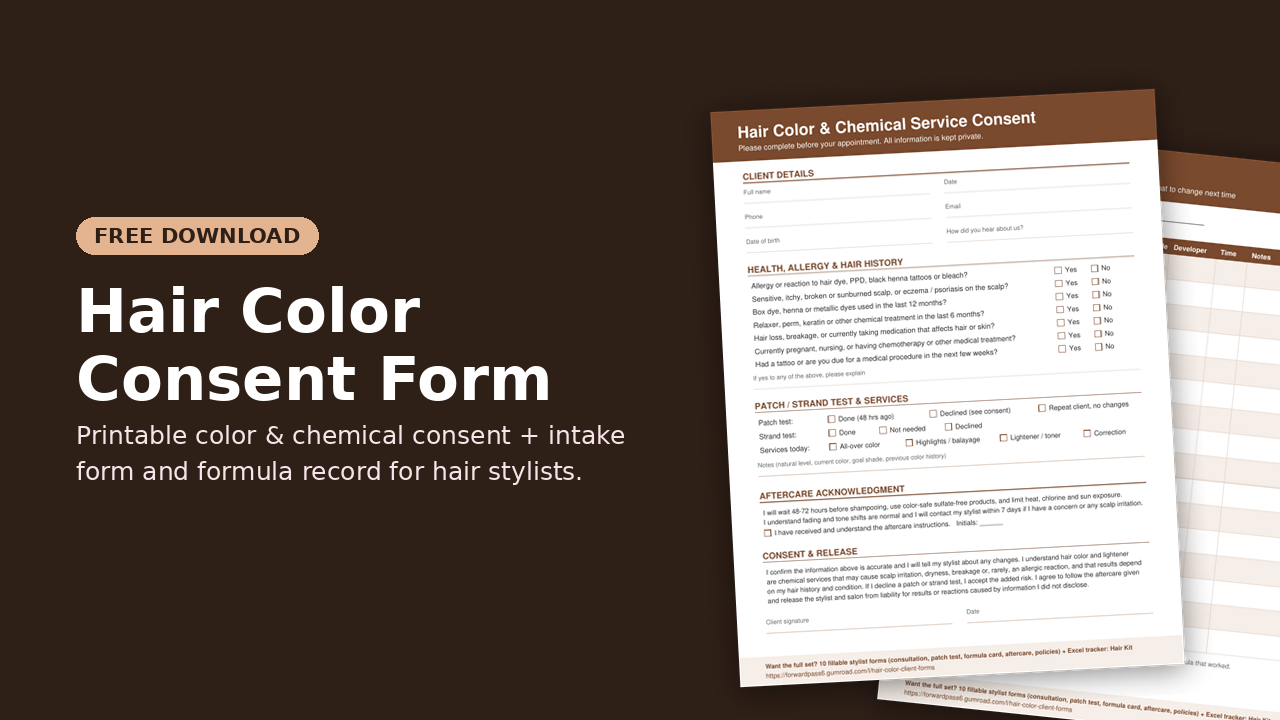
Free Hair Color Consent Form
A printable hair color and chemical service consent and intake form plus a client formula record for stylists, colorists and salons.
Download free →Section 1: Contact details and booking basics
Start with what you need to reach the client and to know whether the booking fits your schedule and services.
- Full name and the name they prefer to be called
- Phone number, email and preferred contact method for questions and reminders
- New client or returning client? If returning, when was their last visit with you?
- Which service are they asking about: all-over color, root touch-up, gray coverage or blending, highlights, balayage, color correction, toner or gloss, a fashion color, or "not sure"?
- Are they also booking a cut, treatment or styling in the same visit?
- Is there a date they want to look their best for, such as a wedding, photo session, trip or holiday party?
- Do they prefer weekdays, evenings or weekends, and are there dates they cannot do?
"Not sure" is a useful answer. It tells you to guide the client with the next sections and to plan a consultation rather than guessing at a service name. A deadline is just as useful: if the goal may take more than one appointment, you need to know about the event early enough to plan the steps.
Section 2: The color goal and inspiration photos
This is where the client describes what they want. Words like "blonde," "subtle" and "natural" mean different things to different people, so ask for pictures as well as words.
- In a few words, what would they like their hair to look like after the appointment?
- Two or three inspiration photos, with a note on what they like in each: the tone, the placement, how bright it is, how much of their natural color shows
- One or two photos of looks they do not want (this is often more helpful than the photos they love)
- Do they want low upkeep with soft regrowth, or are they happy to come back often to keep a sharper look?
- Warm, cool or neutral tones, if they know, or "I’m not sure, help me choose"
- Is this a big change or a refresh of what they have now?
| Client says | Helpful follow-up question |
|---|---|
| "I just want to go a bit lighter" | A shade or two lighter than now, or noticeably blonde? Can you send a photo of the level you are thinking of? |
| "Balayage like this photo" | Do you like how bright the ends are, how soft the roots are, or both? How often would you want to come back? |
| "Cover my grays" | Full coverage, or would you be happy with blending so regrowth is softer? Where do the grays show most? |
| "Fix my color" | What happened, and when? Can you send photos of your hair now, in daylight, from the front, back and sides? |
| "Something fun for the holidays" | A gloss or toner, a pop of color in a few sections, or an all-over change? How long would you like it to last? |
The table is an example of how follow-up questions work, not a script. The aim is to turn a general wish into a goal you can plan, time and price.
When you look at inspiration photos, remember that lighting, filters and editing can change how color looks. Ask the client to tell you what they like about the photo rather than promising an exact match, and say on your form that you will talk through what is realistic for their hair.
Section 3: Current hair and color history
What is already in the hair affects what you can do, how long it takes and whether it is wise to do it in one visit. Clients often forget or leave things out, so ask specific questions and make it easy to answer "I don’t know."
- How would they describe their natural color? (A client’s self-description is a starting point. You will see the actual level and tone in person.)
- Is their hair colored now? If so, with what: salon color, box dye from a store, henna or other plant-based dye, a color-depositing product, or a semi-permanent fashion color?
- When was the last color service, and roughly how many times has the hair been colored or lightened in the past couple of years?
- Has the hair been lightened or bleached before? All over or in sections?
- Any chemical services such as perms, relaxers, keratin or smoothing treatments, or other straightening services? When?
- Have they used any color removers, at home or in a salon?
- Current photos taken in natural daylight: front, back, both sides, and a close-up of the roots and ends
Box dye, henna and past lightening are the answers that most often change a quote, because they can affect how the hair lifts and takes color. You do not need to decide anything from the form alone. These answers tell you whether to plan a strand test, a longer appointment or an in-person consultation first.
Keep allergy and sensitivity questions, previous reactions to color and any patch test record on your consent form at the appointment, where you can store them properly and the client signs. On the questionnaire, a single line inviting the client to mention anything they would like to discuss before the appointment is usually enough. If a client mentions a previous reaction, let them know you will talk about it before booking and follow the product manufacturer’s instructions and your own salon policy.
Section 4: Hair condition, length and density
Two clients asking for the same service can need very different amounts of time and product. Length and density are the main reasons, and condition decides how far you can safely go in one visit.
- Current length: above the chin, chin to shoulders, shoulders to mid-back, or longer (a photo with the length visible is best)
- How thick is their hair: fine, medium or thick? Do they have a lot of hair, or not much? (Many clients know roughly how long a blow-dry takes, which is a good clue.)
- Texture: straight, wavy, curly or coily
- Do they have extensions, and what type? Are those being colored too?
- How does their hair feel at the moment: soft and healthy, dry, breaking, tangling easily, stretchy when wet?
- How often do they use hot tools, and at what temperature, if they know?
- Have they had a recent haircut, or are they planning to cut damaged ends at this visit?
| What the client tells you | How it might change your quote or plan |
|---|---|
| Long, thick hair | More product and more application time; you may add a length or density charge if your menu has one. |
| Short hair, fine density | Less product; time may be shorter, though detailed placement still takes time. |
| Dry ends that break easily | You may suggest a gentler plan, a treatment, a trim or more than one appointment. |
| Extensions to be colored | Check the extension maker’s guidance; price and time are usually quoted separately. |
| Curly or coily texture | Placement and styling time may be different; ask how they wear their hair day to day. |
These rows are examples to help you explain a quote, not rules. Your own menu, experience and the products you use decide how each answer is handled.
Section 5: Maintenance, home care and lifestyle
A color that looks great on the day but does not fit the client’s routine will not stay great for long. These questions help you suggest a result they can keep, and they set up the rebooking conversation early.
- How often are they able to come back for touch-ups or toners: every few weeks, every couple of months, or only a few times a year?
- How much time do they spend styling their hair on a normal day?
- Do they swim often, spend a lot of time in the sun or wash their hair every day? (All of these can affect how long a color lasts.)
- Which shampoo and conditioner do they use now? Are they open to changing products for color care?
- Do they have a work dress code or other reason to keep the color within certain limits?
- Do they want a look that grows out softly, or are they happy with visible regrowth between visits?
Upkeep is part of the real cost of a color service. A client who can only come back a few times a year may be happier with a softer, lower-maintenance plan than with a look that needs frequent visits, even if both start at a similar price. Talking about it now avoids disappointment later.
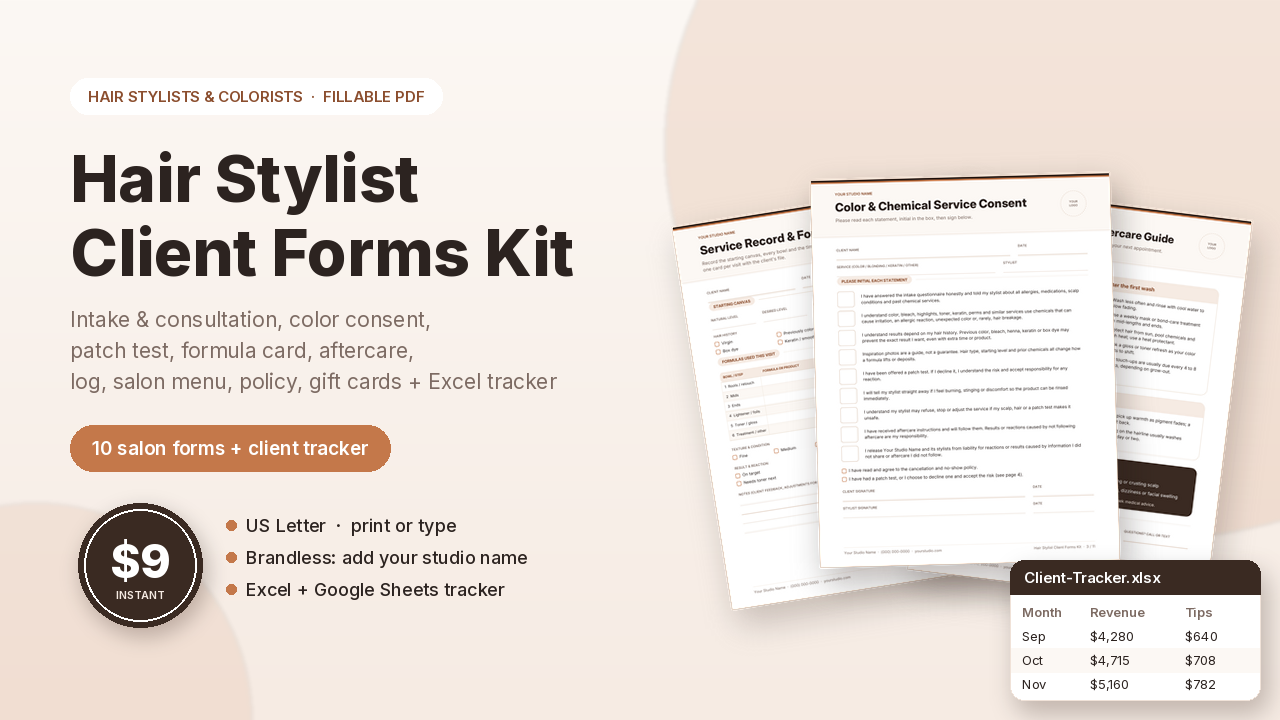
Hair Stylist Client Forms Kit
10 fillable forms (intake and hair consultation, color and chemical consent, patch test record, formula card, aftercare guide, appointment log, salon menu, policies, photo release and gift certificates) plus an Excel client tracker with next-visit due dates.
Get it →Section 6: Budget, time and appointment logistics
You do not need a client’s exact budget, but you need to know whether their expectations and your prices are in the same range, and whether they can give the appointment the time it needs.
- Do they have a budget range in mind for this visit? (Offer ranges they can choose from, or let them leave it blank.)
- Are they open to more than one appointment if their goal needs it?
- How much time can they set aside on the day? Some color services take most of a morning or afternoon.
- Will they bring anyone with them? (Your salon may have a policy on guests or children.)
- How would they like to pay, and do they have a gift card or package to use?
- Have they read your booking, deposit and cancellation policies?
Share your main policies on the form itself, so the client sees them before they book. The table below shows the kind of terms to preview, with placeholders for your own details.
| Term | What to preview (fill in your own) |
|---|---|
| Pricing | [Starting price from your menu / price range after consultation / hourly for correction work] |
| Consultation | [Free / paid and applied to the service / required for color correction and big changes] |
| Deposit | [Amount or percentage] to hold the appointment; [applied to the service / non-refundable / transferable once with notice] |
| Cancellation and late arrival | [Notice required] for changes; [what happens to the deposit]; late arrivals may be shortened or rebooked |
| Patch and strand tests | [When required, how far ahead, per the product instructions and your salon policy] |
| Adjustments | [How soon the client should contact you, and what is included] |
The bracketed text is a placeholder. Use your own terms, and write them in your salon deposit policy and cancellation policy so the form, the confirmation message and the salon all say the same thing.
Section 7: What to confirm before the appointment
Once you have the answers and the client wants to go ahead, a short confirmation message saves problems on the day. Include:
- The service you agreed on, in plain words, and the price or price range
- How long to plan for, and whether this is the first of more than one appointment
- Whether a patch test or strand test is needed first, and when (follow the color manufacturer’s instructions and your salon policy)
- How to arrive: for example, whether to come with dry hair, avoid certain products beforehand, or bring the inspiration photos
- The deposit amount, how it was paid and your cancellation terms
- That you will finish the consultation in person and complete the consent form before you start
The final say on what is safe and realistic always comes after you see and feel the hair in person. Say this clearly in the confirmation. It protects the client and gives you room to adjust the plan without the client feeling misled.
Turning the answers into a quote
Once the form is back, read it in a set order: the goal, the history, the condition, then length and density. That tells you the likely service, time and product. Then check budget and upkeep to see whether the plan fits the client. The table shows how different combinations might be handled.
| Answers (example) | Possible next step (example) |
|---|---|
| Never colored, wants soft dimension, shoulder length, medium density | Quote from your menu for the service; standard appointment length. |
| Dark box dye, wants light blonde for an event next week | Book an in-person consultation and strand test; explain it may take more than one visit and the event date may limit what is possible. |
| Gray coverage every few weeks, short hair | Quote root touch-up from your menu; suggest a regular rebooking schedule. |
| Long, thick hair, wants all-over lightening, previously lightened | Consultation first; quote a range with a length or density charge if your menu has one. |
| Recent at-home color that went wrong | Treat as possible color correction; ask for photos, then consult in person before giving a firm price. |
These are examples, not price rules. Your menu, your experience and the products you use decide the final plan. The useful habit is to connect each quote to the client’s answers, so you can explain why it costs what it does. For more on setting the numbers themselves, see hair color pricing.
When an in-person consultation is worth it
Many simple bookings can be quoted from the form and photos. Some cannot. Ask for an in-person or video consultation when:
- The client wants a big change in lightness or a move from dark to light
- The hair has box dye, henna, a color remover or several layers of past color
- The client describes the job as fixing or correcting a previous color
- The hair is very long or thick, or the condition sounds fragile
- The client is unsure about the goal or tone and wants advice
- Your product instructions or salon policy call for a test before the service
Say on your form when a consultation is required and whether it is free or paid. Clients usually accept it when they understand it leads to a more accurate price and a better plan.
Common mistakes with color questionnaires
- Asking only for the service name. "Balayage" or "highlights" alone is not enough to quote. Ask for photos and a short description.
- Skipping the color history. Box dye, henna and past lightening are the answers that most often change the plan. Ask directly.
- Quoting a firm price from a filtered photo. Ask for current photos in daylight and give a range until you have seen the hair.
- Promising an exact match to an inspiration photo. Promise to talk through what is realistic instead.
- Putting detailed allergy and health questions on a public form. Keep those on the consent form at the appointment.
- Making the form too long. Keep it to the questions you actually use. Clients can fill in more detail during the consultation.
- Hiding your policies. Show deposit, cancellation and test requirements before the client books.
- Forgetting the deadline. Ask about events so you can plan multi-step changes in time.
One-page checklist
- Contact details, preferred name and contact method
- New or returning client; service wanted or "not sure"
- Deadline or event date; days and times that work
- Color goal in words, plus inspiration photos and "do not want" photos
- Upkeep preference: soft grow-out or sharper look with frequent visits
- Natural color (client’s description) and current color
- Box dye, henna, lightening, color removers and chemical services, with dates
- Current photos in daylight: front, back, sides, roots and ends
- Length, density, texture and extensions
- Condition and heat styling habits
- Maintenance, home care and lifestyle
- Budget range, openness to more than one visit, time available
- Policies previewed: pricing, consultation, deposit, cancellation, tests
- Confirmation sent: service, price range, time, tests, how to arrive, consent form at the appointment
Put these questions into your booking form or a fillable consultation sheet, and you will spend less time on back-and-forth messages and more time on appointments that are planned and priced well.
FAQ
What is the difference between a color consultation questionnaire and a consent form?
The questionnaire comes before booking and helps you understand the goal, history and hair so you can quote and plan time. The consent form is completed at the appointment, covers allergies, tests and the client’s agreement to the service, and is signed and kept on file.
Should I ask about allergies on the questionnaire?
Keep detailed allergy and sensitivity questions for the consent form at the appointment, where you can store them properly. On the questionnaire, invite the client to mention anything they would like to discuss before booking.
Can I give a price from photos alone?
For simple services on hair you know, often yes, as a range. For big changes, box dye or color correction, give a range and ask for an in-person consultation before a firm price.
How long should the questionnaire be?
Short enough that clients finish it. Many salons use a handful of required questions and let clients add detail in optional fields or at the consultation.
Should returning clients fill it in again?
Not every time. Ask returning clients what has changed since their last visit, such as at-home color, new chemical services or a new goal, and check your client record.
What if the client’s goal cannot be done in one visit?
Explain the plan in steps, give a price range for each step and confirm the timing, especially if there is an event date.
This page is general information for hair stylists, colorists and salons, not legal, medical or licensing advice. Rules on consent, patch testing, record keeping, deposits, cancellations and salon licensing vary by location, and color products come with their own instructions. Check the current requirements that apply where you work, follow the manufacturer’s instructions for the products you use and have your own forms and policies reviewed.
Related templates
Free Hair Color Consent Form
A printable hair color and chemical service consent and intake form plus a client formula record for stylists, colorists and salons.
Download free →Hair Stylist Client Forms Kit
Intake and hair consultation, color and chemical consent, patch test record, formula card, aftercare guide, policies and more, plus an Excel client tracker.
Get it →