How Much to Charge for a Haircut: Build a Hair Stylist Price List (Plus Free Client Form)
How hair stylists and barbers can set haircut prices: cost per chair hour, pricing by time and type of cut, add-ons for long or thick hair and blowouts, new vs returning clients, rebooking and memberships, deposits and no-shows, and price increases, with a worked example.
Why your haircut price list matters
Haircuts are the service clients book most often, so the price you choose shapes your whole week. Price too low and a full book still leaves you short at the end of the month. Price without a clear system and you end up quoting a different number to every client, giving away blowouts and long-hair time for free, and feeling awkward every time you raise prices.
A simple price list fixes that. Work out what an hour in your chair costs, decide how long each cut takes, set clear add-ons for long or thick hair and styling, and write down your rules for new clients, deposits and no-shows. The sections below walk through each step, with a worked example at the end. All numbers on this page are example numbers, not market data.
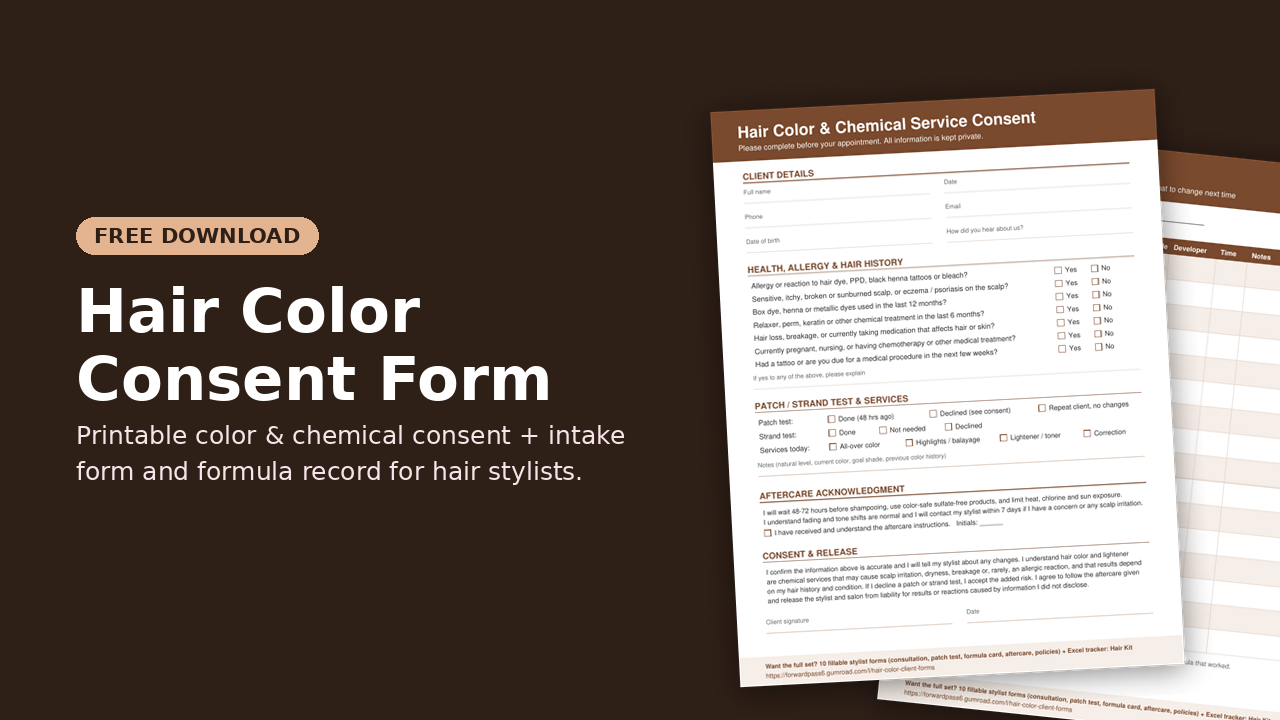
Free Hair Color Consent Form
A printable hair color and chemical service consent and intake form plus a client formula record for stylists, colorists and salons.
Download free →1. Work out your cost per chair hour
Before you look at anyone else's prices, find your own floor. Add up your monthly costs: booth rent or your share of salon overhead, products used on clients (shampoo, conditioner, styling products), tools and sharpening, insurance, booking software, card processing fees and education. Divide that by the hours you actually work with clients each month.
- Example costs: $900 booth rent, $150 products, $60 software and insurance, $90 card fees and supplies = $1,200 a month.
- Example hours: 25 hours a week with clients, about 100 hours a month.
- Example cost per hour: $1,200 / 100 = $12 an hour before you pay yourself.
- Add your pay: if you want to earn $40 an hour, your chair needs to bring in at least $52 an hour.
If a cut takes 45 minutes, that example floor is about $39. Anything under that loses money, no matter how busy you are.
2. Price by time and type of cut
Most stylists keep a short menu of cut types, each with a typical time. This is easier for clients to understand than gendered prices, and it matches the real work in your chair.
- Short cut / clipper cut (example 30 min): fades, buzz cuts and short tapered cuts.
- Standard cut (example 45 min): wash, cut and simple dry for short to medium hair.
- Long-hair cut (example 60 min): layers and longer hair that needs more sectioning and drying.
- Restyle / big change (example 75-90 min): a new shape, a big length change or a first cut for a curly or textured client.
- Fringe / neck trim (example 10-15 min): a small fixed price between full cuts.
Multiply each time by your hourly target to get a starting price, then round to clean numbers. For example, at $52 an hour, a 45-minute standard cut comes to about $39, which you might list as $40 or $45.
3. Add-ons for long hair, thick hair and styling
Add-ons protect your time without making your base prices look high. List them clearly on your menu and booking page.
- Long or extra-thick hair: example $10-20 extra for hair past the shoulders or hair that takes much longer to dry.
- Blowout or styling finish: example $15-30 for a full round-brush blowout, curls or a flat iron finish.
- Deep conditioning or scalp treatment: example $10-20.
- Beard trim or line-up with a cut: example $10-15.
- Curly or textured cutting: some stylists list curly cuts as their own service with more time, rather than an add-on.
4. New clients vs returning clients
New clients take more time: a consultation, questions about their hair history and often a bigger change. Many stylists book new clients into a longer slot or charge a slightly higher first-visit price, then move them to the regular price once they rebook.
Use a short client intake or record card to note hair type, past chemical services, allergies or sensitivities, and the cut you did. It speeds up every later visit and helps you price consistently. For color clients, see the guide to hair color pricing and the hair color consent form.
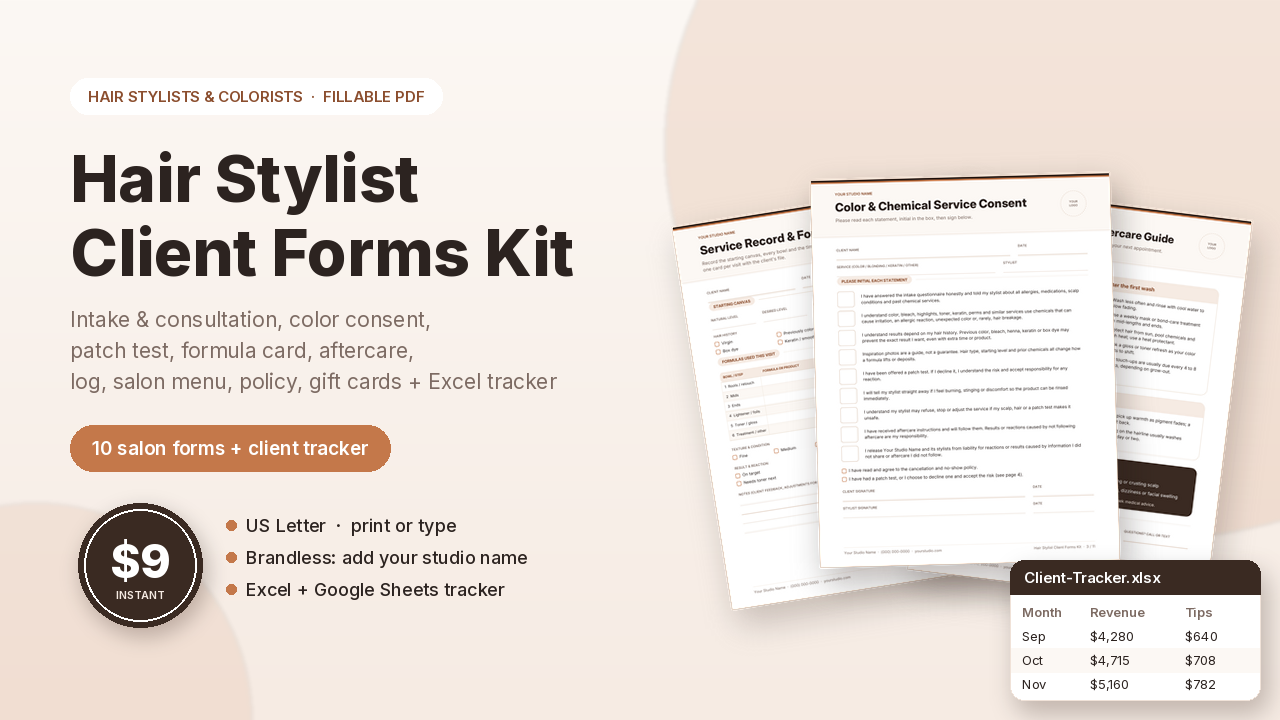
Hair Stylist Client Forms Kit
10 fillable forms (intake and hair consultation, color and chemical consent, patch test record, formula card, aftercare guide, appointment log, salon menu, policies, photo release and gift certificates) plus an Excel client tracker with next-visit due dates.
Get it →5. Rebooking, maintenance and memberships
Regular clients are the most valuable part of a stylist's book. Short cuts often need a trim every 3-6 weeks, longer styles every 8-12 weeks. Offer to book the next visit before the client leaves, and consider a simple loyalty offer instead of discounts on first visits.
- Example rebook offer: book within 6 weeks and get a free fringe trim between visits.
- Example maintenance plan: a monthly fee that covers one short cut every 4 weeks, paid automatically, with a 3-month minimum.
- Keep it simple: one or two offers are easier to track than a long list of deals.
6. Deposits, cancellations and no-shows
A missed 60-minute appointment is an hour of income gone. Many stylists use a deposit policy or a card on file for new clients, and a clear cancellation policy for everyone.
- Example deposit: $15 for new clients, applied to the service.
- Example notice: 24-48 hours to cancel or reschedule without a fee.
- Example late rule: after 15 minutes late, the service may be shortened or rebooked.
- Example no-show fee: 50% of the booked service.
Show the policy at booking, have clients agree to it and apply it the same way every time. Check local consumer rules before calling a deposit non-refundable.
7. When and how to raise your prices
Review your price list at least once a year. Good signs that it is time: your book is full weeks ahead, your costs have gone up, or you have finished new training. Raise by a modest, clear amount, give returning clients a few weeks' notice, and update your menu, booking page and signage on the same day.
Some stylists keep long-time clients on their old price for a few months as a thank-you. Whatever you choose, write it down so you are not deciding at the chair.
Worked example: a standard cut with a blowout
Here is a labeled example, not market data. A returning client with shoulder-length thick hair books a standard cut with a blowout.
- Standard cut (45 min): $45
- Long or thick hair add-on: $10
- Blowout finish (20 min): $20
- Total: $75 for about 65 minutes
- Example costs: products about $4, card fees about $2.25, plus about $13 of booth rent and overhead for the time
- About $56 left for roughly an hour of work
If the same client had booked a cut only and you blow-dried and styled for free, you would have given away $30 of time. Clear add-ons keep the price fair for both of you.
Common haircut pricing mistakes
- Copying the salon down the street without knowing your own costs.
- Giving away long-hair time, blowouts and styling for free.
- Pricing by gender instead of time and service, which can feel unfair and may break local rules.
- Never raising prices, then needing a big jump later.
- No written deposit, cancellation or no-show policy.
- No client records, so every visit starts from scratch.
FAQ
How much should I charge for a haircut?
There is no single right number. Start from what an hour in your chair costs you (booth rent or salon overhead, products, card fees, insurance and your own pay), divide by how many cuts you finish in an hour, then compare with stylists near you who have similar experience. Any prices on this page are example numbers, not market data.
Should women's and men's haircuts cost different amounts?
Many salons now price by time and service instead of gender, for example a short cut, a long-hair cut and a restyle. Pricing by length, thickness and time is easier to explain, feels fairer to clients and matches the real work. Check your local rules too, as some places restrict gender-based pricing for the same service.
Is it OK to charge more for long or thick hair?
Yes, as long as the add-on is listed up front. Long or very thick hair takes longer to cut, wash and dry. A clear add-on, such as an example $10-20 extra for hair past the shoulders, is easier to accept than a surprise at checkout.
How often should I raise my haircut prices?
Many stylists review prices once a year and raise them when their costs go up, their books are full or their skills grow. Give returning clients a few weeks' notice, show the new price list in the salon and online, and raise prices by a modest amount rather than all at once after years of no change.
Should I charge for no-shows on haircuts?
Many stylists take a small deposit or a card on file for new clients and charge a fee for no-shows or very late cancellations. Write the rule down, show it at booking and apply it the same way to everyone. Check local consumer rules before calling any deposit non-refundable.
Should kids' haircuts cost less?
Often they do, because the cut is shorter and simpler, but set an age limit and a time limit. A simple clipper cut for a young child might be priced lower, while a teenager wanting a restyle takes the same time as an adult cut and is priced like one.
This page is general guidance, not legal, tax or insurance advice. Licensing, pricing, consumer and deposit rules vary by state and city, so check your local rules.
Related templates
Free Hair Color Consent Form
A printable hair color and chemical service consent and intake form plus a client formula record for stylists, colorists and salons.
Download free →Hair Stylist Client Forms Kit
Fillable hair color and salon client forms plus an Excel client tracker with next-visit due dates.
Get it →