How Much to Charge for Hair Color: Root Touch-Ups, Single Process, Highlights, Balayage and Color Correction (Plus a Free Hair Color Consent Form)
How stylists and colorists can price hair color: work out your costs and hourly floor, know your product cost per service, compare local rates, price root touch-ups, single process, highlights and balayage, charge color correction hourly, add long or thick hair surcharges, and set consultation, patch test and deposit rules, with a worked example and a free printable hair color consent form.
Why hair color pricing goes wrong
Color is often priced by copying the salon down the street or by quoting one number for "highlights" no matter how much hair the client has. That leaves out the color, lightener, developer and toner that go on every head, the processing time when your chair is blocked, the foils, gloves and backbar products, and the extra time a long, thick or previously colored head takes. A full book can still pay badly. A clear method fixes this: know your costs, hourly floor and product cost per service, price each service by the time and product it really uses, charge correction work by the hour, and put your consultation, patch test and deposit rules in writing.
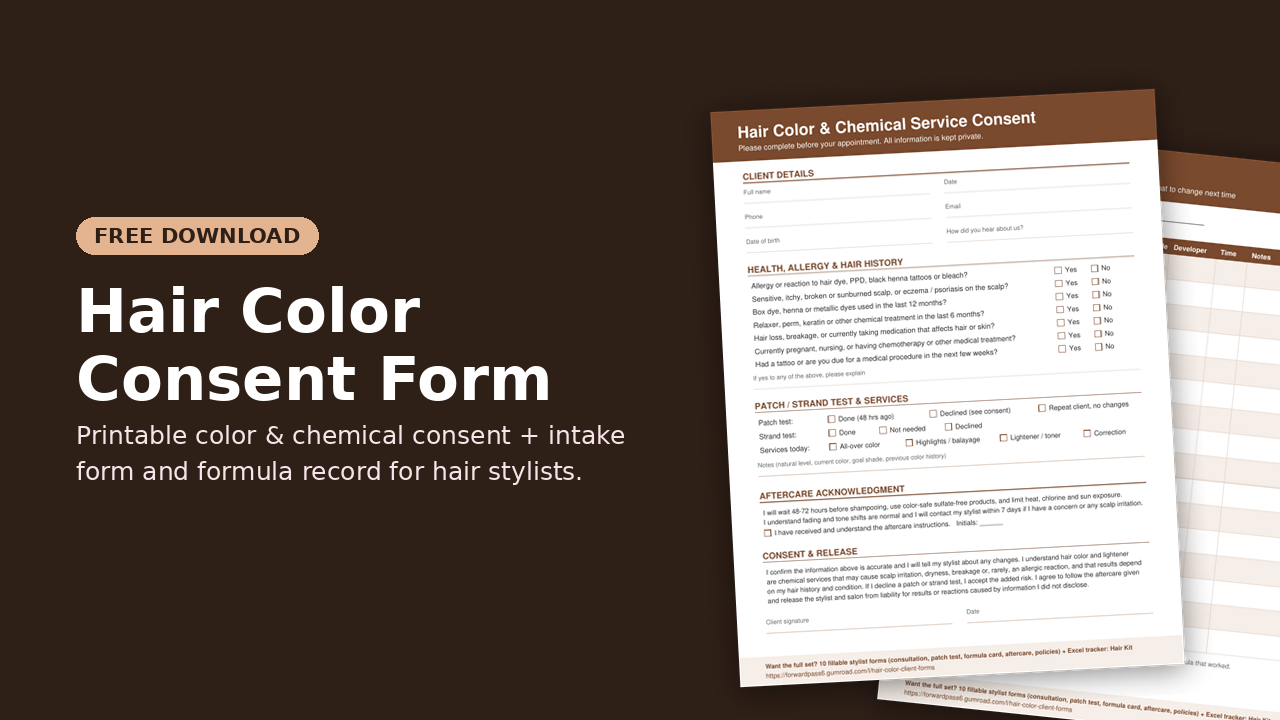
Free Hair Color Consent Form
A printable hair color and chemical service consent and intake form plus a client formula record for stylists, colorists and salons.
Download free →1. Work out your costs and hourly floor
Add up your yearly booth or chair rent, or your commission split, color, lightener, developer, toner and bond builders, foils, bowls, brushes, gloves, capes and towels, shampoo, treatments and styling products used at the bowl and chair, tools such as dryers and irons, license renewals and continuing education, insurance, booking software, card fees and marketing, and self-employment taxes where they apply. Add the income you want, then divide by the hours you can realistically have clients in your chair in a year. Remember unpaid time: consultations, cleanup, mixing and gaps between bookings all reduce the hours you can bill. That gives you an hourly floor, the least an hour of your chair time must earn.
2. Know your product cost per service
Color is one of the few salon services where product cost changes a lot from client to client. Weigh or measure what you actually mix for a few typical services, such as a root touch-up, a full single process, a partial and full highlight and a balayage with toner, and work out the cost of each using what you pay per tube or tub. Add a small amount for foils, gloves and backbar products. Many colorists keep these numbers on their formula cards so they can see the real cost of each client. If a service regularly uses a second bowl of color or lightener, that cost belongs in the price, not in your margin.
3. Research local rates
Look at the color menus that salons and independent stylists near you publish on their websites, booking pages and social profiles. Note how they price: "starting at" prices, prices by service, prices by hair length, or hourly rates for correction. Compare like with like. A new stylist, an experienced colorist with a waitlist and a blonding or vivid color specialist are priced differently, and so are suite renters and full-service salons. Decide where you fit. You can charge above your area when your work, results and client experience justify it, but if local prices sit below your floor, the fix is your menu and your positioning, not longer days.
4. Price by service
Root touch-up: usually the shortest color service, with a set amount of product and a predictable time, so a fixed price works well; set a limit on regrowth (for example a number of weeks or a length) beyond which it becomes a full single process. Single process or all-over color: price for the product a full head needs and the time to apply and process. Highlights: many colorists list partial and full prices, since the number of foils and the time vary a lot. Balayage and lived-in blonding: often take longer and frequently include a toner or gloss, so they usually sit at the top of the menu; say whether toner, a bond builder and a blow-dry are included. Toners and glosses can be priced on their own or as add-ons. Whatever the service, check that the price covers your floor for the full chair time plus the product cost from step 2.
5. Charge color correction by the hour
Color correction, such as removing box dye, fixing banding or going from dark to light, is hard to predict. It can take several hours or several visits, and the result depends on the hair's history and condition. That is why many colorists price correction hourly, after a consultation, with an estimated range of hours and product. Explain up front that the estimate can change once you see how the hair lifts, that more than one session may be needed to protect the hair, and that the client agrees to the plan in writing. Hourly pricing protects you from a fixed quote turning into an unpaid afternoon.
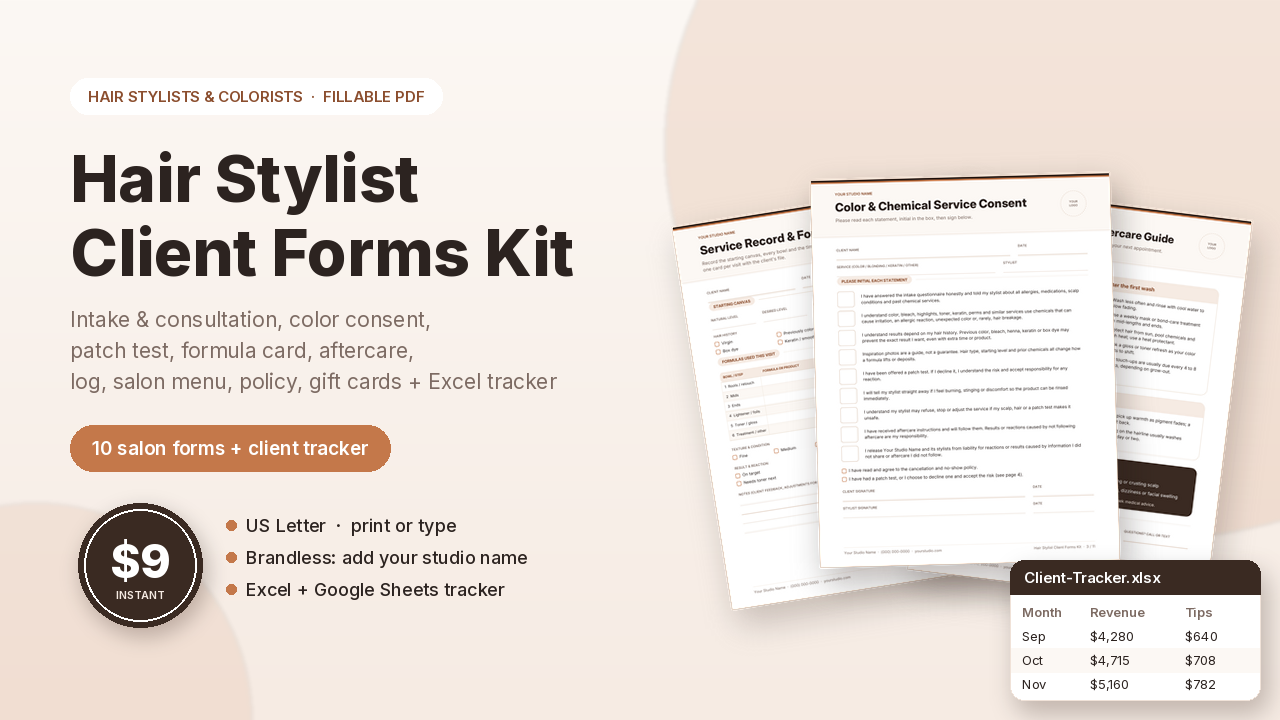
Hair Stylist Client Forms Kit
10 fillable forms (intake and hair consultation, color and chemical consent, patch test record, formula card, aftercare guide, appointment log, salon menu, policies, photo release and gift certificates) plus an Excel client tracker with next-visit due dates.
Get it →6. Add long and thick hair surcharges
Long, very thick or very dense hair takes more product and more time, sometimes a lot more. Rather than raising every price, many stylists add a long or extra-thick hair surcharge, or list prices by length (for example short, medium, long and extra long). Define the rule clearly, such as hair past the shoulders or a second bowl of product, so it is applied the same way every time. Tell clients at booking and in your menu, so the surcharge is never a surprise at checkout.
7. Consultations and patch tests
A consultation before major color changes lets you check the hair's history, condition and the client's expectations, and give a realistic quote. Some colorists offer a free short consultation; others charge a fee that comes off the service. Many color manufacturers include instructions for an allergy alert or patch test before using their products, often a set time before the service; follow the instructions for the products you use and your local rules. Record the result and the date on the client's record, and decide whether a missed patch test means the appointment is moved.
8. Deposits and cancellation rules
Long color appointments are expensive to lose. A no-show on a balayage or correction can empty half a day. Many stylists take a deposit for long services, new clients and correction work, which comes off the final price. Spell out how much notice is needed to cancel or reschedule, what happens to the deposit if the client is late or does not show, and whether there is a fee for late cancellations. State the rule at booking, have clients agree in writing, and track deposits paid, applied or forfeited.
9. Raise prices as you get busier
Review your prices at least once a year, and sooner when color, rent or insurance costs go up. If you are booked weeks out and turning clients away, that is usually a sign you can raise your prices. Give regulars notice, honor quotes and bookings already made, and apply new prices to new bookings. Raising prices in small steps, or raising the services you are busiest with first, is easier for regulars than one big jump.
Worked example (example numbers)
These are example numbers to show the method, not a recommended price. Say your yearly costs, excluding color product, come to $18,000 and you want to earn $52,000, so you need $70,000. If you can bill about 1,400 hours of chair time a year, your floor is about $50 an hour. A root touch-up that blocks 1.5 hours of your chair, including processing, with $12 of color needs at least 1.5 x $50 + $12 = $87. A full balayage with toner that blocks 3.5 hours with $35 of lightener, toner and foils needs at least 3.5 x $50 + $35 = $210. If long, thick hair adds about 45 minutes and $15 of product, a surcharge of about $53 covers it. A color correction estimated at 4 to 6 hours would be quoted as $50 an hour plus product, so roughly $230 to $340 at this floor. These are floors; compare them with local rates before setting your menu.
Put your prices and policies in writing
Most color disputes start with nothing on paper: a client who did not mention box dye, a surcharge they did not expect, a skipped patch test or a deposit they thought was refundable. A signed hair color consent form records the client's hair history, allergies and agreement to the risks of chemical services. A patch test record and formula card keep your results repeatable and your records clean, and a written policy sheet covers deposits, cancellations and surcharges. Clear forms make clients trust you and make your policies easy to enforce.
FAQ
How much should I charge for hair color?
Work out your hourly floor from your yearly costs and income goal divided by the hours you can bill, add the product cost of each service, then compare with what stylists of similar experience charge in your area.
How do I price balayage compared with highlights?
Balayage often takes longer and usually includes a toner or gloss, so many colorists price it above a full highlight. Price each by the chair time it blocks plus the product it uses.
Why is color correction usually charged by the hour?
Correction is hard to predict and can take several hours or visits depending on the hair's history, so hourly pricing with an estimated range, agreed after a consultation, protects both you and the client.
Should I charge extra for long or thick hair?
Many stylists add a surcharge or price by length, because long or thick hair uses more product and time. Define the rule clearly and show it on your menu.
Do I need a patch test before hair color?
Many color manufacturers give instructions for an allergy alert test before using their products. Follow the instructions for the products you use and your local rules, and record the result.
Should I take deposits for hair color appointments?
Many stylists take a deposit for long services, new clients and correction work that comes off the final price, with clear cancellation rules agreed at booking.
This page is general guidance, not legal, tax, medical or licensing advice. Rules on cosmetology licensing, patch testing, deposits and fees vary by location, so check the rules where you work and follow your product manufacturer's instructions.
Related templates
Free Hair Color Consent Form
A printable hair color and chemical service consent and intake form plus a client formula record for stylists, colorists and salons.
Download free →Hair Stylist Client Forms Kit
Fillable hair color and salon client forms plus an Excel client tracker with next-visit due dates.
Get it →