How to Start a Client Referral Program (+ Copy-Ready Referral Messages)
Why referrals work, when to ask, five copy-ready messages (email, text, in person, follow-up and a thank-you-for-referring note), simple reward ideas with a labeled example, referral card wording, a tracking table and a checklist.
Why referrals work for small service businesses
When someone needs a cleaner, a dog groomer, a nail tech, a personal trainer or a handyman, they often ask a friend, a neighbor or a coworker first. A recommendation from someone they trust answers the big question a stranger has about a small business: can I trust this person in my home, with my pet or with my project?
Referred clients tend to arrive already knowing what you do and roughly what you charge, because the person who referred them told them. That usually means fewer price surprises, easier first conversations and clients who fit the way you work. Referrals also cost little: a thank-you and, if you choose, a small reward you only give when a referral actually books.
Most happy clients are willing to recommend you; they just do not think of it unless you ask, and they do not know how to pass you along unless you make it easy. A simple referral program fixes both. This guide covers when to ask, copy-ready referral request messages for email, text and in person, a follow-up, a thank-you-for-referring note, simple reward ideas, referral card wording, a tracking table, common mistakes and a checklist. Change the wording so it sounds like you.

Free 1-Page Invoice Template
A free 1-page invoice for Excel, Google Sheets and LibreOffice plus a printable PDF, with automatic line totals, discount, tax and due date. Add a referral line to the footer.
Download free →When to ask for referrals
- Right after a great result. When a client is happy with a fresh clean, a finished project or a well-groomed dog, recommending you feels natural.
- When a client compliments you. "My sister would love this" is an open door. Thank them and hand over a card or link.
- After a client leaves a review. Someone who just took the time to write a review is clearly willing to recommend you.
- Before you have open spots. Ask a few weeks before a slower season, such as early December for January, so new clients can book into the gaps.
- At a milestone. A regular client's anniversary with you, the end of a training block or a project handover.
When not to ask: right after a problem you have not fixed yet, in the same message as a payment reminder, or so often that it feels like a sales pitch. A clear ask now and then, plus a referral line on your cards and invoices, is enough.
Decide how your referral program works
Before you send a single message, write down a few simple rules so you can explain them in one sentence:
- Who can refer: usually any current or past client.
- What counts: a new client who books and completes a paid appointment (not just someone who asks for a quote).
- What the referrer gets: a thank-you note at minimum, and if you choose, a small reward (ideas below).
- What the new client gets: optional, such as a small welcome add-on on the first visit.
- How you know who referred whom: ask every new client "How did you hear about me?" and note the name.
- Limits: for example, one reward per new client, and rewards are not cash unless you have decided that is appropriate for your business.
Write the rules once and use the same wording on cards, messages and your website so nobody is confused.
Copy-ready referral request messages
Replace the words in [brackets]. Keep each message short and make the next step obvious: share a link, forward a message or pass on a card.
1. Email to a happy client
Subject: Thank you, and a small ask
Hi [Name],
Thank you for trusting me with [your home / Biscuit / your project] this year. It has been a pleasure working with you.
Most of my new clients come from people like you telling a friend. If you know someone who could use [service] in [town], I would be grateful if you passed my name along. You can forward this email or share this link: [booking or website link].
[Optional: As a thank-you, when someone you refer books their first appointment, I will [reward].]
Thank you either way. I appreciate you.
[Your name]
[Business name]
2. Text message
Hi [Name], it's [Your name] from [Business]. Thanks again for having me out for [service]! If a friend or neighbor ever needs [service], I'd be grateful if you shared my link: [short link]. Reply STOP to opt out of texts.
Consent note: only text clients who already text with you or who agreed to receive messages from your business. A referral request can count as a marketing message under the rules in some places, so keep it to one text, identify your business, include a simple way to opt out, and check the messaging rules where you work. Do not text the people your client refers unless they contact you first or agree to be contacted.
3. In-person script
I'm really glad you're happy with it. I'm a small business and most of my new clients come from referrals. If you know anyone who could use [service], would you mind passing along one of my cards? [Optional: If they book, I'll [reward] as a thank-you.]
Keep two or three referral cards with you, hand them over with a smile, and say thank you whether they take one or not.
4. Gentle follow-up (one only)
Hi [Name], a quick follow-up on my note from last week. If anyone you know needs [service] this [season], here's the link to share: [short link]. No pressure at all. Thanks again for being such a great client!
[Your name]
Send one follow-up at most. After that, rely on your cards, invoice footer and the next natural moment to ask.
5. Thank-you-for-referring note
Hi [Name],
I just wanted to say thank you for recommending me to [New client first name]. I had my first appointment with them on [date], and it means a lot that you would trust me with someone you know.
[Optional: As a small thank-you, [reward] is waiting for you at your next visit.]
Thank you for supporting a small business.
[Your name]
Send this note even if you do not offer a reward. Share only what the new client would be comfortable with: a first name and the fact that they booked is plenty. Never share details about their home, pet, health or job.
Simple referral reward ideas
You do not have to offer a reward. A sincere thank-you note works on its own. If you do offer one, keep it simple, affordable and easy to explain, and give it only after the referred client completes a paid appointment.
| Reward idea | Works well for | Notes |
|---|---|---|
| Free add-on at the next visit | Groomers, nail techs, detailers, cleaners | For example, a nail art accent, a teeth brushing, an interior wipe-down or an inside-the-fridge clean |
| Set dollar amount off the next service | Most service businesses | Easy to explain and track; state the amount, not a vague "discount" |
| Small gift | Any business | A coffee shop gift card, a candle or a pet treat bag, with a handwritten note |
| Two-sided reward | Businesses that want new clients to try them | Both the referrer and the new client get a small perk on their next or first visit |
| Priority booking | Busy seasonal businesses | First pick of holiday, spring or peak-season slots |
| Charity donation | Clients who prefer not to receive anything | A small donation to a local cause in the referrer's name |
Labeled example: a reward that fits your prices
A mobile dog groomer charges [$70] for a full groom. She decides that when a referred client completes a first groom, the referrer gets [$10] off their next groom and the new client gets a free blueberry facial (an add-on that costs her a few dollars in product and a few minutes). She writes the rule on her referral card as: "Refer a friend: when they book their first full groom, you get $10 off your next one and they get a free blueberry facial."
Example only. Names, dates, prices and entries are made up to show the method. Use your own.
Choose a reward you can afford even if many clients use it, and make sure your prices still cover your time and costs after the reward. Keep rewards separate from reviews: never offer a reward in exchange for a review, only for a referral that books.
Check your local rules. Some licensed professions, such as health care, legal, financial, real estate and certain personal care or trade licenses, have rules that limit or ban paying or rewarding people for referrals. Rules also vary by state and country. If you hold a professional license, check your licensing board's rules before offering any referral reward, and when in doubt, stick to a thank-you note.
Referral card wording
A referral card is a business card your client hands to a friend. Print a stack, keep some in your kit and leave one or two with each happy client. Keep it to a few lines and include a way to know who referred the new client.
[Business name]
[Service] in [town]
Recommended by: ____________
Book your first appointment at [short link] or text [phone].
Mention this card and [the person who referred you] gets a thank-you from me.
[Optional: New clients get [welcome perk] on their first visit.]
Other short lines that work on cards, invoices and email signatures:
- "Know someone who needs [service]? I'd love the referral: [short link]"
- "Most of my clients come from referrals. Thank you for passing my name along."
- "Refer a friend: when they book, you both get [perk]."
If you send invoices from a template, add one referral line to the footer so every client sees it without an extra message.
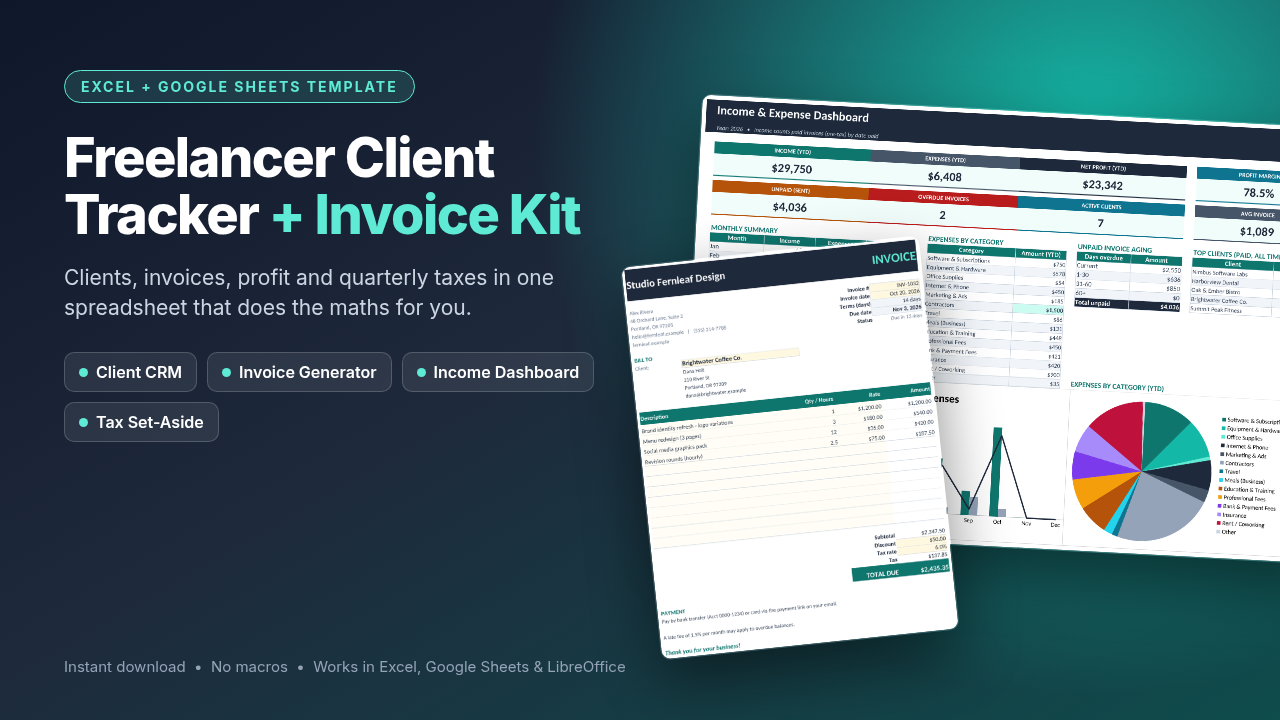
Freelancer Client Tracker + Invoice Kit
One Excel and Google Sheets file with a client list that stores each client's rate and payment terms, an invoice generator with client dropdowns, an invoice log with overdue alerts, an expense tracker, an income dashboard and a quarterly tax set-aside calculator. It does not include referral templates or a referral tracker; copy the messages on this page and add referral columns yourself.
Get it →Track your referrals
A few columns on your client list show who referred whom, whether the new client booked and whether you have said thank you:
| Referred by | New client | How they heard | First booking | Completed | Thank-you sent | Reward given |
|---|---|---|---|---|---|---|
| [Name A] | [Name D] | Referral card | Jan 6 | Yes | Jan 7 (note) | Jan 20 add-on |
| [Name B] | [Name E] | Forwarded email | Jan 9 | Yes | Jan 10 (note) | Next visit |
| [Name A] | [Name F] | Text link | Jan 14 | No (rescheduled) | - | - |
Example only. Names, dates, prices and entries are made up to show the method. Use your own.
If you already keep clients and invoices in a spreadsheet, add these columns next to your client list. The Freelancer Client Tracker + Invoice Kit includes a client list with each client's details, an invoice generator, an invoice log and an income dashboard; it does not include referral templates or a referral tracker, so add the referral columns yourself and copy the messages from this page.
Common mistakes
- Never asking. Happy clients rarely refer you unless you ask and make it easy.
- Vague rules. "Refer a friend for a discount" leaves people guessing. State what counts and what they get.
- Rewards you cannot afford. Pick a reward that still leaves you a fair price for the job.
- Forgetting to say thank you. Thank every referrer, reward or not.
- Not asking new clients how they heard about you. Without that question you cannot thank the right person.
- Contacting referred people who did not agree. Let the referrer pass on your details, or contact the new person only if they agreed.
- Mixing referrals and reviews. Rewards are for referrals that book, never for reviews.
- Ignoring license rules. Licensed professionals should check whether referral rewards are allowed.
Referral program checklist
- Referral rules written in one or two sentences
- Reward chosen (or thank-you note only) and checked against your prices
- Licensing or local rules checked if you hold a professional license
- Short booking link ready
- Referral cards printed with a "Recommended by" line
- Referral line added to invoice footer and email signature
- "How did you hear about me?" added to your intake or booking form
- Email and in-person ask ready; texts only to clients who agreed, with an opt-out
- One follow-up at most
- Thank-you-for-referring note sent for every referral
- Referral tracking columns updated
FAQ
What is a client referral program?
A simple, written way to encourage happy clients to recommend you: you ask at the right moments, make sharing easy with a link or card, track who referred whom, and thank every referrer, sometimes with a small reward once the new client books.
Do I have to offer a reward for referrals?
No. A sincere thank-you note works on its own. If you offer a reward, keep it small, state it clearly and give it only after the referred client completes a paid appointment.
What is a good referral reward for a small service business?
A free add-on, a set dollar amount off the next service, a small gift, priority booking or a two-sided perk for both clients. Choose something you can afford even if many clients use it.
Can I text clients asking for referrals?
Only if they already text with you or agreed to receive messages from your business. Keep it to one short text, identify your business, include a way to opt out, and check the messaging rules where you work.
Are referral rewards allowed for licensed professionals?
It depends. Some licensed professions, such as health care, legal, financial and real estate, limit or ban paying for referrals, and rules vary by state and country. Check your licensing board's rules first, and use a thank-you note if unsure.
Can I reward a client for leaving a review instead?
No. Review platforms do not allow rewards for reviews. Keep referral rewards for referrals that book, and ask for reviews separately with nothing in return.
This page is general information for small service businesses, not legal, tax or marketing compliance advice. Rules on referral rewards, messaging, privacy and consumer protection change and vary by profession, country and state; check the rules that apply to you and your license, and ask a qualified professional if you are unsure. All names, prices and dates shown are examples only.
Related templates
Free 1-Page Invoice Template
A free 1-page invoice for Excel, Google Sheets and LibreOffice plus a printable PDF, with automatic line totals, discount, tax and due date. Add a referral line to the footer.
Download free →Freelancer Client Tracker + Invoice Kit
Client list with rates and payment terms, invoice generator, invoice log with overdue alerts, expense tracker and profit dashboard.
Get it →More free guides
- How to Ask Clients for Reviews
- Year-End Client Thank-You Note Templates for Service Businesses
- January Slow Season Promo Ideas for Service Businesses
- Price Increase Letter to Clients
- Cleaning Gift Certificate
- How to Track Freelance Clients, Projects and Payments in One Spreadsheet
- Year-End Checklist for Freelancers
- House Cleaning Pricing