Window Cleaning Contract Template: What to Include (Free Template + Example)
A plain-English walkthrough of the clauses window cleaners put in their service agreements: parties and property, interior and exterior scope, pane counts, screens, tracks and sills, hard-water stains and post-construction cleaning, per-pane or per-job pricing, ladder and height limits, weather rescheduling, existing glass damage, liability, recurring service, payment, re-clean window and sign-off, with a worked example and free window cleaning forms.
Why window cleaning jobs need a written agreement
Window cleaning disputes rarely come from the cleaning itself. They come from what each side assumed. The customer thought screens and tracks were included. The quote said 30 windows but the house had 30 windows with divided panes. A second-story window over a sunroom could not be reached safely with a ladder. It rained the day after, and the customer wanted a free redo. Or a scratch was found on a patio door that had been there for years.
A short window cleaning contract, often called a window cleaning service agreement, settles these questions before the first pane is touched. It names the property, describes exactly what is being cleaned, explains how the price is calculated, sets height and access limits, and covers weather, existing glass damage, liability, recurring service, payment and a re-clean window.
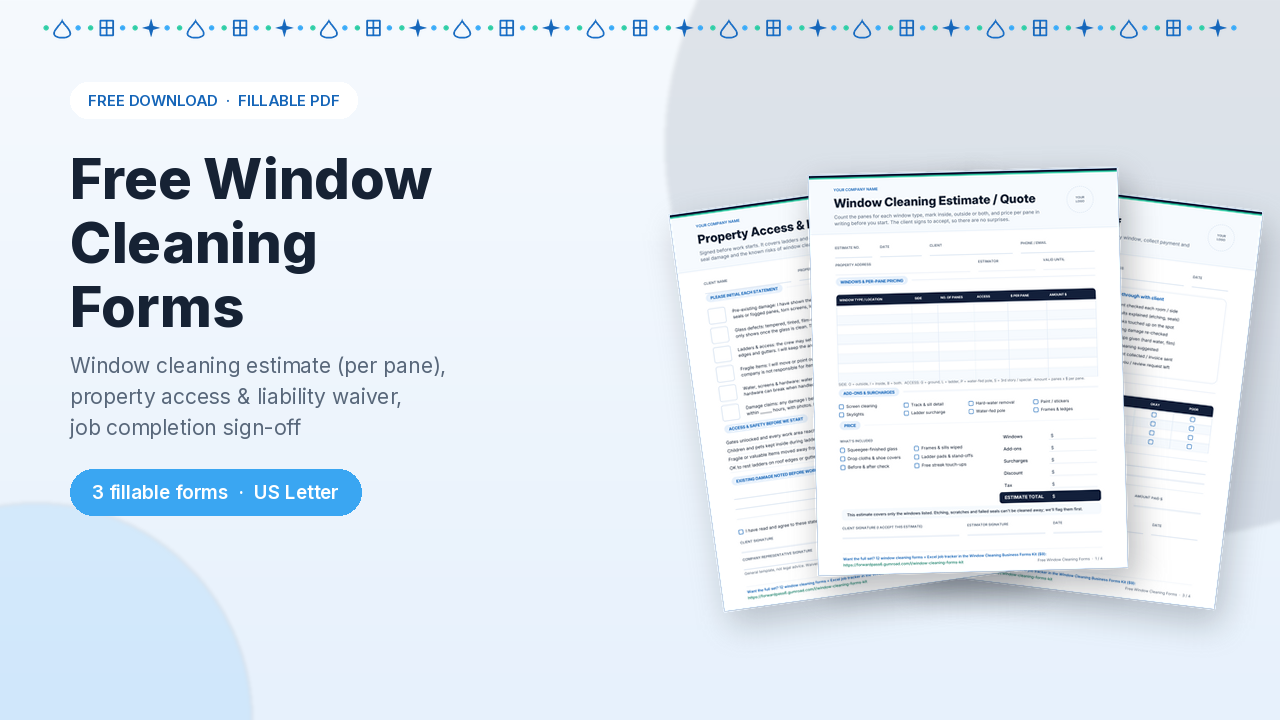
Free Window Cleaning Forms
A printable estimate form plus a simple service agreement for residential window cleaning jobs.
Download free →1. Parties and property details
Start with your business name, phone, email and any license or registration number your area requires. Add the customer's name, contact details and the service address. For rentals, condos and commercial buildings, note who is authorizing the work and who to contact on the day: owner, tenant, property manager or building superintendent.
Record the property type and size, such as a two-story single-family home, a ground-floor storefront or a three-story townhouse. Note gate codes, parking, pets and whether someone must be home for interior work.
2. Scope of work: what is and is not included
The scope section is where most arguments are prevented. Be specific about each of these:
- Interior, exterior or both. State which sides are included for every window, or list exceptions (for example, exterior only on the second floor).
- Pane and window count. Write the number of windows and how you count them. A double-hung window has two sashes; a French door may have 15 small panes. Define whether you price per window, per pane or per side.
- Screens. Removed, brushed and rinsed, or not included.
- Tracks and sills. Wiped, vacuumed and detailed, or not included.
- Frames, skylights, mirrors, glass railings and storm windows. List any that are included.
- Hard-water stains. Mineral deposits from sprinklers often do not come off with standard cleaning. Say whether stain removal is included, quoted separately or tested on one pane first, and that full removal is not guaranteed.
- Post-construction cleaning. Paint, stucco and adhesive take extra time and scrapers; price it separately and note the higher scratch risk.
Add a line that anything not listed is not included and will be quoted separately if the customer asks for it on the day.
3. Pricing: per pane, per window or per job
Window cleaners usually price one of three ways: per pane, per window (often with a per-side rate) or a flat per-job price based on a walkthrough. Whichever you use, write the method into the agreement with the count it is based on, so the customer can see how the total was built.
Example price sheet only; set your own prices for your market: standard window, inside and outside, $10 each; exterior only $6; French or divided-light panes $2 per pane; screens $3 each; tracks $3 per window; second-story windows by ladder add $3 per window; hard-water stain treatment from $15 per window; minimum job charge $150. For flat per-job quotes, say what the price includes (for example, 24 windows inside and out, screens and sills) and that added windows or services are billed at the listed rates.
For photo or phone estimates, state that the final price is confirmed on site.
4. Ladder, height, access and safety limits
Height work is the biggest safety risk in window cleaning. Your agreement should say what you will and will not do:
- The maximum height or number of stories you service, and the method used (ladder, water-fed pole or other equipment).
- Whether you will work from a roof. Many cleaners do not walk on roofs at all, or only on low-pitch single-story roofs in dry conditions.
- That you may decline any window you cannot reach safely because of slope, landscaping, decks, power lines, unstable ground or weather, with no charge for that window.
- That the customer should clear furniture and fragile items from interior sills and give safe access to exterior windows.
Ladder, fall-protection and working-at-height rules vary by location and may apply to you and your employees. Check your local rules and your insurer's requirements before you take multi-story or commercial work.
5. Weather and rain rescheduling
Rain, high wind, ice and freezing temperatures affect both safety and results. Add a weather clause stating that you may reschedule for unsafe conditions, such as high wind for ladder work or temperatures that freeze cleaning solution, and that you will offer the next available date at no charge.
Also address rain after a cleaning. Most cleaners state that rain or sprinklers after the service are not grounds for a free re-clean. If you prefer to offer a short rain guarantee, write the exact terms, such as which windows and how many days.
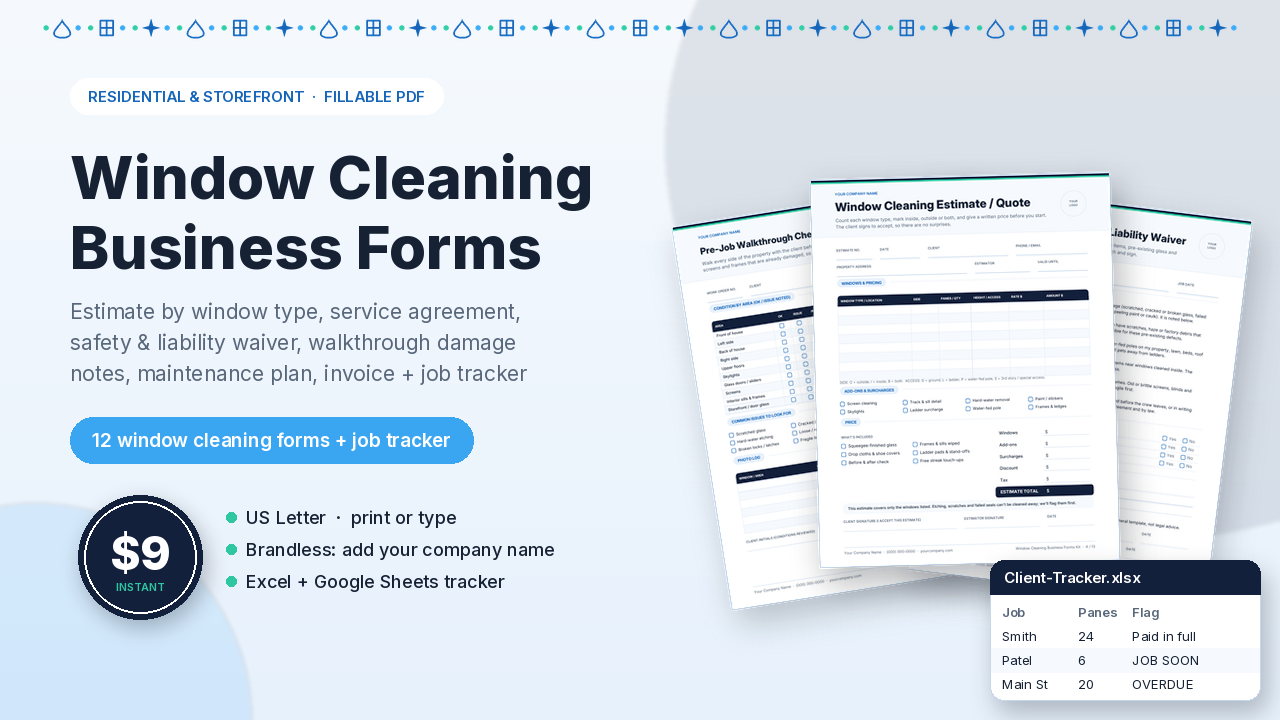
Window Cleaning Business Forms Kit
Fillable window cleaning business forms (client intake, estimate, service agreement, property waiver, walkthrough, job checklist, invoice and more) plus an Excel client and job tracker.
Get it →6. Existing damage, seal failure and scratched glass
Many windows have problems that only show once the glass is clean. List the common ones in a disclaimer and note any you see during the walkthrough:
- Failed seals. Fogging or condensation between the panes of double-glazed windows is inside the unit and cannot be cleaned.
- Scratched or etched glass. Existing scratches, etching from hard water and factory defects in tempered glass often become more visible after cleaning.
- Brittle frames, screens and seals. Old screens, cracked caulking, loose glazing and painted-shut sashes may break or tear during normal handling.
- Window films and tints. The customer should disclose films before the job.
Take dated photos of any visible damage before you start and attach them to the work order.
7. Liability and insurance wording
State whether you carry general liability insurance and, if you have employees, any coverage your area requires. Add a fair liability clause: you take reasonable care, report any damage you cause right away, and are not responsible for pre-existing conditions, failed seals, defects in glass or frames, or damage caused by conditions the customer did not disclose.
Commercial clients often ask for a certificate of insurance. How far you can limit liability in a consumer contract depends on local law, so treat any limit as something to check locally rather than a guarantee.
8. Recurring service schedule and cancellation
Recurring plans are where window cleaning businesses build steady income. If the customer signs up for regular service, write down the frequency (monthly, quarterly, twice a year), which windows are included on each visit (for example, exterior every quarter and interior twice a year), the price per visit, and how prices may change, such as a once-a-year review with 30 days' notice.
Add a cancellation policy for single appointments, for example free rescheduling up to 24 hours before the visit and a trip fee if the crew arrives and cannot work because of a locked gate or no access to the interior. Example only: a $40 trip fee. For recurring plans, say how either side can end the plan, such as written notice before the next scheduled visit.
9. Payment terms
Most residential window cleaning is paid on completion. List accepted payment methods, whether a card fee applies where allowed, and when payment is due. For commercial accounts, state the invoice terms, such as payment due within 15 or 30 days, and any late fee where local rules allow it.
10. Satisfaction and re-clean window
A clear re-clean policy builds trust without inviting endless callbacks. Offer to return and re-clean any window with streaks or missed spots if the customer reports it within a set window, for example 48 or 72 hours, with a photo. Exclude problems the disclaimers already cover: rain, sprinklers, failed seals, scratches, stains outside the agreed treatment, and anything that happened after the visit.
11. Completion sign-off
Before leaving, walk the property with the customer or send photos if they are not home. Confirm the window count, screens reinstalled in the right openings, sills wiped and drop cloths removed. Have the customer sign or initial the work order with the final count and total, or confirm by reply text.
Common mistakes in window cleaning agreements
- Quoting “30 windows” without saying whether you count windows, sashes or panes
- Not stating whether screens, tracks and sills are included
- Promising to remove hard-water stains without testing first
- No height limit or roof-access policy
- No disclaimer for failed seals and existing scratches
- No weather clause, so rain becomes a free re-clean
- Recurring service with no frequency, price review or cancellation terms
Worked example: a two-story home, inside and out
Example numbers only; set your own prices for your market. A homeowner requests a quote for a two-story house. On the walkthrough, the cleaner counts 22 standard windows (10 on the second floor), one French door with 15 panes and 22 screens. Using the example price sheet: 22 windows inside and out at $10 is $220; the second-story add-on is 10 × $3 = $30; the French door panes are 15 × $2 = $30; screens are 22 × $3 = $66. The total is $346. The customer asks about spots on two sprinkler-facing windows; the cleaner tests one pane, notes that the stains only partly lift, and the customer declines the $15-per-window treatment. Two fogged double-pane windows and a scratch on the patio door are photographed and noted as existing conditions. The customer signs the agreement, the job is completed and signed off, and the customer pays $346 by card.
How to send and store your agreement
Send the agreement with your quote so customers see the terms in advance. Keep the signed agreement, walkthrough notes and before photos together in one job file for each customer. Review your template once a year, or whenever your prices, insurance or local rules change, so the terms still match how you actually work.
FAQ
Do I need a contract for residential window cleaning?
A one-page service agreement is enough for most homes. It records the window count, scope, price, height limits and disclaimers, so a simple job does not turn into a dispute.
Should I price window cleaning per pane or per window?
Either works if the agreement explains how you count. Per-window pricing is simpler for standard windows; per-pane pricing is fairer for French doors and divided-light windows. Many cleaners combine both.
Are screens and tracks usually included?
It varies by business. Many cleaners include a basic screen wipe and charge extra for detailed screen and track cleaning. Whatever you choose, write it in the scope section.
Will I have to re-clean windows if it rains?
Not if your agreement says rain and sprinklers after the service are excluded. Most cleaners offer a re-clean window only for streaks or missed spots they caused.
What if the window glass is already scratched or the seal has failed?
Note it during the walkthrough, photograph it, and include a disclaimer that existing scratches, etching and fogging between panes are not caused by cleaning and cannot be fixed by it.
How high should a window cleaner agree to work?
Set a limit that matches your equipment, training and insurance, and state that you may decline windows you cannot reach safely. Height and fall-protection rules vary, so check your local rules.
This page is general guidance, not legal advice. Licensing, insurance requirements, ladder and fall-protection rules, liability limits and consumer contract rules vary by location. Check your local rules and have a qualified professional review your window cleaning contract before you use it.
Related templates
Free Window Cleaning Forms
A printable estimate form plus a simple service agreement for residential window cleaning jobs.
Download free →Window Cleaning Business Forms Kit
Fillable window cleaning forms plus an Excel tracker for clients, jobs, invoices and follow-ups.
Get it →