Car Detailing Client Questionnaire: What to Ask Before You Quote
A practical guide for mobile and shop-based detailers: the questions to ask a prospective client before you give a price, how each answer changes the quote, and what to have ready once they book.
Why you need a questionnaire before you quote a detail
"How much for a full detail?" is the message every detailer gets, usually with no other information. The honest answer is "it depends," because a garage-kept compact that gets washed every month and a third-row SUV that hauls two shedding dogs and a youth soccer team are completely different jobs, even if both owners call their car "pretty clean."
A short pre-quote questionnaire fixes that. Sent by text, email or a simple online form as soon as someone asks for a price, it collects the details that actually drive your time and product use: the vehicle, its condition, pet hair, stains and odors, the service they want, where the work will happen, timing and budget. It is not the same as the documents you use once the job is booked. Your service agreement and vehicle inspection form record the condition walkaround, existing damage and signatures; your detailing checklist covers the work itself; and car detailing pricing explains how to build packages and rates. The questionnaire has one narrower job: get you to an accurate quote quickly. Below are the sections to include, the questions in each, and how to turn the answers into a price.
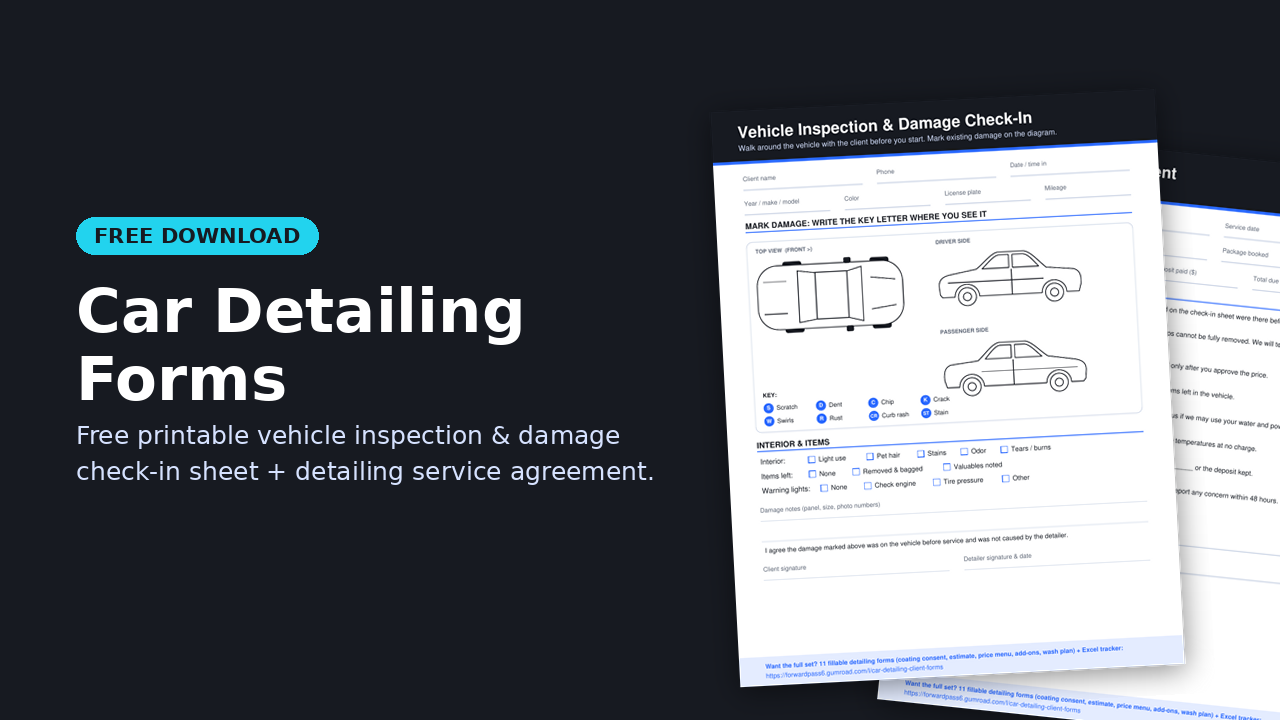
Free Car Detailing Forms
A printable vehicle inspection & damage check-in sheet with car diagrams plus a simple detailing service agreement.
Download free →Section 1: Contact details and the vehicle
- Client name, phone number, email and preferred contact method
- How they heard about you, and whether they are a returning client
- Vehicle year, make and model
- Body type: coupe, sedan, small SUV or crossover, full-size SUV, minivan, pickup (regular, extended or crew cab), van
- Number of seating rows, and whether a third row is folded or in use
- Interior material: cloth, leather, vinyl, Alcantara or suede-like trim
- Exterior color and paint finish, including any matte paint, wrap or existing coating or film
- Any aftermarket parts: lift kit, oversized wheels, bed liner, roof rack, tonneau cover
- More than one vehicle to be detailed at the same visit?
Year, make and model tell you size, interior layout and often paint softness before you see the car. Most detailers price by size class, so a correct body type matters more than anything else in this section. Matte paint, wraps and existing ceramic coatings need different products and methods, so catching them before you quote avoids an awkward conversation on site.
Section 2: Current condition and photos
Condition is the biggest variable in any detail and the one clients most often underestimate. Ask neutral, judgment-free questions:
- When was the vehicle last professionally detailed, if ever?
- On a scale of 1 to 5, how would they rate the interior? The exterior?
- Any heavy dirt, mud, sand, road salt or tree sap?
- Any loose items, trash or child seats that will need removing before you start?
- Any scratches, swirl marks, oxidation, water spots or faded trim they want improved?
- Any existing damage you should know about: chips, dents, cracked trim, torn seats, warning lights?
- Would they send photos of the front seats, rear seats, cargo area, carpets and each side of the exterior, in daylight?
Photos tell you more than any rating scale. Ask for daylight photos of each seat row, the carpets, the cargo area and all four sides; a close-up of the paint in sunlight helps if they want swirl removal. Explain that the quote assumes the vehicle matches the answers and photos, and that you will confirm on arrival with a walkaround before starting. Existing damage noted here should later be recorded on your inspection form, signed by the client, before any work begins.
Section 3: Pet hair, stains and odors
- Do pets ride in the vehicle? What kind, how many and how often?
- Where is the hair concentrated: seats, carpets, cargo area, headliner?
- Any stains: coffee, food, makeup, ink, grease, crayon, mud? Where, and how old?
- Any spills of milk, juice or other liquids that may have soaked into the padding?
- Any odors: smoke, pets, food, mildew or musty smells, or an odor they cannot identify?
- Has the vehicle had any water leaks or flooding?
- Any vomit, bodily fluids, mold or other biohazards?
Pet hair, stains and odors are where a two-hour interior becomes a five-hour interior. Embedded hair in carpet and fabric takes time and specialist tools, so many detailers add a pet hair charge based on severity rather than a fixed price. Be honest about what you can promise. Some stains, especially old dye-based ones, may only lighten, and smoke or mildew odors may need more than one treatment. Biohazards and mold usually need a separate quote, protective equipment and sometimes a referral, so ask directly and say clearly if you do not take that kind of work.
Section 4: Service type: interior, exterior, full detail, paint correction or ceramic
Ask what they want and why. A client selling the car, a client who wants it to look new for the holidays and a client protecting a brand-new vehicle all need different packages:
- Interior only, exterior only, or a full detail inside and out?
- A maintenance wash for a regular client, or a first-time deep detail?
- Any paint correction: one-step polish to improve gloss, or multi-step to remove more defects?
- Any protection: wax or sealant, or a ceramic coating? Is the vehicle new or already coated?
- Add-ons: engine bay, headlight restoration, trim restoration, seat shampoo or extraction, leather conditioning, odor treatment, glass treatment, wheel and tire detail
| Service type | What it usually means for the quote (example only) |
|---|---|
| Exterior wash and protection | Shortest job; [exterior package price] by vehicle size |
| Interior detail | Vacuum, wipe-down, glass and spot cleaning; [interior package price]; pet hair and stains extra |
| Full detail | Interior plus exterior; [full detail price] by vehicle size |
| Maintenance detail | Lower price for regular clients on a schedule; [maintenance rate] |
| Paint correction | Priced by steps and condition after a paint inspection; [correction price or day rate] |
| Ceramic coating | Prep and correction usually required first; [coating package price]; cure time and aftercare apply |
| Add-ons | Priced per item, such as headlights or engine bay at [add-on price] |
Write down exactly which tasks belong to each package so "full detail" means the same thing to you and the client. Paint correction and ceramic coating are best quoted as a range until you have seen the paint in good light, because defects that do not show in a phone photo often show under an inspection light. For pricing methods, see how to price car detailing.
Section 5: Location, mobile setup, water and power
For mobile detailers, the location questions matter as much as the vehicle questions. For shop-based detailers, they become drop-off and pickup questions.
- Will the detail happen at the client's home, workplace or another location, or at your shop?
- Service address, and how far it is from your base or service area
- Is there a driveway, garage, private lot or only street parking?
- Is there shade or covered space, which matters for products and coatings?
- Is there an outdoor water spigot and an outlet you can use, or do you need to bring your own water and power?
- Any HOA, building, apartment or workplace rules about washing vehicles on site?
- Any restrictions on water runoff or noise at that location?
- For shop work: drop-off and pickup times, and whether they need a ride or will wait
Water and power access changes your setup time, what equipment you load and sometimes your price. Some detailers charge a travel fee beyond a set radius or for locations without water or power. Direct sun and wind make some products harder to use and can affect coating work, so ask whether shade or a garage is available. Apartment complexes and offices may not allow washing on site, and some areas have rules about runoff, so check before you confirm.
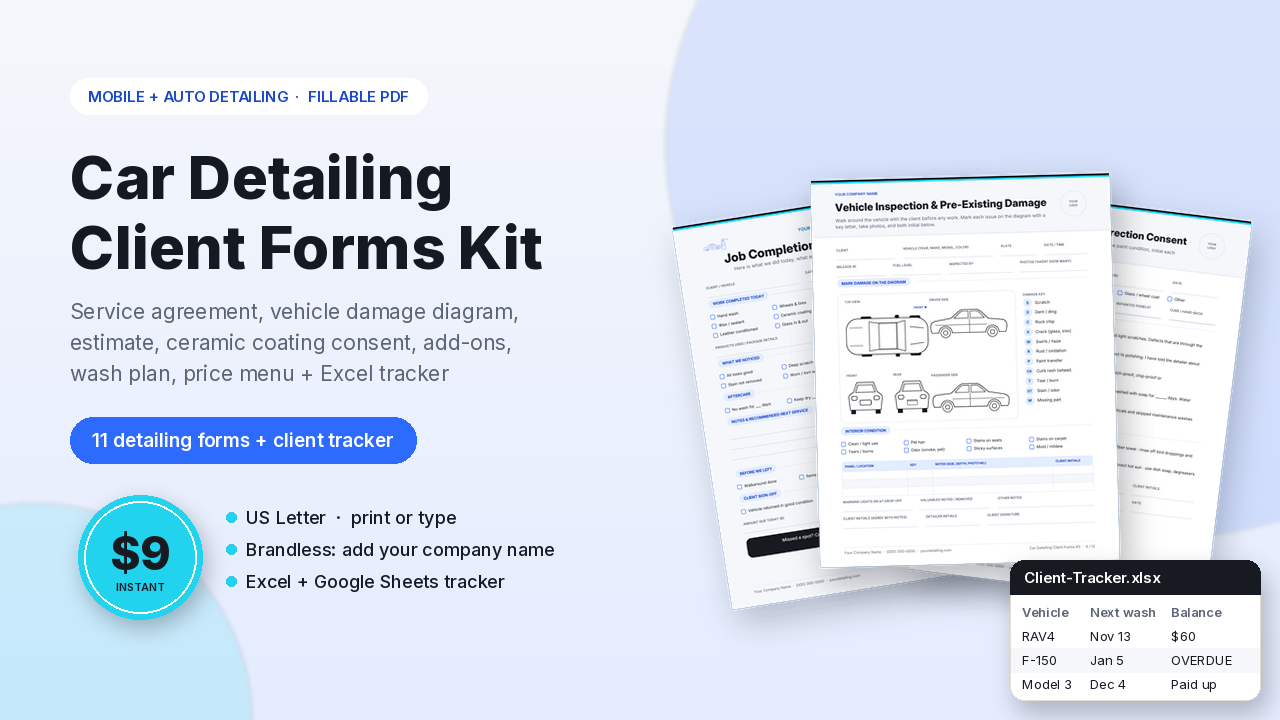
Car Detailing Client Forms Kit
11 fillable forms (client & vehicle profile, service agreement, vehicle inspection with damage diagram, package price menu, estimate, ceramic coating & paint correction consent, job completion report and more) plus an Excel client tracker.
Get it →Section 6: Scheduling and timing
- Preferred dates and times, and how flexible they are
- Any deadline: selling, a lease return inspection, a trip, a holiday or an event?
- How long can the vehicle be unavailable? Can it stay overnight for correction or coating work?
- Will they hand over keys, and will someone be on site during the work?
- Do they want a one-time detail or a recurring maintenance schedule: every two weeks, monthly, seasonal?
- Weather backup: what happens if rain, snow or extreme heat or cold affects the date?
A basic exterior can take a couple of hours, while paint correction and ceramic coating can take a full day or longer, plus cure time before the vehicle gets wet. Make sure the client understands how long you need the car and when they can drive it again. For mobile work, agree a weather plan up front, since cold, rain and direct heat all affect results. In colder months, see winter car detailing pricing for salt, slush and cold-weather add-ons.
Section 7: Budget and policies preview
Ask for a rough budget or the price range they expect. It helps you suggest a package that fits, such as an interior-only detail now and exterior protection next month, or a one-step polish instead of multi-step correction. Then preview your main policies so the service agreement holds no surprises. The table below uses bracketed placeholders only; it is not recommended wording.
| Policy | What to show (placeholders) |
|---|---|
| Pricing basis | Packages are priced by [vehicle size / condition / package], with add-ons listed separately. |
| Condition surcharges | Heavy pet hair, stains, sand or odors may add [fee or hourly rate], confirmed before work starts. |
| Deposit | A deposit of [amount or percentage] is required to book [correction / coating / all] jobs. |
| Travel and setup | Mobile service within [radius] is included; beyond that, [travel fee]. If water or power is not available, [policy]. |
| Cancellation and weather | Cancelling within [timeframe] means [fee or policy]. Weather reschedules are [policy]. |
| Results | Some stains, odors and paint defects may improve but not disappear; [results statement]. |
| Payment | Payment is due [when], by [methods]. |
The policies themselves belong in your signed car detailing service agreement. The questionnaire only previews them so the client knows how you work before you send a number.
Turning the answers into a quote
With a completed questionnaire and a set of photos, you can choose the right package, estimate your time and send a clear quote, often without seeing the vehicle first. The example below is for illustration only. The prices are placeholders; set your own based on your costs, market and experience.
| Questionnaire answer | How it affects the quote (example only) |
|---|---|
| Mid-size SUV, three rows, cloth seats | Size class [large]; full detail base of $[amount] |
| Last professional detail: never; interior rated 2 of 5 | First detail priced as a deep interior; [time or condition fee] |
| Dog rides in the cargo area daily, heavy hair in carpets | Pet hair charge of [amount or hourly rate]; bring hair removal tools |
| Coffee stain on driver seat, light smoke odor | Seat extraction add-on at $[price]; odor treatment at $[price], results not guaranteed |
| Wants swirl marks reduced and gloss improved | Offer one-step polish at $[price]; confirm after paint inspection on site |
| Driveway, outdoor spigot and outlet available | No water or power surcharge; standard setup time |
| Interested in monthly maintenance afterwards | Quote maintenance rate of $[amount] per visit after the first detail |
Send the quote with the package, what is included, any add-ons and condition charges, the first-detail price and any maintenance price shown separately, exclusions, and a note that the price assumes the vehicle matches the answers and photos provided. On arrival, do a walkaround with the client, record existing damage on the inspection form and confirm any changes in price before you start.
Common mistakes to avoid
- Quoting "a full detail" without asking about the vehicle. Size, rows and interior material change your time.
- Skipping photos. A few daylight photos prevent most price surprises.
- Not asking about pet hair, stains and odors. They often take longer than the rest of the interior combined.
- Promising perfection. Say which stains, odors and paint defects may improve but not disappear.
- Quoting correction or coating from photos alone. Give a range and confirm after a paint inspection.
- No weather plan for mobile work. Agree how rain, heat and cold reschedules work.
- Starting without a walkaround. Record existing damage and get a signature before you touch the car.
- Booking correction or coating without a deposit. Long jobs tie up a full day; hold the slot only once the agreement and deposit are in.
One-page car detailing client questionnaire checklist
- Contact details, preferred contact method and how they found you
- Vehicle year, make, model, body type, seating rows and interior material
- Paint finish, wraps, film or existing coatings, and aftermarket parts
- Last professional detail, condition ratings, existing damage and daylight photos
- Pet hair, stains, spills, odors, leaks and any biohazards
- Service type: interior, exterior, full detail, maintenance, paint correction, ceramic coating
- Add-ons such as headlights, engine bay, extraction, trim, odor treatment
- Location, parking, shade, water and power access, and site rules
- Dates, deadline, how long the vehicle can be unavailable, keys and weather backup
- One-time or recurring maintenance schedule
- Budget range and policies previewed: condition charges, deposit, travel, cancellation, results, payment
Send the questionnaire as soon as someone asks for a price, review the answers and photos before you quote, and once they book, move them onto your service agreement and vehicle inspection form.
FAQ
What should a car detailer ask before giving a quote?
Ask for the vehicle year, make, model and body type, the interior material, the current condition and when it was last detailed, pet hair, stains and odors, the service they want, where the work will happen including water and power access, their timing and a rough budget.
Can you quote car detailing from photos?
For most interior, exterior and full details, yes, as long as the quote states that it assumes the vehicle matches the answers and photos. Paint correction and ceramic coating are better quoted as a range and confirmed after inspecting the paint in good light.
How is a client questionnaire different from a vehicle inspection form?
The questionnaire is collected before quoting, to choose a package and estimate time. The inspection form is completed on site after booking, with the client, to record existing damage and condition before any work starts.
Should I charge extra for pet hair?
Many detailers do, because embedded hair can add significant time. Asking about pets before quoting lets you include a pet hair charge based on severity instead of surprising the client on the day.
What do mobile detailers need to know about the location?
Whether there is a driveway or garage, shade, an outdoor water spigot and an outlet, and any HOA, building or workplace rules about washing vehicles on site. That determines your setup, equipment and whether any travel or setup fee applies.
When should I collect a deposit?
Usually once the client accepts the quote and signs your service agreement. Many detailers require deposits for long jobs such as paint correction and ceramic coating, and for new clients booking busy dates.
This page is general information for car detailers and detailing businesses, not legal, insurance or safety advice. Consumer protection rules on deposits, cancellation fees and contracts, requirements for business licenses and insurance, and local rules on water runoff and washing vehicles vary by location. Check the current requirements that apply to you, follow product labels and safe work practices, and have your own forms and agreement reviewed.
Related templates
Free Car Detailing Forms
A printable vehicle inspection & damage check-in sheet with car diagrams plus a simple detailing service agreement.
Download free →