Spray Tan Pricing: How Much to Charge (Plus Holiday Party & Mobile Rates)
A practical guide to setting spray tan prices: single and express sessions, mobile travel fees, group and holiday party rates, bridal tans, packages and memberships, your real cost per tan, deposits and cancellations, prep and aftercare, consent and patch tests, with a worked example and a free spray tan consent form.
Why spray tan pricing is easy to get wrong
A spray tan looks like a quick, cheap service: ten to fifteen minutes in the booth, a little solution and you are done. That is why so many tanning artists undercharge. Once you add setup and cleanup, the consultation, barrier cream, gloves, sticky feet, booth filters, travel time and the clients who never show up, a price that looked fine on paper can leave very little profit.
This guide covers the common pricing models, your real cost per session, and the busy holiday party season from November through New Year's Eve. Every number on this page is a clearly labeled example to show the math. It is not market data. Prices vary by city, experience, solution and setup, so check what is normal near you and set your own rates.
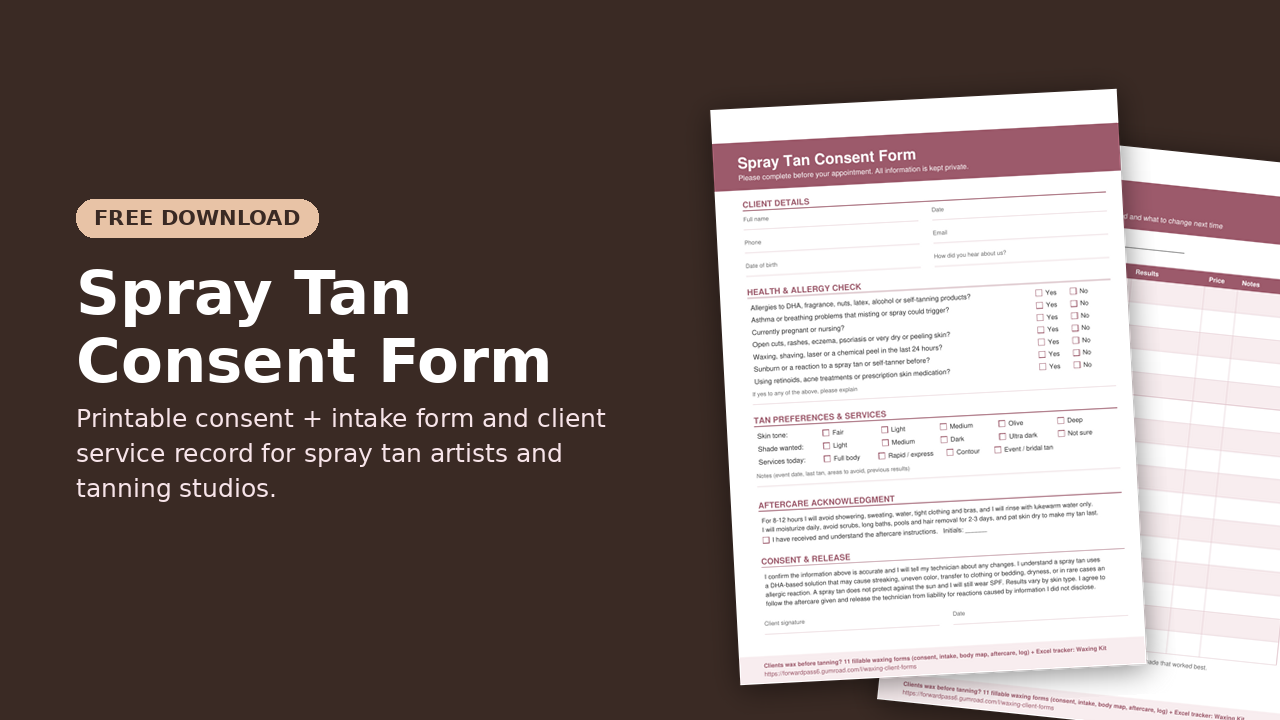
Free Spray Tan Consent Form
A printable spray tan consent and intake form plus a client service record.
Download free →1. Start with your cost per session
Before you pick a price, add up what one tan actually costs you. A simple cost list:
- Solution. The ounces used per full-body tan times the price per ounce. Darker or express solutions often cost more.
- Disposables. Nitrile gloves, sticky feet, disposable underwear, hair caps, wipes, paper towels.
- Barrier cream for hands, feet, nails, elbows and knees.
- Equipment wear. Spray gun parts, hoses, tent and extraction filters, replaced over time.
- Overheads. Studio rent or a share of it, booking software, card fees, insurance, laundry and marketing.
- Your time. Consultation, prep, cleanup and messages, not just the spray.
Example only, not real supplier prices: solution $4.00, gloves and disposables $1.00, barrier cream $0.50, filters and gun wear $0.50, card fees $1.50, share of rent, software and insurance $6.00. That is about $13.50 per tan before paying yourself. If a tan takes 30 minutes of your time end to end and you want to earn $40 an hour, you need about $33.50.
2. Single session pricing
A single full-body session is your anchor price. Everything else (express, packages, parties) is built from it.
Example range only; check your local market: a single standard full-body tan at $35 to $55 in a studio. Some artists charge a little more for a first visit to cover the consultation.
Spell out what the price includes: one full-body application, barrier cream, disposables, and whether a quick touch-up (for example on hands or feet within 48 hours) is included or extra.
3. Express (rapid) tans
Express or rapid solutions let clients rinse after a shorter development time, which makes them popular with busy clients and before events. The solution usually costs more per ounce.
Example only: add $5 to $10 to your standard price for express, so a $45 standard tan becomes $50 to $55 express. Explain that development time affects depth of color.
4. Mobile spray tans and travel fees
Going to a client's home, hotel or office is convenient for them and expensive for you. You carry the tent, extraction fan, gun, solution and towels, set up, clean up and drive both ways. Charge a separate travel fee rather than hiding it in the tan price.
- Base mobile price. Your studio price plus a mobile premium, or a flat call-out fee.
- Travel zones. A free or low-fee radius, then extra per mile or per zone.
- Minimums. A minimum booking (for example two tans or a set dollar amount) for far zones.
- Access notes. Parking, stairs, power outlet and a space you can protect from overspray.
Example only: $25 call-out fee within 10 miles, then $1.50 per mile each way; minimum two tans beyond 20 miles. Parking rules, permits and business licensing for mobile services vary by location, so check your local rules.
5. Group and holiday party pricing
Group bookings are where spray tans can be very profitable: one setup, one trip and several clients back to back. Think bachelorette weekends, proms, competitions and, in November and December, office parties and New Year's Eve.
Price groups per person with a minimum number of tans, and charge your travel fee once per event. A small per-tan discount works because setup is shared, but keep the day more profitable than separate bookings.
Example only: $40 per person for groups of 4 to 7, $35 per person for 8 or more, minimum 4 tans or $160, plus the normal travel fee. Put the schedule in writing: start time, time per guest (for example 15 to 20 minutes), and what happens if guests are late or do not turn up.
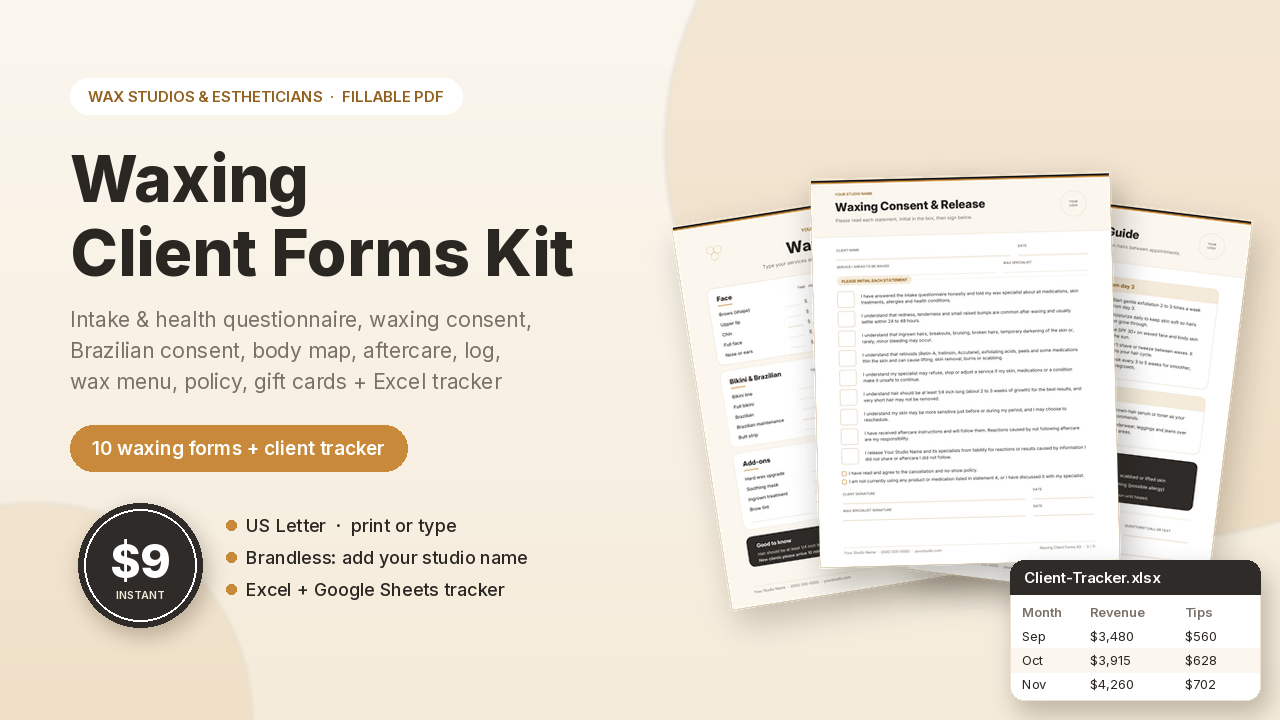
Waxing Client Forms Kit
11 fillable waxing forms (consent, Brazilian add-on, body map, aftercare, appointment log) plus an Excel client tracker.
Get it →6. Holiday demand: November, December and New Year's Eve
The weeks from mid-November to December 31 are often the busiest of the cold season for tanning artists. Holiday parties, family photos, weddings and New Year's Eve all fall in a short window, and the most wanted slots (Friday afternoons, Saturdays, December 30 and 31) fill first.
- Peak-date pricing. Some artists add a small peak surcharge for the busiest days, or require full prepayment instead of a deposit. If you do, show it on your price list before people book.
- Protect your schedule. Open holiday bookings in early November, take deposits for every peak slot and tighten the cancellation window.
- Plan timing. Remind clients to tan one or two days before the event so the color has developed and settled.
- Gift cards. Holiday gift cards bring in cash now and bookings in January. Gift card and expiry rules vary by state, so check your local rules before setting terms.
Example only: a $5 surcharge on December 23, 30 and 31, with full prepayment for New Year's Eve slots.
7. Bridal spray tan pricing
Bridal tans need more care: a trial tan weeks before the wedding to test the shade, a tan timed for the day before or two days before, and often a bridal party of bridesmaids and family. Many artists sell a bridal package rather than separate tans.
Example only: bridal package $95 to $130 including a trial tan and the wedding tan; bridal party tans at the group rate; on-location travel and early-morning start fees extra. Put the date, time, location, number of guests and deposit in a written booking agreement.
8. Packages and memberships
Packages and memberships reward regular clients and smooth out your income between busy seasons.
- Packages. Prepaid bundles, for example 3 or 5 tans, used within a set time.
- Memberships. A monthly fee for a set number of tans, with extra tans at a member rate.
- Rules to write down. Expiry, whether tans can be shared, freezes for travel or illness, and how members cancel.
Example only: 3 tans for $120 ($40 each), 5 tans for $190 ($38 each); membership $75 per month for 2 tans, extra tans $35. Rules on prepaid services, expiry and memberships vary by location, so check your local rules.
9. Deposits and cancellation policy
Short, time-sensitive bookings make no-shows costly, so write your policy down.
- Take a deposit for first visits, mobile bookings, parties, bridal and every peak holiday slot.
- State the notice needed to cancel or reschedule without losing the deposit (24 or 48 hours is common).
- Say what happens if the client arrives without following prep (for example wearing deodorant or makeup), arrives late, or you cannot tan them safely.
- For groups, say whether the deposit is per guest or for the whole booking and whether missing guests are still charged.
Example only: $15 deposit for single tans, 50% deposit for parties and bridal, 48-hour notice to reschedule; late cancellations and no-shows lose the deposit.
10. Prep and aftercare notes clients actually read
Many complaints about streaks, patches or color that fades fast come from prep and aftercare, not the spray. Send short, clear notes when the client books:
- Before: exfoliate and shave or wax 24 hours before; arrive with clean, dry skin and no lotion, deodorant, perfume or makeup; wear loose, dark clothes.
- After: follow the rinse time you give them; avoid sweating, swimming and water until then; moisturize daily and pat dry after showers.
- Remind them that a sunless tan does not protect against the sun, so they still need sunscreen.
Decide in advance whether you offer free touch-ups and on what terms.
11. Consent form and patch test
Every new client should complete a spray tan consent and intake form before the first tan. It records skin type, allergies and sensitivities (for example to DHA, fragrance or nuts, depending on the solution), pregnancy or medical conditions, recent waxing or treatments, and agreement to your prep and aftercare instructions. Offer a patch test to clients with sensitive skin or allergies, and record the result.
You can download a free form and see what to include in our spray tan consent form guide. This is general guidance, not medical advice. Tell clients with medical concerns to check with their doctor first.
Worked example: a holiday party booking
Example numbers only; set your own prices for your market. A host books a mobile spray tan party for 6 guests on Saturday, December 12, 18 miles away, ahead of an office holiday party. The artist's group rate is $40 per person for 4 to 7 guests ($240). The travel fee is $25 call-out plus $1.50 per mile for the 8 miles beyond the free 10-mile zone, each way (8 × 2 × $1.50 = $24), so $49 travel. Two guests choose express for $5 extra each ($10). Total: $240 + $49 + $10 = $299, with a 50% deposit ($149.50) to hold the date.
Costs: 6 tans at an example $6.00 of supplies each (solution, disposables, barrier cream and filter wear from the cost example above) is $36, plus about $10 of fuel. The artist spends roughly 3 hours including travel and setup and keeps around $253 before overheads and tax, about $84 an hour. Every guest completes a consent form before the event.
Common spray tan pricing mistakes
- Pricing from the solution cost only and ignoring disposables, filters, card fees and overheads
- Charging the studio price for mobile tans with no travel fee or minimum
- Group discounts so deep that a party earns less than separate bookings
- No deposits for peak December slots and New Year's Eve
- Packages and memberships with no expiry or freeze rules
- Skipping the consent form and patch test question for new clients
- Copying a competitor's prices without knowing their costs
FAQ
How much should I charge for a spray tan?
Work out your cost per session (solution, gloves, barrier cream, disposables, filters, card fees and overheads) and the value of your time, then compare with local studios. As an example only, many artists price a standard tan somewhere around $35 to $55, but your market may differ.
How much should I charge for a mobile spray tan?
Charge your normal tan price plus a travel fee, such as a flat call-out fee within a set radius and a per-mile or per-zone charge beyond it. Add a minimum booking for long trips.
How do I price a spray tan party?
Charge per person with a minimum number of guests, add your travel fee once, and take a deposit. A small per-person discount is fine because setup is shared, but check that the event still earns more per hour than separate bookings.
Should I charge more during the holidays?
Some artists add a small surcharge or require full prepayment for the busiest dates, such as the days before Christmas and New Year's Eve. Whatever you choose, show it on your price list before clients book.
Do spray tan clients need a consent form and patch test?
A consent and intake form is strongly recommended for every new client, and a patch test is sensible for clients with sensitive skin or allergies. See our spray tan consent form guide for what to include.
What should a spray tan cancellation policy say?
State the notice needed to cancel or reschedule (often 24 or 48 hours), whether the deposit is kept for late cancellations and no-shows, and how group and holiday bookings are handled.
This page is general guidance, not legal, tax or medical advice. All prices on this page are examples to show the math, not market data. Pricing, licensing, gift card and prepaid service rules, consumer rules and insurance requirements vary by state, county and city. Check your local rules and set prices that fit your own costs and market.
Related templates
Free Spray Tan Consent Form
A printable spray tan consent and intake form plus a client service record.
Download free →Waxing Client Forms Kit
11 fillable waxing forms (consent, Brazilian add-on, body map, aftercare, appointment log) plus an Excel client tracker.
Get it →