Nail Salon Consent Form: What to Include (With Template)
What a nail salon consent form should include, with copy-ready sample consent wording, when to use one, signing and storage tips, common mistakes and an FAQ.
A nail salon consent form is a short page the client reads and signs before a service. It confirms that they shared their health details, understood the risks in plain words and agreed to follow aftercare. Below: when to use one, what to include, copy-ready sample wording, storage tips, mistakes to avoid and an FAQ.
This is general information, not legal advice. Rules for salons and nail technicians differ by state and country. Check your state board of cosmetology rules, and consider asking a local attorney or your insurer to review your consent wording.
What a consent form does
A consent form records that the client understood the service, shared relevant health information and accepted the normal risks, such as irritation or an allergic reaction. It matters most for enhancements like acrylic, gel and dip, for pedicures, and for any client with a health condition.
It does three jobs:
- Starts the right conversation. Going over the risks gives the client a moment to mention an allergy they forgot.
- Sets expectations. The client knows that lifting, breakage or a reaction can happen and that aftercare affects the result.
- Creates a record. A signed, dated form shows what the client was told and what they agreed to on that day.
It does not replace clean tools, safe technique or your license rules. Treat it as a clear, honest record.
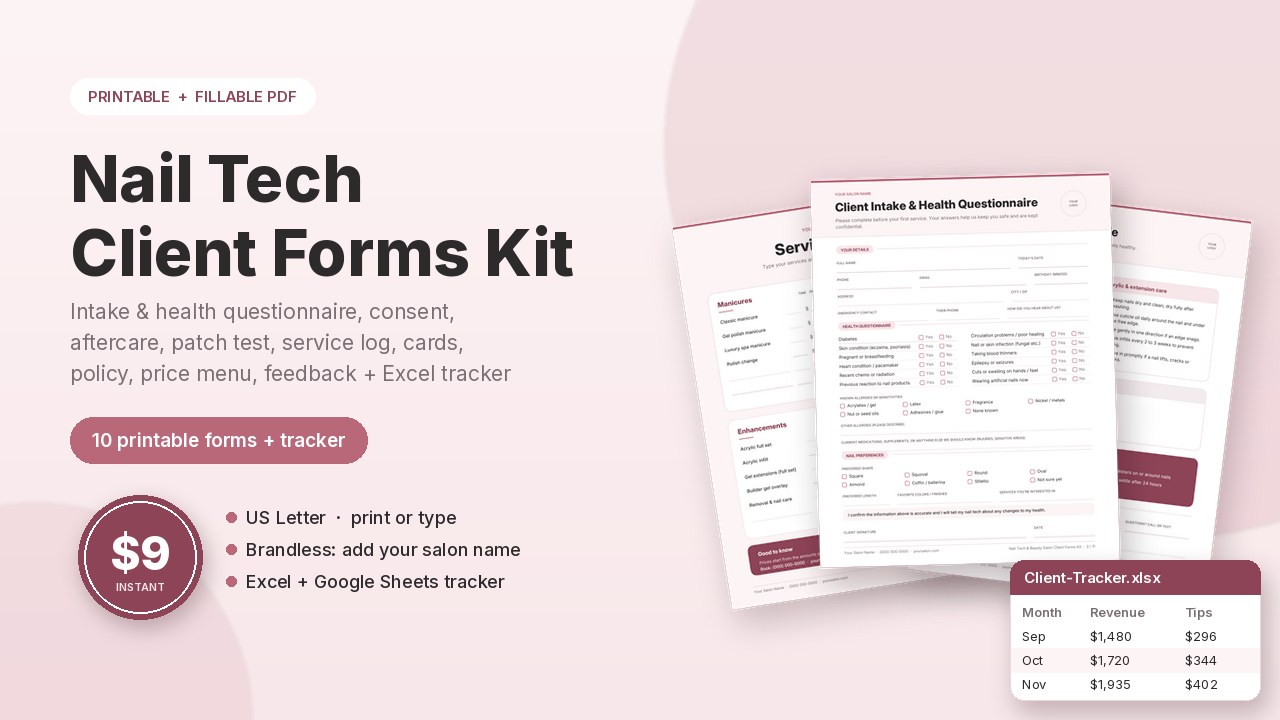
Nail Tech Client Forms Kit
An 11-page fillable PDF (intake and health questionnaire, consent and release, gel and acrylic aftercare handout, patch test record, visit log and more) plus an Excel client tracker.
Get it →When to ask for a signed consent form
- First visit: together with the client intake and health questions, since the consent refers back to those answers.
- A new kind of service: for example, a client moving from regular polish to acrylic or gel.
- A new product system: especially if you recommend a patch test.
- After a health change: pregnancy, a new medication, diabetes, a skin condition or a recent reaction.
- Minors: a parent or guardian should sign, and your state board rules may say more about serving minors.
- On a schedule: for example, once a year for returning clients.
What to include
| Section | What it covers | Why it matters |
|---|---|---|
| Client and visit details | Name, date, services today, technician | Ties the signature to a specific visit |
| Health confirmation | Client confirms the intake answers are honest and complete | Puts responsibility for sharing information on the client |
| Known risks | Allergic reaction, irritation, infection, lifting, damage to the natural nail | Plain words mean the client actually understood |
| Product sensitivity | Gel and acrylic ingredients can cause sensitivity; patch test if recommended | Covers the reactions clients ask about |
| Speaking up | Client tells you right away about pain, burning or heat | Lets you stop before a small problem grows |
| Right to stop or refuse | You can decline or stop if a condition makes it unsafe | Supports a safety call in the moment |
| Aftercare | Client received aftercare and results depend on following it | Links the result to home care |
| Removal | Picking, peeling or biting can damage natural nails | Explains a common cause of damage |
| Policies | Client read your cancellation, deposit and repair policies | Keeps booking rules in one signed place |
| Photo permission | Optional yes or no to photos of their nails | Lets you post work with clear permission |
| Signatures and date | Client and technician sign and date | Completes the record |
Sample consent wording you can adapt
Replace the words in [brackets] and ask the client to initial each statement. Keep it to one page.
[Salon name] Nail Service Consent
Client name: [ ] · Date: [ ] · Service(s) today: [ ] · Technician: [ ]
Please initial each statement:
- [ ] I have answered the health questions honestly and told my technician about any allergies, medical conditions or medications.
- [ ] I understand that nail services can carry risks, including allergic reaction, irritation, infection, lifting and damage to the natural nail.
- [ ] I understand that gel and acrylic products contain ingredients that can cause sensitivity, and I agree to a patch test if my technician recommends one.
- [ ] I will tell my technician right away if I feel pain, burning, heat or discomfort.
- [ ] I understand my technician may refuse or stop a service if it is not safe to continue.
- [ ] I have received aftercare instructions and understand that results depend on following them.
- [ ] I understand that picking, peeling or biting off product can damage my natural nails.
- [ ] I have read and agree to the salon's [cancellation / deposit / repair] policy.
Photos (optional): [ ] Yes, you may photograph my nails and share them online without my face or name. [ ] No photos, please.
Client signature: [ ] · Date: [ ]
Technician signature: [ ] · Date: [ ]
Parent or guardian (if under [age]): [ ]
If you add a release of liability line, keep it narrow and honest, for example limited to reactions or results caused by information the client did not share or aftercare they did not follow, and have it checked locally.
Patch tests and saying no
If a client has a history of sensitivity, or you are switching product systems, a patch test gives you a record before a full set. Write down the product and batch number, where and when it was applied, and what you saw at the check times you use. Follow the product manufacturer's instructions.
If a client has a possible infection, broken skin or swelling on the area, the consent form backs you up when you say no. Explain calmly, suggest they see a doctor, offer to rebook once it has cleared and note it on their record.
Free Nail Client Intake Form
A 2-page printable PDF: a nail client intake form with health questions and a signed consent line, plus a client service record.
Download free →Photo permission
If you post your work, ask separately with a clear yes or no box, so a client can sign the consent and still decline photos. Say what you will share (for example, nails only, no face or name). If a client later asks you to remove a photo, take it down and note it on their record.
Signing, storing and updating forms
- Paper or digital: a printed form in a client folder or a fillable PDF saved per client both work.
- Keep health details private: store completed forms in a locked file or a password-protected folder and share them only with staff who need them.
- Know how long to keep them: your state board may set record-keeping rules. If it does not, decide on a period and keep to it.
- Update when things change: ask about health changes at each visit and get a new signature after anything significant.
- Keep visit notes: a client record card shows what was done and any reaction, next to the signed form.
Pair it with aftercare and policies
Hand clients printed nail aftercare instructions and post your cancellation policy, deposit policy and repair policy where they can see them. Clear paperwork helps prevent disputes before they start. See also nail pricing and the beauty business forms checklist.
Common mistakes and how to fix them
- Signing once and never again. Fix: ask about health changes each visit and re-sign on a schedule and after any change.
- Legal jargon clients skim. Fix: short statements in plain words, with an initial box beside each one.
- One blanket release for everything. Fix: list the real risks honestly and keep any release line narrow.
- Photo permission buried in the fine print. Fix: a separate yes or no box.
- No technician signature or date. Fix: add both, so the form is tied to a visit.
What is in the templates
| Template | What you get |
|---|---|
| Free Nail Client Intake Form ($0+) | A 2-page printable PDF: an intake page with six health yes or no questions, nail history and preferences, and a short consent statement with a signature line, plus a client service record page. Print and fill by hand. |
| Nail Tech Client Forms Kit ($9+) | An 11-page PDF you can fill on screen or print: client intake and health questionnaire, Service Consent & Release (nine statements to initial, optional photo permission, client and technician signatures), gel and acrylic aftercare handout, patch test record (24 and 48 hour checks), service record and visit log, appointment reminder cards, cancellation and no-show policy, service menu and price list, client feedback form, and a before-you-use page with a state board checklist. Plus an Excel client tracker. |
Both are general templates, not legal advice. Review the wording for your state.
FAQ
Do nail salons need a consent form?
It depends on where you work. Some state boards or insurers expect signed consent for certain services, and others do not require it. Even where optional, it gives you a clear record. Check your state board rules and your insurance policy.
What should a nail salon consent form say?
Client and visit details, confirmation that the health answers are honest, the main risks in plain words, product sensitivity and patch tests, speaking up during the service, your right to stop, aftercare, safe removal, your policies, optional photo permission, and client and technician signatures with the date.
How often should clients sign a new consent form?
At the first visit, before a new kind of service or product system, and after any health change. You can also ask returning clients to re-sign on a set schedule, such as once a year.
Does a signed consent form protect me from liability?
Not completely. It records what the client was told and agreed to, but it does not replace safe practice, clean tools or following your license rules. Ask a local attorney or your insurer what your form should say.
Can I combine the intake form and the consent form?
Yes. Some salons use one page with health questions and a short consent statement, like the free intake form. A separate consent page with initialed statements gives you more detail for enhancements and pedicures.
Related templates
Nail Tech Client Forms Kit
An 11-page fillable PDF (intake and health questionnaire, consent and release, gel and acrylic aftercare handout, patch test record, visit log and more) plus an Excel client tracker.
Get it →Free Nail Client Intake Form
A 2-page printable PDF: a nail client intake form with health questions and a signed consent line, plus a client service record.
Download free →