Nail Aftercare Instructions to Give Clients (Gel, Acrylic and Dip)
Nail aftercare instructions for gel, acrylic, dip and polish clients: a copy-ready aftercare card, signs to watch for, common mistakes and an FAQ.
Clients leave the chair with fresh nails and a lot to remember. Written aftercare gives them something to check at home and helps their set last until the next appointment. Below: points for every client, notes by service, signs to watch for, a copy-ready aftercare card, how to hand it over, common mistakes and an FAQ.
This is general salon guidance, not medical advice. Follow the instructions from your product manufacturer and your state board's rules, and tell clients to see a doctor about any reaction or possible infection.
Why written aftercare helps
Spoken instructions at checkout are easy to forget. A printed card or a text they can scroll back to lasts longer. Written aftercare also:
- Sets expectations. Clients know what is normal wear and what is worth a call.
- Supports your repair policy. If free fixes depend on following aftercare, the client has seen the aftercare in writing.
- Gives you a record that aftercare was given.
Free Nail Client Intake Form
A 2-page printable PDF: a nail client intake form with health questions and a signed consent line, plus a client service record.
Download free →Aftercare points for every client
These apply to almost any service.
- Wear gloves for cleaning and washing dishes. Long soaks and cleaning chemicals are hard on product and on the skin around the nail.
- Don't use nails as tools to open cans or peel labels.
- Apply cuticle oil daily. It keeps the skin and the product edge flexible. Around the nail and under the free edge is enough.
- Don't pick or peel product off. It can take layers of the natural nail with it. Book a removal instead.
- Don't fix lifting at home with glue or tools. Water can get trapped under a lifted area. Come in for a repair.
- Contact the salon right away about redness, itching or swelling. See the warning signs below.
Service-specific notes
Add the matching row to the card, and adjust timings to your manufacturer's instructions.
| Service | First day | Ongoing care | Maintenance and removal |
|---|---|---|---|
| Gel polish | Avoid very hot water, hot tubs and saunas for the rest of the day | Gloves for chores, cuticle oil daily | Book a fill or removal every 2 to 3 weeks; soak-off removal at the salon |
| Builder gel / hard gel / gel extensions | Avoid very hot water for the rest of the day | File gently in one direction if an edge snags; don't clip the extension | Book fills or rebalances every 2 to 3 weeks; removal at the salon |
| Acrylic | Treat new length carefully while you get used to it | Keep nails clean and dry; oil daily; come in if a nail lifts or cracks | Book infills every 2 to 3 weeks to keep lifting in check; removal at the salon |
| Dip powder | Follow the timing in your product's instructions for water and heavy use | Gloves for chores, cuticle oil daily | Book a new set or removal on your usual schedule; soak-off removal at the salon |
| Regular polish | Polish can stay soft for a while after it feels dry, so avoid bumps and tight pockets for the next few hours | A thin top coat every few days can help reduce chips | Remove with polish remover; no salon visit needed |
Signs to watch for
Put these on every card. Ask the client to contact you, or a doctor, right away if they notice:
- Redness, swelling, heat or throbbing around the nail
- Itching, a rash or blisters on the fingers, around the nails or elsewhere, such as the face or eyelids
- Green, yellow or dark spots under the nail or product
- Pain that does not settle
- A nail that lifts, cracks or breaks
If a client may be reacting to a product, remove the enhancement, avoid re-applying product until the area has healed and suggest they see a doctor. Record the products used and discuss a patch test before the next service. The nail client intake form guide covers the allergy questions to ask at the first visit.
Copy-ready aftercare card
Copy this, delete what does not apply, and replace everything in [brackets]. It fits on a half sheet.
[Salon name]: caring for your new nails Today's service: [gel polish / builder gel / acrylic / dip / polish]. Thank you for coming in!
Please don't: pick, peel or bite off product; glue or file lifting at home; soak off at home unless we have shown you how. Contact us or a doctor right away if you notice redness, swelling, heat, itching, a rash, blisters, green, yellow or dark spots under the nail, or pain that does not settle. Repairs: [free repairs within ___ days for issues caused by product or application; damage from wear, picking or accidents is charged at our repair rate]. Your next visit: [date and time] for [fill / removal / new set]. Questions? Call or text [phone]. |
How to hand it over
- Say the top three out loud: gloves, oil and no picking.
- Give a printed card and text a copy the same day, so it is easy to find later.
- Note it on the record: "aftercare given", the date and the products used.
- Link it to your policies. If repairs are free only within a set number of days, say so on the card and in your written policy. The salon cancellation policy template and salon deposit policy template guides cover the wording.
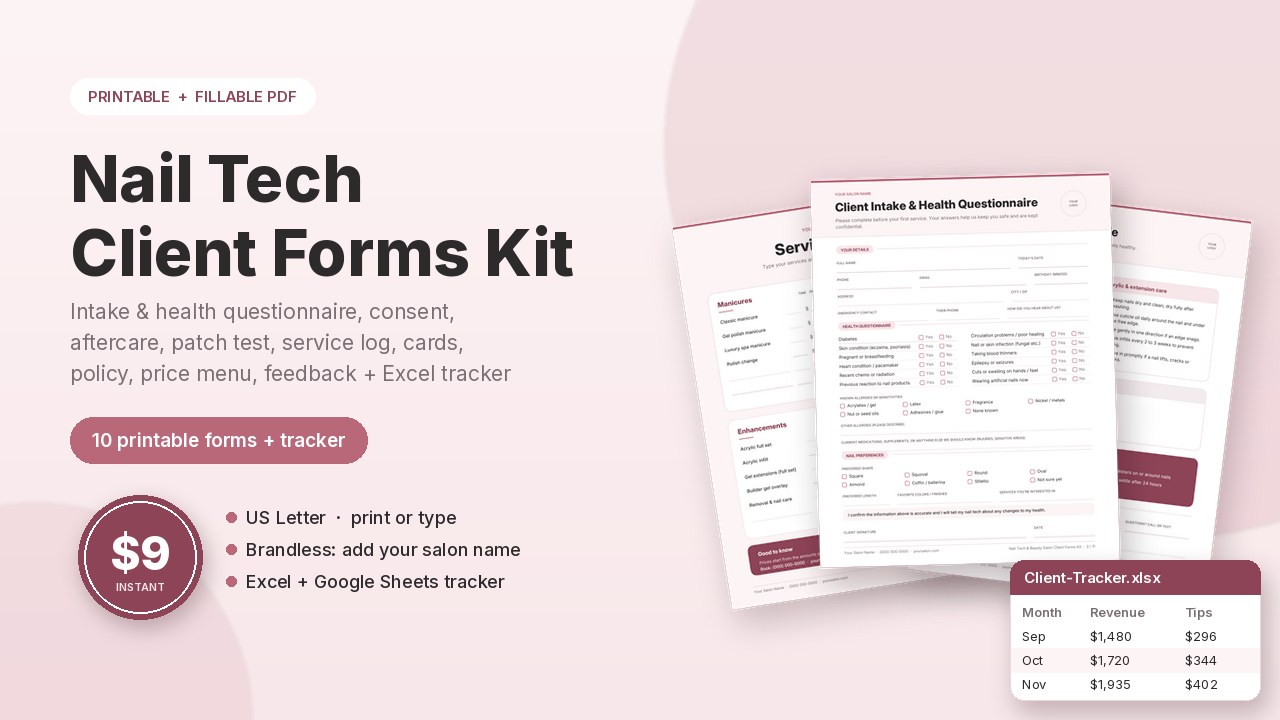
Nail Tech Client Forms Kit
An 11-page fillable PDF (intake and health questionnaire, consent and release, gel and acrylic aftercare handout, patch test record, visit log and more) plus an Excel client tracker.
Get it →Common mistakes and fixes
| Mistake | Fix |
|---|---|
| Only explaining aftercare out loud | Give a printed card and text a copy the same day. |
| One generic card for every service | Keep the general points, then add a line for today's service. |
| No warning signs listed | Always include what to watch for and who to contact. |
| A repair policy the client never saw | Put the repair window on the card and in your signed policy. |
| Not recording that aftercare was given | Add "aftercare given" and the date to the service record. |
| Timings that clash with the product instructions | Check your manufacturer's instructions and update the card to match. |
For consent wording that confirms the client received aftercare, see the nail salon consent form guide. If you are setting repair and removal prices, the nail pricing guide can help.
What is in the templates
| File | What it includes | How it helps with aftercare |
|---|---|---|
| Free Nail Client Intake Form (2-page PDF) | Client details, 6 health and safety yes/no questions (including allergies), nail history and preferences, a consent statement with signature, and a client service record page | Records allergies before the service and gives you a place to note reactions or lifting after each visit |
| Gel and Acrylic Aftercare Handout (kit, 1 page) | Gel and acrylic care columns, a "please don't" list, warning signs to contact the salon or a doctor about, a next-visit box and space for notes from the tech | A ready-made handout instead of writing your own card |
| Rest of the kit PDF (11 pages in total) | Intake and health questionnaire, service consent and release (with a statement that aftercare was received), patch test record, client service record, appointment reminder cards, cancellation and no-show policy with a repairs section, service menu, client feedback form and a before-you-use page | Covers consent, patch tests, records and the repair policy behind your aftercare |
The kit also includes an Excel client tracker (clients, visits and a monthly summary). The kit PDF is fillable in free PDF readers or can be printed. The free PDF is print-and-write: it has blank lines, not fillable fields. The kit's aftercare handout covers gel and acrylic; for dip or polish, use the card above.
FAQ
What should nail aftercare instructions include?
General care (gloves, cuticle oil, no using nails as tools), a line for today's service, a "please don't" list, signs to watch for with who to contact, your repair policy and the next appointment.
How often should clients book fills?
Every 2 to 3 weeks is a common schedule for gel and acrylic, but it depends on the product and the client's nail growth. Agree the interval and write it on the card.
Should I give aftercare instructions on paper or digitally?
Both work well together: a printed card goes home with the client, and a text or email copy is easy to find later.
What if a client has a reaction after a service?
Ask them to contact you and to see a doctor. The safe step is to remove the product and not re-apply it until the area has healed. Record the products used and talk about a patch test before any future service. This page is not medical advice.
Does the Nail Tech Client Forms Kit include an aftercare handout?
Yes. The kit's 11-page PDF includes a one-page gel and acrylic aftercare handout with care tips, a "please don't" list, warning signs, a next-visit box and space for your notes. It does not have a separate dip or polish version, so use the card on this page for those services.
Related templates
Free Nail Client Intake Form
A 2-page printable PDF: a nail client intake form with health questions and a signed consent line, plus a client service record.
Download free →Nail Tech Client Forms Kit
An 11-page fillable PDF (intake and health questionnaire, consent and release, gel and acrylic aftercare handout, patch test record, visit log and more) plus an Excel client tracker.
Get it →