How Much to Charge for Nails: Gel, Acrylic and Dip Prices, Nail Art Add-Ons, Fills and No-Show Fees (Plus a Free Nail Client Intake Form)
How nail techs can price their services: work out your costs and hourly floor, compare local prices, price gel, acrylic, dip and pedicures by time, charge for nail art, length and removals, set fill and repair rules, and add deposits and no-show fees, with a worked example and a free printable nail client intake form.
Why nail pricing goes wrong
Many new nail techs set one price for a full set, then spend an extra 40 minutes on long coffin nails with hand-painted art and earn half of what they planned. Others never charge for removals, repairs or soak-offs of another salon's work, so their best-booked days are their least profitable. A clear method fixes this: know your costs and hourly floor, price each base service by the time it takes, charge separately for length, art and extras, and protect your chair with written fill, repair, deposit and no-show rules.

Free Nail Client Intake Form
A printable nail client intake and consent form plus a service record.
Download free →1. Work out your costs and hourly floor
Add up your yearly booth or suite rent, gel, acrylic and dip products, tips, files, bits and disposables, e-file and lamp replacements, insurance, licensing and continuing education, booking software and card fees, sanitation supplies, and self-employment taxes where they apply. Add the income you want, then divide by the hours you can realistically have a client in the chair. That is your hourly floor. Estimate a rough product cost per service too, so you know what each appointment costs before your time.
2. Compare local prices
Check what salons and independent nail techs near you charge on their booking pages, price menus and local listings. Note what each price includes: length, shape, a simple design, cuticle work, or a gel top coat. A low headline price often charges extra for everything. You can price toward the top of your area for advanced skills, a strong portfolio, a private suite, consistent retention, or evening and weekend hours. If your floor is above local prices, look at your service times and booking gaps before quietly undercharging.
3. Price base services by time
Time each service you offer: gel manicure, gel-X or soft gel extensions, acrylic full set, dip powder, builder gel overlay, classic pedicure and spa pedicure. Multiply each typical time by your hourly floor, add the product cost, and round to a clean menu price. Set prices for short length as the base, then add a tier for medium and long or extra-long because longer nails take more product and time.
4. Charge for nail art, removals and repairs
Price nail art in tiers rather than one vague add-on: for example simple (a single accent nail or French tip), medium (several designed nails, chrome or ombre) and complex (full hand-painted sets, 3D charms or encapsulation), or per nail for detailed work. Charge for soak-off removal, and more for removing another salon's work. Decide on repairs: a free fix within a short window (for example 3 to 5 days) for lifting or breaks caused by the service, and a per-nail repair fee after that or for breaks from accidents.
5. Set fill, deposit, late and no-show policies
Define a fill clearly, for example within 2 to 3 weeks, with a rule that after a set number of weeks or with heavy lifting the client is booked as a new full set. Many techs take a non-refundable deposit at booking that comes off the service price, especially for long art sets. Set a late policy (for example, after 10 to 15 minutes the design may be simplified or the appointment rebooked), a cancellation window (often 24 to 48 hours) and a no-show fee. Put every policy in writing and have clients agree before their first visit.
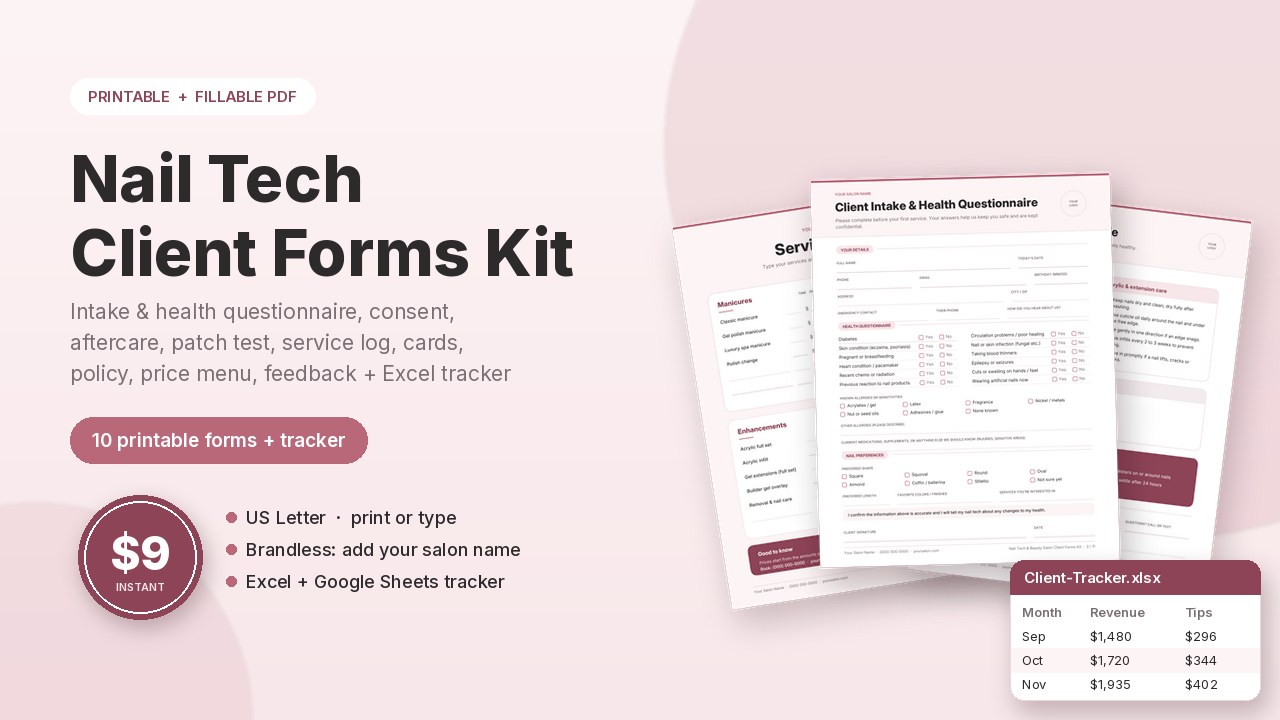
Nail Tech Client Forms Kit
An 11-page fillable PDF (intake and health questionnaire, consent and release, gel and acrylic aftercare handout, patch test record, visit log and more) plus an Excel client tracker.
Get it →6. Raise prices the right way
Review prices at least once a year and whenever product costs or rent go up. Give regular clients notice, for example 30 days, by text, a sign at your station and your booking page. Raise prices in clean steps, and consider raising add-ons and long-length tiers first, since they are where time overruns usually happen. A fully booked calendar weeks ahead is a sign your prices are too low.
Worked example (example numbers)
These are example numbers to show the method, not a recommended price. Say your yearly costs come to $14,000 and you want to earn $40,000, so you need $54,000. If you can fill about 1,300 client hours a year, your floor is about $41.50 an hour. A gel-X set takes you 1.5 hours with about $6 in product: 1.5 x $41.50 + $6 = $68.25, so a menu price of $70 for short length. Add $10 for medium, $20 for long, and $10 / $20 / $35 for simple, medium and complex art. A 2-week fill that takes 1.25 hours lands near $58, so $60. A client who books long gel-X with medium art pays $70 + $20 + $20 = $110 for about 2.25 hours, which still clears your floor.
Put your prices and policies in writing
Most nail disputes start with nothing on paper: a client who says she was never told about the fill window, the repair window or the deposit. A signed intake and consent form records allergies, skin and nail conditions and agreement to your policies. A service record shows the products, shape and length you used, so every fill is consistent. A consent form, aftercare handout, written cancellation policy and client tracker back up your repair rules and show who is due and who keeps no-showing. The free intake form above covers the basics, and the full kit adds the rest.
FAQ
How much should I charge for a full set of nails?
Work out your hourly floor from your costs and income goal, multiply by how long the set takes you, add product cost, then compare with local prices. Price gel, acrylic and dip separately and add tiers for length.
How should I price nail art?
Many techs use tiers such as simple, medium and complex, or a per-nail price for detailed hand-painted work, so the price follows the extra time each design takes.
How much should nail fills cost?
Price fills by the time they take you, usually within a set window such as 2 to 3 weeks. After that window, or with heavy lifting, many techs charge a new full set price.
Should nail techs charge for removal?
Many do, because a soak-off takes real time and product. It is common to charge more for removing another salon's work than your own.
Should nail techs take deposits?
Many do, especially for long or detailed appointments. A non-refundable deposit applied to the service price reduces no-shows. State the deposit and when it is forfeited in your written policy.
Do nail techs need a client intake form?
A signed intake and consent form records the client's health information, allergies and agreement to your policies, which helps protect you and the client. Check local licensing and insurance requirements.
This page is general guidance, not legal, tax, medical or licensing advice. Rules on nail services, licensing, insurance and deposits vary by location, so check the rules where you work.
Related templates
Free Nail Client Intake Form
A printable nail client intake and consent form plus a service record.
Download free →Nail Tech Client Forms Kit
An 11-page fillable PDF (intake and health questionnaire, consent and release, gel and acrylic aftercare handout, patch test record, visit log and more) plus an Excel client tracker.
Get it →