Esthetician Consent Forms: Which Services Need One
A plain-English guide to which skin, wax, tan and lash services need a client consent form, with free printable forms for each.
If you offer skin, wax, tan, lash or brow services, a consent form is one of the simplest habits you can build into every appointment. This guide explains which esthetician services usually come with a consent form, what each form should ask, how to use it during a real appointment, when to ask clients to sign again, and how to store the paperwork. It also lists exactly what is inside the forms linked here.
This is a practical guide, not legal or medical advice. Licensing, record-keeping and consent rules differ by state, county and country, so check your local licensing board or state rules, and ask a local professional if you need wording reviewed.
Why consent forms matter
A signed form shows the client was told about risks, aftercare and reasons a service may not be suitable before you started. It also prompts the questions that catch allergies, recent skin procedures and medications such as retinoids early, while there is still time to change the plan.
Just as important, the form slows the first few minutes of the appointment down in a good way. Instead of relying on a quick verbal "any allergies?", the client reads specific questions and answers them in writing. That tends to surface details people forget to mention, such as a prescription acne cream or a peel they had last week.
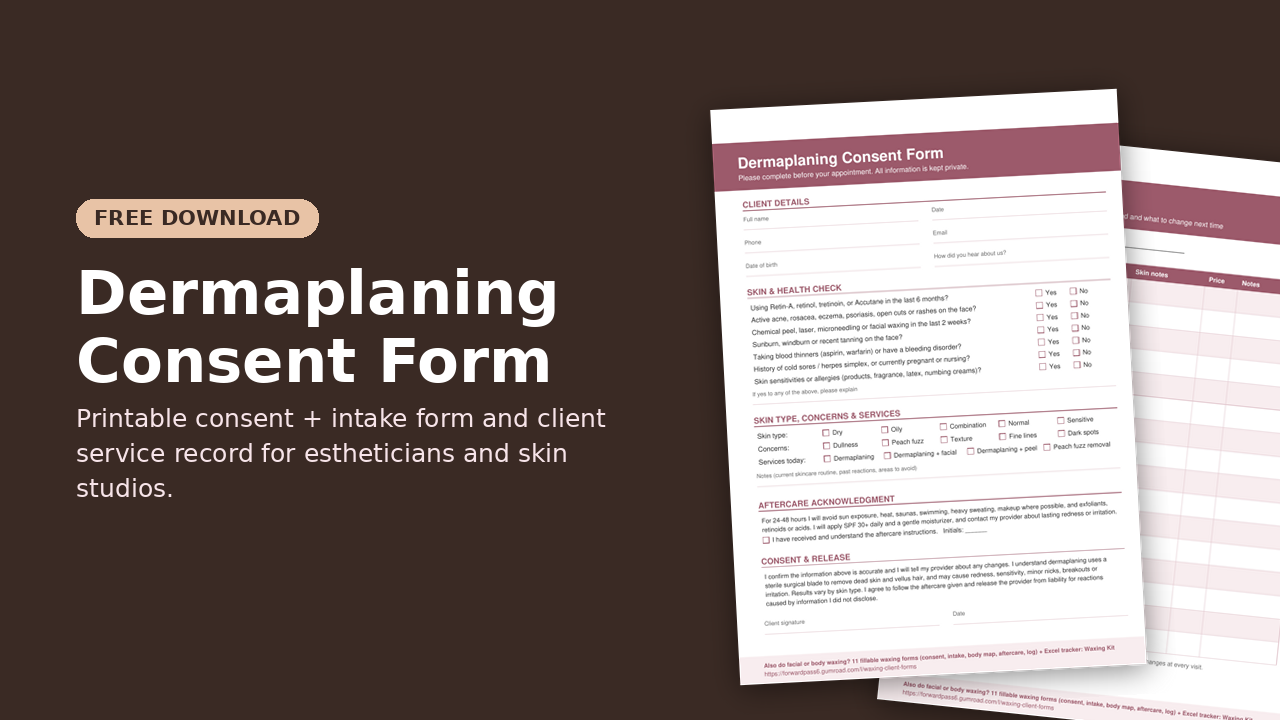
Free Dermaplaning Consent Form
A printable dermaplaning consent and intake form plus a client service record.
Download free →Consent, intake and service record: three different jobs
People often say "consent form" when they mean three separate pieces of paperwork. Keeping them separate in your head makes each one easier to fill in.
- Intake or health questionnaire. Contact details plus the yes/no questions about allergies, skin conditions, medications and recent procedures. It tells you whether the service is suitable today.
- Consent and release. A plain description of the service, its common reactions and risks, the client's confirmation that their answers are accurate, an aftercare acknowledgment, and a signature and date.
- Service record. What you actually did at each visit: date, service, products or wax used, how the skin reacted and what to change next time. This is the page you read before the next appointment.
The free forms here combine the first two on one page and add a service record page.
Services that usually need one
Almost any service that touches the skin, eyes or brows benefits from written consent. The table below shows the most common esthetician services and the questions the form should focus on. Each linked guide covers that service in more depth.
| Service | What the form should focus on | More detail |
|---|---|---|
| Dermaplaning | Retinoid use, active breakouts or rashes on the face, recent peels or laser, sunburn, cold sore history, blood thinners | Dermaplaning consent form, aftercare |
| Waxing | Retinoids and exfoliating acids, recent peels or sunburn, circulation problems or blood thinners, wax or rosin allergies, areas to be waxed | Waxing consent form, aftercare |
| Brazilian and bikini waxing | A separate add-on page for intimate areas, plus what to expect and how to ask to pause or stop | Brazilian wax consent form |
| Spray tanning | Allergies to DHA or fragrance, breathing problems that misting could trigger, recent waxing or shaving, broken skin | Spray tan consent form, aftercare |
| Lash extensions | Adhesive and latex allergies, sensitive eyes, recent eye infections or surgery, contact lenses, ability to lie still with eyes closed | Lash extension consent form, patch test |
| Lash lifts and tints | Eye sensitivity, previous reactions to tint or perm solutions, patch test status | Lash lift consent, lash and brow tint consent |
| Brow lamination | Skin sensitivity around the brows, retinoid use, previous reactions to lamination or tint products | Brow lamination consent form |
| Microblading | A more detailed health history, because the skin is broken; in many places this work falls under separate tattoo or body art rules | Microblading consent form |
Microblading and similar procedures are often licensed differently from standard esthetics, so confirm which rules apply to you before offering them.
What every form should include
- Client details and emergency contact. Name, phone, email and date of birth, so you can reach the client and confirm they are an adult.
- Health questions with yes/no boxes. Allergies, skin conditions, medications such as retinoids, recent peels or laser, pregnancy, and anything else relevant to that service. Leave a line to explain any "yes".
- A plain description of the service and its risks. Use everyday words: redness, tenderness, breakouts, ingrown hairs, irritation. Avoid jargon the client has to look up.
- Aftercare acknowledgment. A short summary of the aftercare and a box for the client's initials to confirm they received it.
- Your right to adjust or decline. A line that says you may change or stop a service if it looks unsafe to continue.
- Photo consent. A separate opt-in if you want to post before-and-after photos. Never assume it.
- Signature and date. The client signs, and you note the date and service it covers.
How to use consent forms in a real appointment
- Send or hand over the form before the service. Ideally the client fills it in before arriving or in the waiting area, not while lying on the bed.
- Read it before you start. Look at every "yes" and ask a follow-up question. A form you never read gives you no protection and no useful information.
- Talk through the main risks and aftercare. The form backs up the conversation; it does not replace it.
- Adjust the plan if needed. A recent peel, a new retinoid or a sunburn may mean a different service, a test area, or rebooking.
- Get the signature, then begin. Check the date and that every initial box is filled.
- Fill in the service record afterwards. Note what you used, how the skin reacted and anything to change next time.
When to ask a client to sign again
An intake form is a snapshot. Review it at every visit with a quick "any changes to your skin, health or medications since last time?", and ask for a fresh form after a change in medications or skincare, a new service, a reaction, or an update to your own forms.
Storing forms and protecting client privacy
Consent forms hold health details, so treat them as private. Keep paper forms in a locked drawer or cabinet, and keep digital copies in a password-protected account rather than a shared phone gallery.
How long you must keep client records, and whether you need specific privacy notices, depends on where you work. Check your state or local licensing board and any insurer requirements rather than guessing. A simple, consistent system (one folder or file per client, newest form on top) makes it easy to find what you need at the next visit.
What is in the free forms and the kit
Every file below was checked against the actual download. Here is exactly what you get:
| File | What it contains | Good to know |
|---|---|---|
| Free Dermaplaning Consent Form (PDF, 2 pages, free) | Page 1: client details, 7-question skin and health check, skin type and concerns, services today, notes, aftercare acknowledgment with initials, consent and release, signature. Page 2: client service record table (date, service, products used, skin notes, price, notes). | Print-and-write; not a fillable PDF |
| Free Waxing Consent Form (PDF, 2 pages, free) | Page 1: client details, 7-question skin and health check, waxing history, areas today (brows to back), notes, consent and release, signature. Page 2: service record (date, areas, wax type, skin reaction, price, notes). | Print-and-write; no separate aftercare initials box |
| Free Spray Tan Consent Form (PDF, 2 pages, free) | Page 1: client details, 7-question health and allergy check, skin tone, shade wanted, services today, notes, aftercare acknowledgment, consent and release, signature. Page 2: service record (date, service, solution and shade, results, price, notes). | Print-and-write; not a fillable PDF |
| Free Lash Extension Consent Form (PDF, 2 pages, free) | Page 1: client details, 7-question health and eye safety check, lash history and patch test status, desired style and look, consent and release, signature. Page 2: service record (date, service, curl and thickness, lengths or map, price, notes). | Print-and-write; aftercare is not on this form |
| Waxing Client Forms Kit: PDF (11 pages, fillable, $9) | Cover, client intake and health questionnaire, waxing consent and release with initial boxes, Brazilian and bikini add-on consent, service record and body map, client aftercare handout, appointment log, wax menu, cancellation and no-show policy, photo and social media release, gift certificates (3 per sheet). Studio name placeholders to replace with yours. | Type into it on screen or print and write |
| Waxing Client Forms Kit: Client Tracker (Excel, same download) | Start Here instructions; Clients sheet (500 rows: contact, allergies and skin notes, intake form date, preferred wax, with last visit, visit count, total spent and next wax due calculated); Visits sheet (2,000 rows with service, area, wax type, skin reaction, price, tip and payment dropdowns); monthly revenue and tips summary; editable Lists sheet for your services, prices and wax cycle. | Works in Excel and Google Sheets |
To be clear about the limits: the kit is built for waxing only. It does not include dermaplaning, spray tan, lash or brow consent forms, and the free forms are single-service printables, not fillable PDFs. If you offer several services, use the matching free form for each one, or adapt the wording with your own professional judgment.
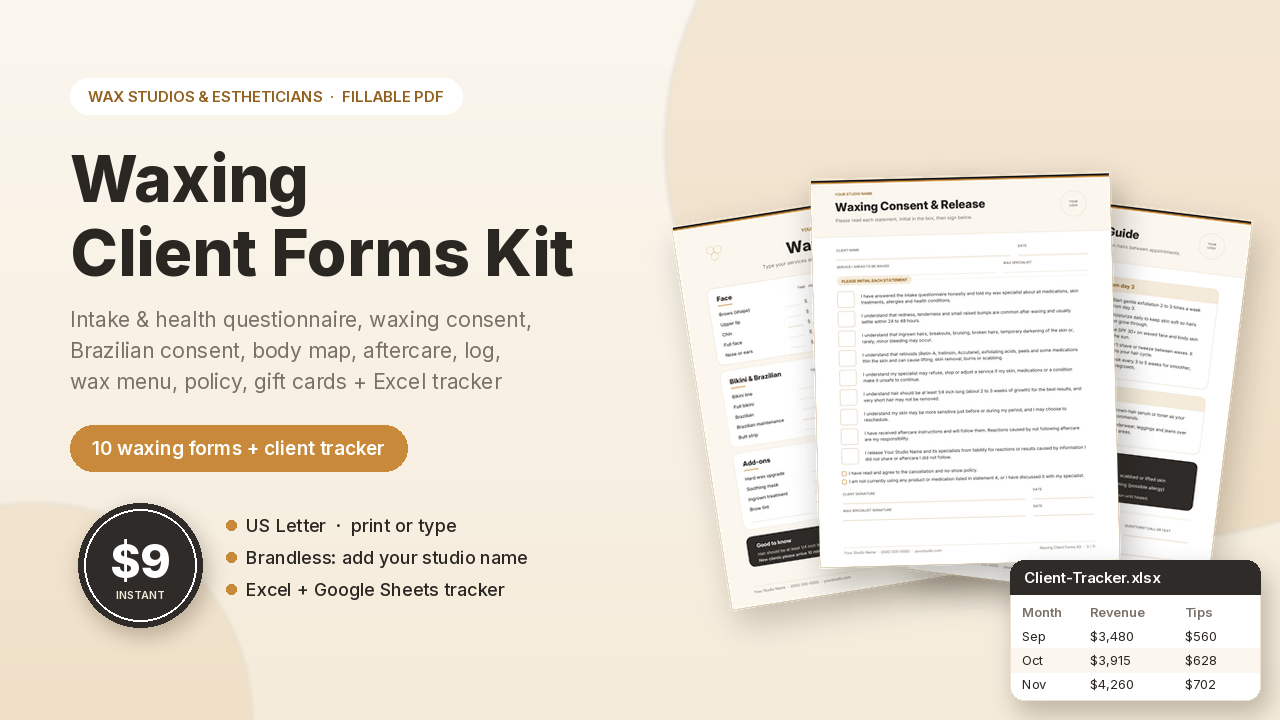
Waxing Client Forms Kit
An 11-page fillable PDF (intake, consent, Brazilian add-on, body map record, aftercare handout, appointment log, wax menu, policies, gift certificates) plus an Excel client tracker.
Get it →Tips for better consent forms
- One form per service type. A generic "beauty services" form misses the questions that matter for each service, like adhesive allergies for lashes or DHA allergies for tans.
- Keep the language plain. If a client has to ask what a word means, rewrite it.
- Put the deal-breaker questions first. Retinoids, recent peels and allergies should be at the top, where nobody skims past them.
- Use initial boxes for the important statements. Initialing each risk or aftercare line makes it more likely the client actually reads them.
- Add your studio name and policies. Your cancellation, deposit and photo policies can sit on separate pages that the client signs once. See the salon cancellation policy template.
- Pair each form with a service record. A client record card or spreadsheet turns one-off forms into a useful history.
Common mistakes and how to fix them
- Collecting forms but never reading them. Fix: make reading the form the first step of every appointment, before any product comes out.
- Using one form for years without updates. Fix: ask about changes at every visit and refresh the form when anything changes.
- Copying another studio's wording blindly. Fix: start from a template, then edit it to match the services you actually offer and the rules where you work.
- Hiding photo consent in the small print. Fix: make photos a separate yes/no choice the client can decline.
- Skipping the patch test question for lashes and tints. Fix: record whether a patch test was done or declined on the form itself.
Keep it simple and current
Review each client's form at every visit and have them re-sign when their health or medications change. Rules differ by location, so check your local licensing board as well. For a wider view of the paperwork a beauty business tends to need, from policies to gift certificates, see the beauty business forms checklist.
FAQ
Do estheticians legally need consent forms?
It depends on where you work. Some licensing boards and insurers expect written consent or client records, others do not spell it out. Check your state or local licensing board and your insurer. Many estheticians use consent forms either way because they catch problems early.
Can one consent form cover all my services?
You can use one intake page for contact and general health details, but each service has its own risks and questions. A short service-specific consent page for dermaplaning, waxing, tanning or lashes works better than one long generic form.
How often should clients fill in a new form?
Review the form at every visit and ask about changes. Ask for a new form when their health, medications or skincare change, when they book a different service, after a reaction, or when your own forms change. Many studios also refresh forms once a year.
Are the free forms on this page fillable PDFs?
No. The free dermaplaning, waxing, spray tan and lash forms are 2-page printables you fill in by hand: a consent and intake page plus a service record page. The paid Waxing Client Forms Kit PDF is fillable on screen and also prints.
Does a signed consent form protect me from every complaint?
No. A form records what the client told you and what you explained, but it does not replace proper training, hygiene and judgment. For questions about liability or wording, talk to a local professional or your insurer.
Related templates
Free Dermaplaning Consent Form
A printable dermaplaning consent and intake form plus a client service record.
Download free →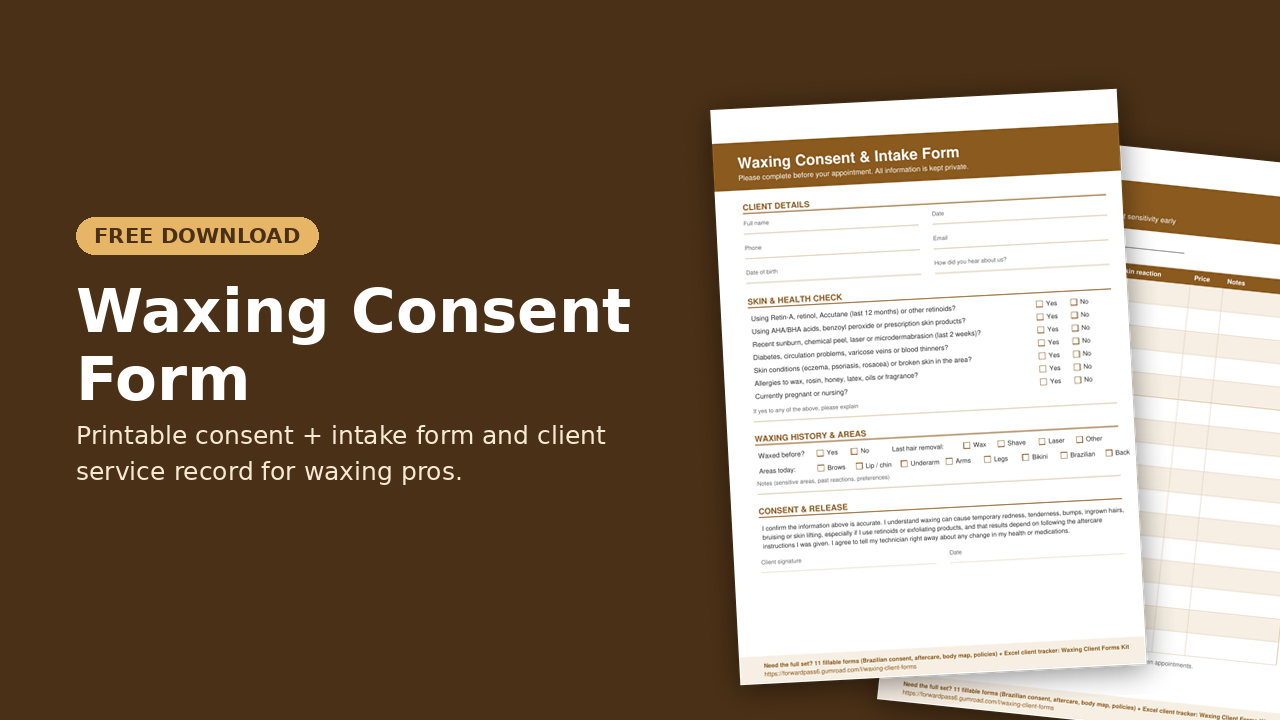
Free Waxing Consent Form
A printable waxing consent and intake form plus a client service record.
Download free →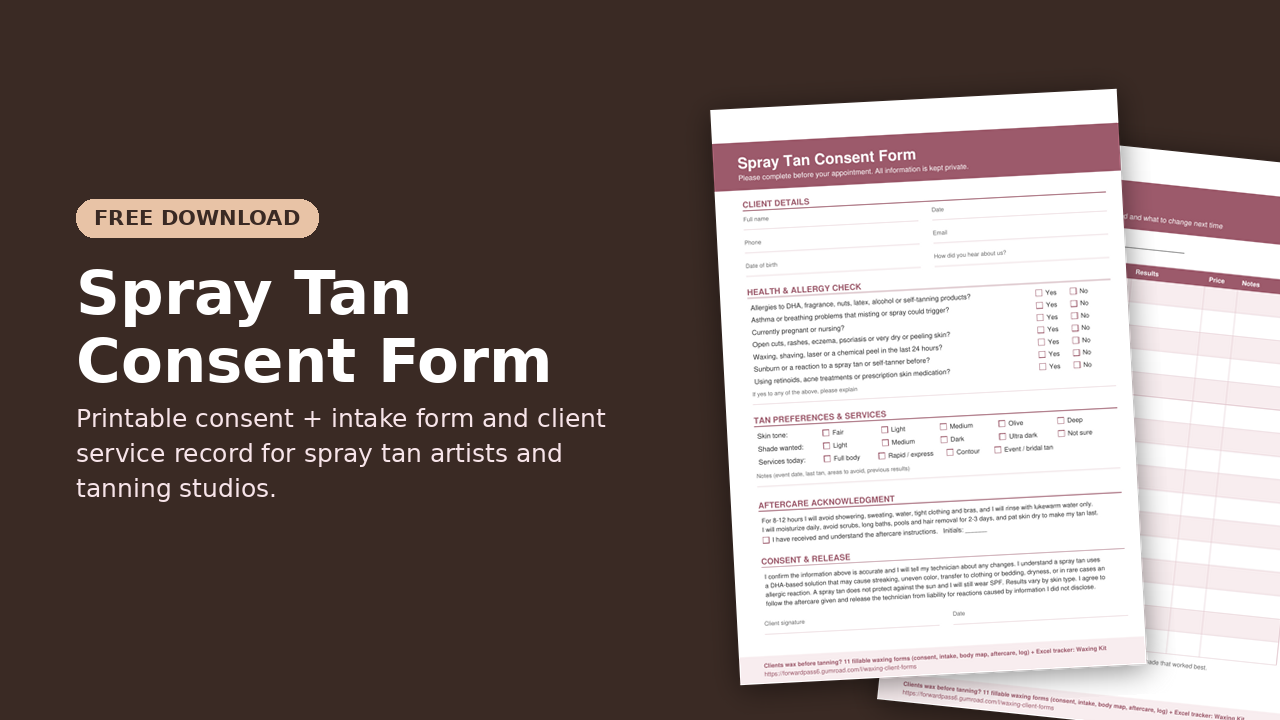
Free Spray Tan Consent Form
A printable spray tan consent and intake form plus a client service record.
Download free →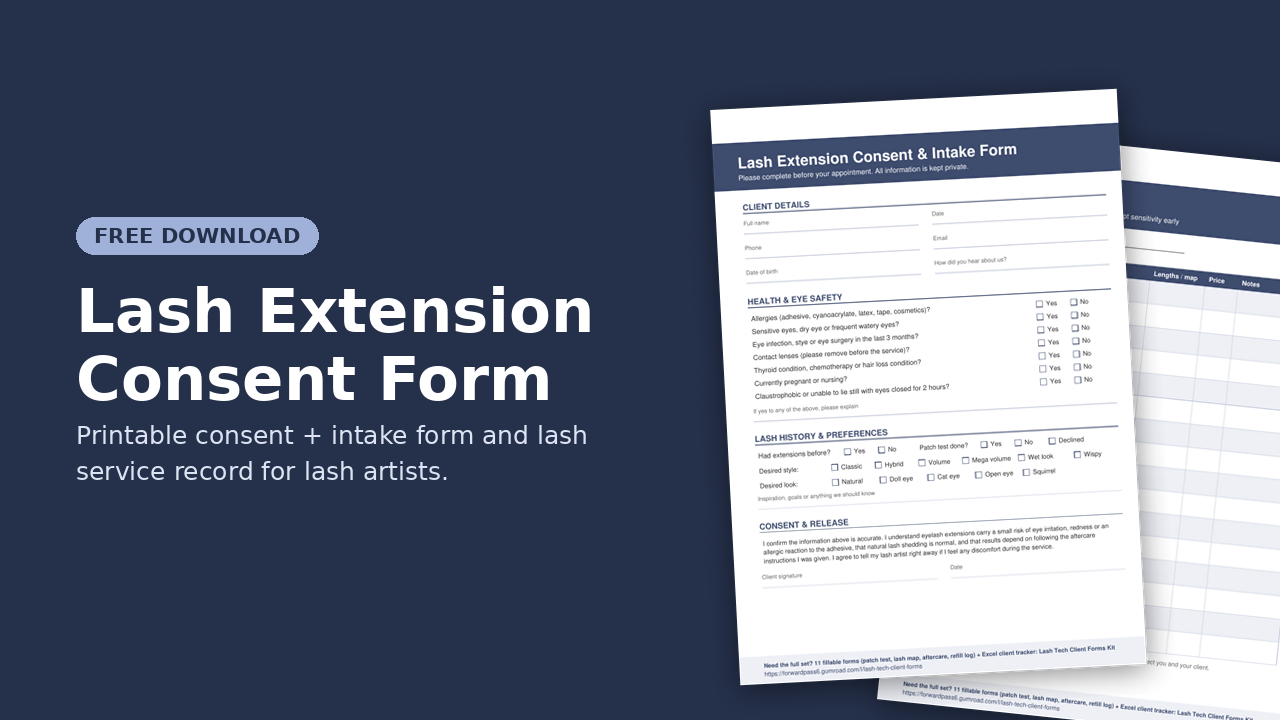
Free Lash Extension Consent Form
A printable eyelash extension consent and intake form plus a lash service record.
Download free →