Lash Lift Pricing: How Much to Charge (Plus Tint Add-Ons, Memberships & Holiday Rates)
A practical guide to setting lash lift prices: your real cost per service, the lift on its own, tint and brow add-ons, repeat visits and memberships, patch tests, deposits and cancellations, corrections, and the holiday rush, with a worked example and a free lash lift and tint consent form.
Why lash lift pricing deserves a proper plan
A lash lift looks like a simple service. It takes about an hour, the products are inexpensive, and clients love the result. That simplicity is exactly why many lash artists underprice it. They copy a nearby salon, forget card fees, rent and patch test time, and end up working a full Saturday for less than expected.
The good news is that lash lifts are a great repeat service. Most clients come back every 6 to 8 weeks, which makes them ideal for rebooking and memberships. This guide walks through your cost per service, how to price the lift itself, add-ons like tint and brow lamination, repeat visits, deposits and the busy holiday season. Every number on this page is a clearly labeled example to show the math. It is not market data. Prices vary widely by city, experience and local rules, so check what is normal near you and set your own rates.
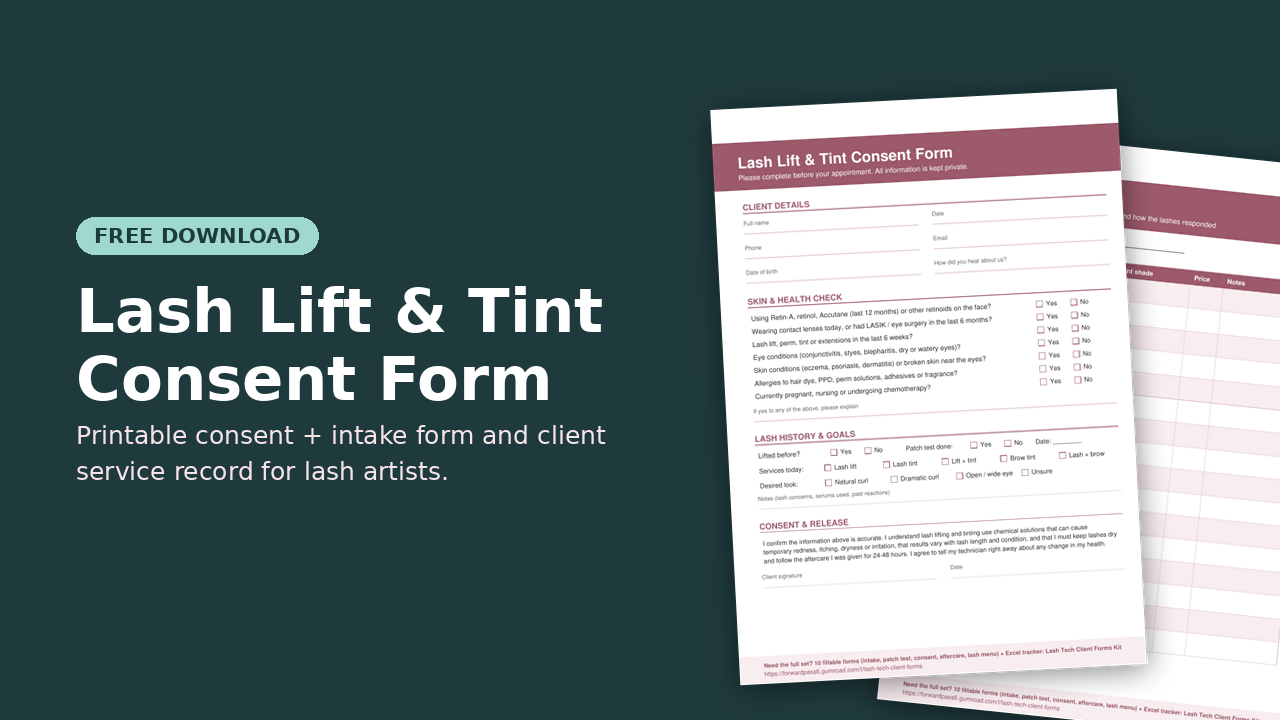
Free Lash Lift & Tint Consent Form
A printable lash lift and tint consent and intake form plus a client service record.
Download free →1. Start with your cost per service
Before you pick a price, add up what one lash lift actually costs you. Include everything that gets used up or paid per appointment, plus a fair share of your fixed costs.
- Lift solutions. The lifting and setting lotions, plus any nourishing step your system uses.
- Shields, rods and adhesive. Silicone shields may be reusable or single-use depending on your system and hygiene rules.
- Tint (if included). Tint, developer and mixing supplies.
- Disposables. Under-eye pads, micro brushes, spoolies, cotton, gloves and wipes.
- Card fees. Usually a small percentage of each payment.
- Overheads. Rent or booth fee, insurance, booking software, laundry, training and marketing, divided by the number of services you do in a month.
Example only: solutions $3, shields and adhesive $1.50, tint $1, disposables $1.25, card fees about $2.25 on a $75 service, and overheads $10 per appointment comes to about $19. If the lift takes 1 hour including consultation and cleanup and you want to earn $45 an hour for your time, your floor is about $64. Anything below that means you are paying to do the service.
2. Pricing the lash lift on its own
Once you know your floor, look at three things: what local artists with similar experience charge, how long your appointments really take, and the result your clients can expect. A lift done by a newly certified artist in a small town and one done by an experienced artist in a busy city center will rarely carry the same price.
Keep your menu simple. One clear price for a standard lash lift, with tint as an add-on, is easier to understand than five variations.
Example only: a standard lash lift priced somewhere between $65 and $95, depending on your market and experience. Your own number should come from your costs and local research, not from this example.
3. Tint and other add-ons
Most lash lift clients ask for a tint, because darker lashes make the lift look more dramatic. Add-ons are where a lot of the profit in this service sits, since they add value without adding much time.
- Lash tint. Usually done in the same appointment, after the lift. Price it as an add-on or offer a lift-and-tint price.
- Brow tint or brow lamination. A popular combination. A lift plus brow lamination in one visit can be bundled at a small discount compared with booking both separately.
- Bottom lash lift or tint. Takes extra time and care, so charge for it.
- Keratin or nourishing treatment. If your system includes an extra step, decide whether it is part of the standard service or an upgrade.
Example only: lash tint add-on $15 to $25, lift and tint together $85 to $110, lift plus brow lamination combo $130 to $150.
4. Repeat visits and memberships
A lash lift usually lasts around 6 to 8 weeks, depending on the client's natural lash cycle. That makes it one of the easiest services to turn into a regular booking. The goal is to make rebooking the obvious choice before the client leaves.
- Rebook at checkout. Offer the next appointment 6 to 8 weeks out while the client is still in the chair.
- Loyalty pricing. A small saving for clients who rebook within a set window can keep your diary full without cutting your standard price.
- Memberships. A monthly fee that covers a lift every 6 to 8 weeks gives you predictable income. Be clear about what happens to unused visits.
- Do not lift too often. Lifting again before the previous lift has grown out can damage lashes. Explain this, and do not let a membership encourage visits that are too close together.
Example only: rebook within 8 weeks and save $5; a membership at $45 a month that includes one lift and tint every 8 weeks, with a 3-month minimum.
5. Deposits and cancellation policy
An hour-long slot left empty by a no-show costs you the full value of the service. A small deposit taken at booking cuts no-shows sharply and makes clients take the appointment seriously. Put the rules in writing and show them at booking.
- Deposit amount. A fixed amount or a percentage, applied to the final bill.
- Notice period. How much notice a client must give to move or cancel without losing the deposit.
- Late arrivals. When a late arrival means a shortened service or a rebooking.
- Local rules. Check your local consumer and deposit rules before calling any deposit non-refundable.
Example only: $20 deposit applied to the service, 48 hours' notice to reschedule, one free reschedule, and arrivals more than 15 minutes late may need to rebook.
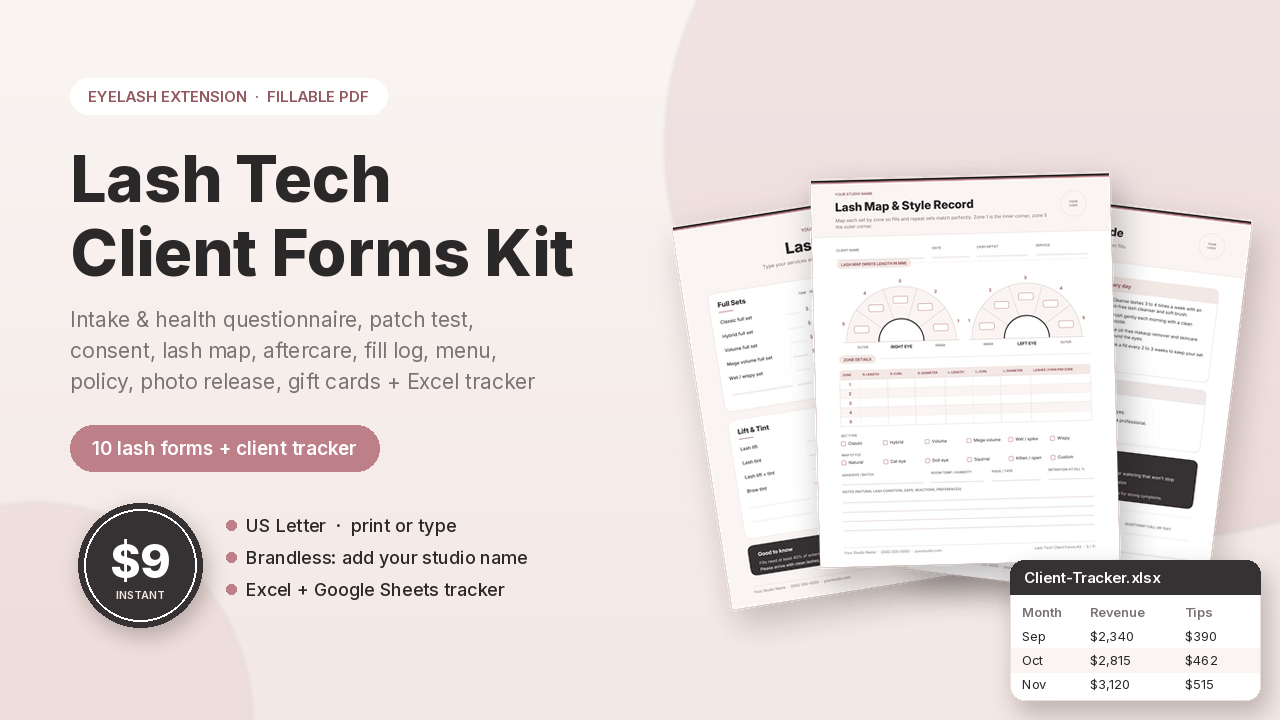
Lash Tech Client Forms Kit
An 11-page fillable PDF (intake, patch test record, consent and release, lash map, aftercare guide, refill log and more) plus an Excel client tracker.
Get it →6. Consultation, patch test and consent
Lash lift and tint products work close to the eye, so a short consultation and a signed consent form are part of a professional service. Many artists also ask new clients to do a patch test for the tint and lift products ahead of the first appointment, following the product maker's instructions and their own training.
Use the consultation to check things like contact lenses, recent eye surgery or infections, allergies, sensitive skin and pregnancy, and to agree on the look the client wants. Record everything on a consent and intake form, and keep it with the client's service record. Our lash lift consent form guide covers what to include.
Example only: patch test free for new clients, or $10 credited to the first service if they book within 2 weeks. If a client has a reaction or you are unsure whether the service is safe for them, do not go ahead, and suggest they speak to a medical professional.
7. Corrections, redos and results you cannot guarantee
Lash lifts depend on the client's natural lashes. Very short, very straight or very sparse lashes may not curl the way the client hoped, and a lift that drops early is often down to aftercare. Decide in advance how you will handle complaints, and write it down.
- Set expectations. Show realistic before and after photos and explain that results vary.
- Correction window. If you offer a fix, set a short window and say what it covers.
- Avoid re-lifting too soon. Processing the same lashes again within days can damage them. A tint top-up or a styling fix may be safer than a second lift.
- Aftercare. Give clear written aftercare, such as keeping lashes dry and avoiding mascara for the first 24 to 48 hours, as your training advises.
Example only: issues reported within 5 days are reviewed for free; a re-lift is only offered after the lashes have grown out, at a reduced price of $40.
8. Holiday demand and gift cards
November and December are busy months for lash lifts. Clients want low-maintenance lashes for parties, travel and family photos, and lash lifts make popular gifts. Plan for the rush instead of squeezing in extra appointments late into the evening.
- Open bookings early. Release December slots in early November and encourage regulars to book ahead.
- Peak dates. Some artists add a small surcharge for the busiest days, such as the weekend before Christmas and New Year's Eve, or for after-hours slots.
- Gift cards. Sell gift cards for a dollar amount rather than a specific service, so price changes do not cause problems. Gift card and expiry rules vary by state, so check yours.
- January slowdown. Use the quieter weeks after the holidays to promote memberships and rebooking offers.
For more holiday ideas across lash services, see our holiday lash pricing guide. Example only: $10 surcharge for Sunday or after-hours appointments in the two weeks before Christmas.
Worked example: one client from gift card to membership
Here is how the numbers might come together for one client. All figures are examples to show the math, not market data.
In early December, a client buys a $100 gift card for a friend. The friend books a lift and tint for a Saturday in mid-December, does a free patch test a week earlier, and pays a $20 deposit at booking. The lift and tint is priced at $95, so $95 is taken from the gift card and the deposit is applied, leaving a $5 card balance and a $20 credit for the next visit.
The service costs about $20 in products, card fees and overheads, and takes 1 hour 10 minutes including consultation. That leaves about $75 for the artist's time, or roughly $64 an hour. At checkout, the client books her next lift for early February and signs up for the $45 a month membership. Over a year, that one gift card turns into around six repeat visits.
Common lash lift pricing mistakes
- Copying the cheapest competitor. Their costs, experience and goals are not yours.
- Forgetting card fees and overheads. Small costs add up across a full week of appointments.
- Giving tint away. Tint is a quick, valuable add-on. Price it.
- No deposit. No-shows hurt most during the holiday rush.
- Skipping the consent form and patch test. They protect both you and the client.
- Not rebooking. A client who leaves without a next appointment may drift to another artist.
- Never reviewing prices. Check your numbers at least once a year, or whenever product costs or rent go up.
FAQ
How much should I charge for a lash lift?
Work out your cost per service (lift solutions, shields, tint, disposables, card fees and overheads) and the value of your time, then compare with local artists at a similar level. As an example only, some artists price a standard lash lift somewhere around $65 to $95, but your market may differ.
Should a lash lift include a tint?
Either works. Many artists list the lift on its own and offer tint as an add-on, with a combined lift-and-tint price. As an example only, a tint add-on might be $15 to $25.
How often can a client get a lash lift?
Many artists suggest every 6 to 8 weeks, once the previous lift has started to grow out. Lifting the same lashes again too soon can damage them, so follow your training and the product instructions.
Do I need a patch test for a lash lift?
Many artists ask new clients to do a patch test for the tint and lift products before the first appointment, following the product maker's instructions and their own training and local rules. Record the result on the client's consent form.
Should I take a deposit for lash lifts?
A small deposit applied to the service reduces no-shows, especially in busy months. As an example only, $20 with 48 hours' notice to reschedule. Check local rules before calling a deposit non-refundable.
Can I charge more for lash lifts during the holidays?
Some artists add a small surcharge for peak dates or after-hours slots in December. If you do, show it clearly at booking. As an example only, $10 for Sunday or after-hours appointments in the two weeks before Christmas.
This page is general guidance, not legal, tax or medical advice. All prices on this page are examples to show the math, not market data. Licensing for lash services, deposit and refund rules, gift card rules, consumer rules and insurance requirements vary by state, county and city. Check your local rules and set prices that fit your own costs and market.
Related templates
Free Lash Lift & Tint Consent Form
A printable lash lift and tint consent and intake form plus a client service record.
Download free →Lash Tech Client Forms Kit
An 11-page fillable PDF (intake, patch test record, consent and release, lash map, aftercare guide, refill log and more) plus an Excel client tracker.
Get it →